
Nationalized oil? Surely we jest?
Calgary Herald
Tuesday, September 27, 2005
Page: A16
Section: The Editorial Page
Byline: David Agren
Source: For The Calgary Herald
Less than a year after Ottawa sold its remaining Petro-Canada shares, the prospect of nationalizing the oil industry has reappeared. A Leger Marketing poll, partly conducted before hurricane Katrina struck, found 49 per cent of Canadians in favour.
For a cautionary tale of nationalization run amok, look south. Way south to Mexico, where energy nationalization spawned an unruly monopoly saddled with a crushing debt, inefficiencies, an unscrupulous union and a shameful environmental record. Petroleos Mexicanos (Pemex) surely stands out as exhibit A in the case against government intervention in the petroleum industry.
Pemex is on the brink of insolvency, according to its director, with debts of nearly $50 billion. Company officials admitted after a spate of pipeline ruptures last winter that 68 per cent of its ducts need repair. Thieves -- often abetted by insiders -- heisted an estimated $1.8 billion per year worth of combustibles from the company between 1998 and 2002, taking the loot from refineries, storage facilities and clandestine pipeline connections.
Mexico's consumer protection agency found Pemex franchised gas stations (the only brand in Mexico) shortchange their customers by about $2 billion a year. Mexico's environmental protection agency named Pemex Mexico's worst polluter in 2000.
Many of its problems stem from its massive tax bill. Pemex pays more than 60 per cent of its gross revenues to the Mexican government. Its taxes account for more than one-third of all government revenues. The heavy tax burden impairs its ability to explore for new reserves and maintain its crumbling infrastructure. According to columnist Fred Rosen of The Herald Mexico, one projection said without a sustained investment in exploration and maintenance, Mexico, now the world's sixth biggest petroleum producer, could become an oil importer within a decade.
To provide more money for exploration and infrastructure, the Mexican congress slashed Pemex's tax bill earlier this summer, but President Vicente Fox vetoed the proposed change, saying the revenue shortfall would prevent him from balancing his budget (one of the few legacies he expects to leave after completing an unremarkable presidential term).
The company has long been a political football no politician dares to radically overhaul. Fox proposed modest reforms early in his administration, but ran into intransigent legislators, who balked at the prospect of foreign ownership in Pemex.
The Mexican constitution forbids foreigners from owning or exploiting the country's natural resources. Opportunistic politicians -- most recently populist presidential front-runner Andres Manuel Lopez Obrador -- have long leveraged the fear of foreigners taking over the Mexican oil
industry, coining slogans like, "La patria no se vende" (the homeland's not for sale).
Attempts to improve the company's poor governance have also fallen short. Fox proposed appointing four industry titans to its board in 2001, including Telmex impresario Carlos Slim, Latin America's richest man, who recently called for allowing private investment in Pemex. Opposition lawmakers forced the president to back down. Until Fox ousted the Institutional Revolutionary Party (PRI) in 2000, ending its 71-year hammer lock on power, Pemex and its union allegedly bankrolled much of the PRI's mischief. In the last federal election, Pemex's former director and the Oil Workers' Union allegedly funneled more than $200 million into the failed PRI campaign in a scandal dubbed Pemexgate.
The powerful union protects a bloated workforce of more than 125,000 employees. In previous years, it would blackmail the government into offering generous wages and benefits, threatening violent strikes if its demands weren't met. In a Pulitzer Prize-winning article on the Mexican
justice system, Washington Post reporter Kevin Sullivan profiled a regional union kingpin, whose power a local academic compared to "a medieval court where the king sits there, people line up to see him, and he makes all the decisions."
Union bosses often dictate hiring; nepotism is rife.
While most Mexicans hate corruption, the prospect of foreign (read: U.S.) interests exploiting their resources is unacceptable. The country still marks Expropriation Day on March 18, a reminder of the day in 1938 when then-president Lazaro Cardenas expelled foreign companies from the industry. U.S. lawmakers have tried to link immigration reform to privatization, but Mexican politicians dismissed the proposal out of hand.
An uncompetitive oil monopoly held hostage by an unscrupulous union and grandstanding politicians: Is this what Canadians want?
Calgarian David Agren is a journalist working in Mexico.
28 September 2005


20 September 2005
Bobsled dreams on display at 'push' event
BY DAVID AGREN/Special to The Herald Mexico
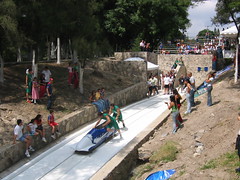
GUADALAJARA, Jalisco. Bobsled pilot Carlos Aranda, standing in a set position behind his sled's push bar at the top of the push track, yelled in a questioning tone, "Preparados (are you ready)?"
Brakeman Roberto Lauderdale responded, "Listo (ready)!" Then, with a mighty push, the pair,competing as Mexico I, charged down the 80meter run, stopping the clock at 4.09 seconds before Lauderdale slammed on the brakes.
Their exploits captured top spot on the first day of competition last weekend in "push," a form of bobsledding, which simulates the quick starts necessary for a good run. And, in a toogood-to-be-true story line, they won the race, dubbed the New Mix Cup, on their home track.
In an odd feat, Mexico hosted a winter sports championship – in a city that saw snow only once in the last century. Athletes from five countries converged on Guadalajara's Unidad Deportiva Revolucion, where the newly inaugurated push track drew high praise from athletes used to practicing on ice.
"I was pleasantly surprised," said Lyndon Rush, a Canadian pilot (bobsled driver), who placed third in the two-man event.
"It's not the same [as on ice], but it's totally good for training."
Although far from the center of the bobsledding universe, the Mexican team's stature has grown immensely in recent years, thanks to the efforts of three-time Olympian Roberto Tames, 41, who has pioneered the sport, growing it from minnow status to respectability.
RESPECT SLOW IN COMING
Fellow competitors and bobsledding officials admire not only his persistence, but also his piloting skills.
"He's a good driver," Rush said. "He always makes it down the track safe."
Respect, though, came slowly for Tames. After the 1988 Calgary Games, the Jamaican team captured immense attention, inspiring the movie "Cool Runnings." But nowadays, Mexico, led by Tames who along with his three brothers finished ahead of the Jamaicans in 1988 outclasses its Caribbean rivals by a wide margin.
"Unfortunately, Jamaica has not been developing … they may not even have a sled on the World Cup circuit this year and therefore, not in the Olympics," said David Kurtz, vice president of international affairs for Federation Internationale de Bobsleigh et de Tobaganning (FIBT).
"Roberto, because of his perseverance, has stayed with it," he added.
Tames' determination and dedication to the sport is legendary. Lacking cash and a sponsor, he drove a borrowed 1978 El Camino from Guadalajara to Calgary. Even though a tire blew out, the water pump quit and the heater didn't work, he arrived in time for an America's Cup race. The trip landed him on the front page of the Calgary Sun and several news organizations, including the Washington Post and the Associated Press, published features on Tames and his crew.
His passion for bobsledding, though, cost him his marriage. After retiring in the mid-1990s, his crew urged him to return, to his wife's displeasure. She gave him an ultimatum: bobsled or their marriage. He chose bobsled.
Tames and Roberto Lauderdale later competed in the 2002 Salt Lake City Games in the twoman event, besting only the U.S. Virgin Islands and Trinidad and Tobago for 35th place in the 37sled event.
Despite the low placing, Tames wanted another shot at the Olympics. He knew, however, he needed a better training facility. So he pitched the FIBT on bringing the world push championships to Guadalajara two years ago and succeeded.
"Roberto has exercised worldwide leadership," Kurtz said. "He's a real asset to the bobsled program in the world."
The Jalisco state government also stepped up, contributing 632,771 pesos (US60,000) towards building the push track in a gully shaded by tall trees in a Guadalajara park. The Guadalajara municipal government, FIBT and 12 corporate sponsors also provided funds and equipment.
Kurtz, the No. 2 person in the FIBT, ranked Guadalajara's push track as the best in the world.
"They have other push tracks in Split, Croatia, the Netherlands and in Germany and none of them compare to this facility," he said.
The competition, however, lacked many of the sport's powerhouse teams, making it a twocountry duel between Canada, an emerging power in bobsled, and Mexico.
"This is an Olympic year and you have coaches that are very, very nervous about sending their top athletes to Mexico, or anywhere really that's not in their strict program," Kurtz explained.
"When the rest of the athletes get their results and see what took place here, next time there's an event here it will be jam packed," he said.
A STRONG SHOWING
For his part, Tames expressed satisfaction with the competition and his team's results.
"Mexico's level has increased. It's going to help us promote the sport and qualify for the Olympics," he said after leading his four-man team to a second place finish 0.11 seconds behind Canada. In their last showdown, the Canadians won by 0.30 seconds and also bested Mexico in the two-man event.
"Having this track has really helped us," he said.
Carlos Aranda, who teaches kindergarten when not training and competing, echoed Tames' sentiments, adding after capturing the Saturday event, "The truth is we thought we could win because we've been training a lot.
"The Canadians are physically imposing … but fortunately we were in our house and we did our best to win."
The next day, in a tense showdown for the world push championship title, Aranda and Lauderdale needed to beat the Canadians' time of 4.14. Despite their best efforts, they fell short by a mere one-hundredth of a second.
"Almost," Aranda said after finishing the run. "We'll win next time."
The Mexican team departs in October for training sessions with the Russian team, before embarking on the World Cup season.
Despite receiving a favorable prediction from Kurtz, who said Mexico could threaten for a spot in the top 10 in the upcoming Turin Games, Aranda's goals are somewhat modest.
"My main goal is to qualify," he said, adding US40,000 in sponsorship money would allow the team to better prepare.
"For a country like us, it's difficult to qualify mainly because we don't have the economic resources to go to as many competitions as we want to.
"But we're putting our hearts into making it."
From the Miami Herald, Mexico Edition.
18 September 2005
Mexico's union blues frustrate expat entrepreneur in Chapala
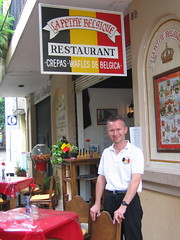
'The thing that bothered me most ... for a whole hour, they were talking about money.' Rony Clygnet, proprietor La Petite Belgique
Story by : David Agren
Rony Clygnet fulfilled a dream in March, opening La Petite Belgique, a small restaurant in the Chapala centro adorned with photos of the king and queen of his native Belgium and red, yellow and black flags. His restaurant served Belgian waffles topped with bananas and chocolate sauce, baked apples or strawberries and whipped cream, providing Lakeside residents an authentic taste of Antwerp, his hometown. Within a few months, his business had grown as customers came from all over Lakeside for the waffles, cheerful service and reasonable prices. He averaged 40 customers per day by early September and employed one person.
But a sindicato (union) official from an outfit affiliated with the Jalisco Federation of Workers also paid a visit, demanding Clygnet sign up with the organization and pay a 4,000-peso fee. He also threatened to close La Petite Belgique unless Clygnet cooperated.
Clygnet initially refused. Two months later, the sindicato obtained a demanda (subpoena) against his restaurant, telling him to appear at its Guadalajara office. He balked at the demanda – which listed someone else as the owner – saying, "I've got a business to run." The Belgian entrepreneur pleaded his case to public security officials and the police, but they initially showed little interest in confronting the sindicato.
After failing to appear in Guadalajara, the union shuttered his restaurant on September 9, padlocking the front screen and spray painting it with the letters, "H/A," for huelga (strike in Spanish – an action taken without consulting La Petite Belgique's lone employee.)
Sindicatos wield immense power in Mexico. By law virtually every business must affiliate itself with a sindicato. While in most countries the workers make the decision to join a union, in Mexico, the business owner chooses the sindicato. In the absence of a choice, the sindicato can dragoon a business and its employees into its organization.
Clygnet knew little about Mexico's labor laws when he opened his shop in March. The experience though prompted second thoughts about whether it was the right decision.
"If I had known this beforehand, I might not have started the business," he said.
Generally speaking, Clygnet has no problems with unions. He was a card-carrying member of Sabena's (Belgium's defunct national airline) union for 14 years. To Clygnet's surprise, in conversations with various sindicato officials, the subject of his employee's welfare never surfaced.
"The thing that bothered me most ... for a whole hour, they were talking about money," he explained. "I said, 'You've been here an hour and you've said nothing about working conditions or my employee.' "
Martha Diaz Lopez, Clygnet's employee, wants nothing to do with the sindicato.
"I'm not lacking anything," the mother of six daughters said, acknowledging some fear that a strike could throw her out of a job, causing financial hardship.
"The sindicato doesn't do any thing for workers," said Eugenia Larrinaga Canberra, manager of the Chapala delegation of the Chamber of Commerce. "It's all money, money, money."
Mexican unions gained much of their power by supporting the long- ruling Institutional Revolutionary Party (PRI). Union organizers have long marshaled large numbers of voters for the party. Former Mexican Workers' Confederation (CTM) president Leonardo Rodriguez Alcaine endorsed PRI presidential aspirant Robert Madrazo earlier this summer on the eve of the sindicato leader's passing. Editorial cartoonists mocked his gesture as a deathbed endorsement, fulfilling his organization's role as a PRI booster.
President Vicente Fox has proposed reforming Mexico's labor laws during his five years in office, but opposition politicians have refused to cooperate.
Legal murkiness governing sindicato activities also complicates matters for many small business owners.
According to Larrinaga, sindicatos may not sign up family businesses or companies with fewer than three employees. La Petite Belgique employs only one person, but Clygnet said a sindicato official told him that once a demanda was issued, it couldn't be reversed.
Hector Vega, a Guadalajara-based accountant, recommends business owners sign up with a "sindicato blanco" (white union), an organization registered with the federal Labor Secretariat that allows entrepreneurs to comply with the law for a nominal fee.
"(A sindicato blanco) won't bother you (later) for money," he explained.
He compared signing up with a sindicato blanco to getting a vaccination.
"Vaccinate yourself ... do it before another union gets their foot in the door.
"The vaccination is a poison against a (more lethal) poison. It's the lesser of two evils."
Some business owners have staved off signing with a sindicato, including Paul Leming, co-owner of Agua Katya, a self-serve water store in Chapala, who has also skirmished with organizers over the past three years. During past visits to his store, organizers dropped off blank contracts, demanding he enroll and pay 500 pesos.
"It's a scam," he said succinctly, while taking a break from his water business.
"It's a three-ring circus and in every ring, you're paying."
Although not affiliated with any sindicato, Leming has paid a sindicato on several occasions, when dealing with disgruntled employees demanding severance pay. In one instance, an employee stole his delivery truck, crashing it in Ajijic last April. Leming paid a sindicato official 500 pesos for advising him on how to fire the employee, who under Mexican law could have demanded a severance package.
Later on the same day the sindicato locked up Clygnet's restaurant Ñ after a loud confrontation in front of many witnesses – a senior CTM official in Guadalajara allowed the business to reopen, although the strike continued. The official also ordered Clygnet to appear in Guadalajara on September 22 to sign up. Clygnet, however, discovered the order to appear was a diversionary tactic so the sindicato could again shut down his business.
Clygnet fought back after he "saw papers [that said] they were going to shut me down."
He wrote to Jalisco Governor Francisco Ramirez Acu–a, who dispatched an inspector from the state's social benefits agency last week to assess the situation. Clygnet and several other business owners also plan Ñ in conjunction with Chapala's municipal government Ñ to establish a hotline for people wishing to register a complaint against the sindicato.
In large part, besides pride and a love of Mexico, Clygnet persists because of Diaz, who he said, "Might be out of a job," due to the actions of a union.
From the Guadalajara Colony Reporter.
13 September 2005
Traditional mariachi lives on in Jalisco
BY DAVID AGREN/Special to The Herald Mexico
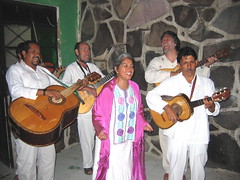
COCULA, Jalisco Before playing a gig with his group Mariachi Tradicional Azteca, Joaquín Arredondo dons an outfit of a loose-fitting white cotton shirt and matching pants, a rustic blanket slung over his left shoulder, a palm-leaf sombrero, and faded sandals. Once dressed, he hoists his guitarrón, a fat guitar-like bass instrument, and is ready to give audiences a taste of Mexico's famed mariachi music in its original form.
"Traditional mariachi is the essence of Jalisco," the third-generation musician said after playing at a recent festival in Cocula in the western state of Jalisco. "It's how mariachi was at the end of the 1800s."
His music and clothing differ little from pioneering group Mariachi de Justo Villa, a Cocula quartet that town residents say thrust mariachi music into the national consciousness 100 years ago, when it played a concert at former president Porfirio Diaz's birthday party in Mexico City's Castillo Chapultepec. Cocula, the self-proclaimed "cradle of mariachi," celebrated the anniversary of the famous gig earlier this month with a parade and concerts at which many of the artists played the traditional style in conjunction with Guadalajara's 12th Mariachi and Charreria Festival.
Mariachi has evolved considerably since the Spanish arrived in Cocula in 1532. Traditional mariachis preserve the genre's roots, drawing inspiration from a time when campesinos, or peasant farmers, "harvested corn and played music" in the countryside beyond the listening distance of hacienda owners, who preferred chamber music and other European imports.
The first mariachis wore typical clothes and sang about their lives in the countryside, playing a rustic style of music that featured some of the same shouting as today's groups, but lacking the attention-grabbing trumpets, orchestral-sounding violins and, most noticeably, garish charro cowboy suits.
Traditional mariachi originally featured three instruments: the violin, vihuela and guittarón, and the groups that played them were typically quartets. Mariachi Tradicional Azteca has eight members, all of whom sing in addition to playing a stringed instrument. Arredondo acknowledged the difference, but said, "It's the quality that's important … not the quantity" of musicians.
LARGELY UNNOTICED
Arredondo and his fellow group members play mostly in festivals like Cocula's, but like their modern counterparts decked out in fancy threads, Mariachi Tradicional Azteca also performs its share of serenades, conquistas and mañanitas. Yet it plays a largely unknown genre.
"People here don't really know what it is," he explained. "In only the last five years, people have started to know it."
The Guadalajara mariachi festival now stages traditional concerts during the first few days of its annual event. Arredondo while grateful for the interest complained that organizers have excluded groups like his from the large galas in Guadalajara's legendary Teatro Degollado, relegating traditional mariachi to lesser venues in the Jalisco capital and the surrounding areas.
In Cocula, however, locals lined a parade route, cheering the traditional groups, who marched past the town's numerous birria restaurants with their contemporary peers.
COCULA TO GARIBALDI
The town, 50 kilometers south of Guadalajara on the highway to the Costa Alegre, takes credit for spreading mariachi beyond Western Mexico and not just through Mariachi de Justo Villa's exploits. Juan Hernández, a migrant from the town, helped make Mexico City's Plaza Garibaldi the premiere mariachi destination in the country after he brought traditional-style bands from Cocula to serenade patrons at Tenampa, his Garibaldi cantina.
Cocula also claims responsibility for several key advances from the early days of mariachi, including the invention of both the guitarrón and the vihuela, a small 12-string guitar with gut strings, by indigenous locals. (Another version of the story says the vihuela comes from Germany and that the indigenous played a similar instrument made from an armadillo shell).
According to Elizabeth Balcazár, director of the Museo del Mariachi in Cocula, the conquering Spanish found an indigenous population with music skills upon arriving in Jalisco. The indigenous Coca later incorporated European instruments like the violin into their music, creating a unique fusion - now known as traditional mariachi.
Although the music defines Mexico in the minds of many, the word "mariachi" reputedly comes from the French word mariage and was coined during the reign of Emperor Maximilian in Mexico, after the occupiers saw peones playing at weddings. Many historians and musicians dispute that account, however.
"Mariachi was called mariachi before the French arrived," said Francisco Gómez, a music teacher at the Guadalajara campus of Tec de Monterrey, adding the word mariachi most likely comes from the Nahuatl language.
The population of southern Jalisco didn't care much for the French, and so acerbic lyrics about the occupiers abound in many old mariachi songs. But while they were occasionally political, these older songs usually focused on everyday life, unlike modern ballads, which gush with feelings of love and are accompanied by forceful instruments and yells.
"The older music is more poetic, it's less aggressive," said José Luis Arellano Rodríguez, music director of Mariachi Tradicional Azteca and a psychologist by profession.
"Authentic music is much softer."
New technology hastened some of mariachi's biggest changes, radically changing its sound. In one example, a Mexico City radio station owner introduced the trumpet, hoping to create a more forceful sound for his broadcasts.
For uncertain reasons, "commercial mariachis" as members of Mariachi Tradicional Azteca dub their modern counterparts traded their simple campesino clothes for charro suits. According to one account, Porfirio Diaz ordered a group to change clothes prior to a gig for a visiting dignitary. Another version says the owner of the Televisa network provided charro suits for mariachis appearing on television.
The change in clothing grates some traditional mariachi musicians.
"This signifies poverty," Arredondo said, pointing to his cotton shirt. "The charro suit is a symbol of the rich."
Despite his preference for the traditional style, Arredondo, a self-described "hired gun," dons a charro suit two nights a week for performances with a commercial group, but admitted, "Modern mariachi doesn't have much importance for me."
But the traditional style captivates the 45-year-old father of two, who said, "For me, it's a drug."
From the Miami Herald, Mexico Edition.
11 September 2005
Populist presidential hopeful stumps in enemy territory

Story by: David Agren
Jesus Cortes Hernandez, a campesino from Techaluta, Jalisco, once held high hopes for President Vicente Fox. The same goes for Alberto "Beto" Cardenas, the former mayor of nearby Ciudad Guzman, governor of Jalisco, secretary of the environment and current National Action Party (PAN) presidential aspirant.
"They haven't fulfilled their promises," Cortes said, while waiting along the side of the road in Ciudad Guzman for the man now carrying his hopes for a better Mexico to arrive: Andres Manuel Lopez Obrador.
The presidential frontrunner brought his pre-campaign tour to southern Jalisco on Thursday, attracting an estimated crowd of 4,000 supporters - and a few hecklers - for a rally in the heart of a PAN stronghold dominated in recent years by Cardenas.
In the last federal election, Lopez Obrador's left-wing Democratic Revolutionary Party (PRD) won less than ten percent of the vote in Ciudad Guzman, a figure supporters predict could jump to 30 percent in 2006.
Cardenas still garners immense support in his native Ciudad Guzman. His face graces countless campaign billboards and bumper stickers. Like Fox, the man who ended one-party rule in Mexico five years ago, Cardenas can boast of a similar accomplishment: he vanquished the Institutional Revolutionary Party (PRI) from the Jalisco governor's office in 1995 after a decades-long and often inglorious reign.
"He's still popular," said Felipe Lopez, a former town resident, who was back for a visit from the United States.
"He did a lot, but some of his promises weren't kept."
Lopez Obrador, as expected, made all sorts of promises during his appearance before a standing-room-only crowd in the stuffy municipal auditorium. In a 30-minute speech that grew in its passion as time elapsed, the former Mexico City mayor, dressed in charcoal pants and a white guayabera shirt, promised many of the same things as his competitors: more seats in public schools, less poverty and less corruption. The latter comments drew jeers of, "Burro!" (donkey) from hecklers.
But he also promised a solid left-wing agenda of renegotiating NAFTA, building more Pemex refineries and severely reducing pensions for ex-presidents. And, true to form, he evoked memories of Carlos Salinas - the Mexican left's favorite bogeyman - saying the despised former president "is the real PRI chief" - a dig at former PRI party president Roberto Madrazo, Lopez Obrador's expected rival in 2006.
"Salinas, Fox ... Roberto Madrazo, there's no difference," he said.
"It's like Coca-Cola and Pepsi Cola, it's the same thing."
His message resonated with many in the audience, some of whom previously backed Fox and Cardenas.
"He's my gallo!" gushed Martha Alvarez Delgadillo, a teacher from Gomez Farias, Jalisco.
"He's our hope."
She later referred to the president as a, "Mandilon," (Mexican slang for a man whose wife wears the pants in the family).
Lopez Obrador left Ciudad Guzman like a rock star, with supporters mobbing his white, Chevrolet SUV. The PRD presidential hopeful moved on to Guadalajara, another PAN stronghold, for a rally later that evening.
From the Guadalajara Colony Reporter.
14 August 2005
Local family brings cheer to Michoacan's 'pueblo of the bells'
Story by : David Agren
The Purepecha -- many of whom don't speak much Spanish -- lead a tough life in rural Michoacan.
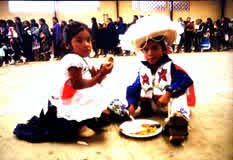
Many of the Purepecha Indians from the countryside left their small plots of land at 5:30 a.m., walking in traditional costumes under overcast skies to the annual Virgen de la Asuncion celebrations in Tingüindin, Michoacan. In earlier years they came to dance and honor the virgin. But for the past 35 years, the efforts of a Guadalajara family with roots in the pueblo have made the event all the more special.
Since the early 70s, Luisa Noriega's family has sponsored a breakfast on the first Sunday in August, bringing, at least for one weekend, a ray of hope into the lives of the impoverished residents.
Family members served more than 850 breakfasts of birria (a spicy goat stew), beans, rice, tortillas and tamarind-flavored atole (a hot cornmeal drink) in the community hall. Later, they passed out 300 despensas (handouts) of beans, rice, tuna, paper products and cooking oil to Purepecha women, who patiently lined up, while an out-of town-salesman hawked a miracle cure for everything, using a loudspeaker atop his beat-up van. Their children each received a toy.
The Purepecha -- many of whom don't speak much Spanish -- lead a tough life in rural Michoacan. Most work for low wages picking avocados and live in one-room homes. Few of the children advance beyond elementary school, instead going to work with their parents in the campo (countryside). With few opportunities available, migration to the United States is common.
At first glance, Tingüindin looks like most of the pueblos lining the winding road south from Zamora. On a typical Sunday morning, women in traditional robes, carrying purchases from the many tianguis (informal markets), walk along the highway, past vendors selling in-season fruit -- mostly pears at this time of year -- from tiny stalls.
Tingüindin's notoriety comes from its impressive triple bell tower at the Santuario Virgen de la Asuncion. According to Noriega, the town's name comes from the Purepecha words tin, güin and din, pueblo of the bells. Additionally, like many Michoacan towns, it also has its claim to fame: traditional bread, which is both sweet and baked in triangular pans.
Noriega's grandmother grew up in nearby Cotija, before moving to Tingüindin during the Cristero rebellion. After moving to Guadalajara, she and her husband would vacation in the town, taking in the celebrations. Dismayed by the nearby poverty -- Luisa's mother said many in the indigenous population barely survived on a diet of only tortillas with salt and chile -- they wanted to give something back to the community.
The idea for a breakfast came while Luisa's grandfather Jose de Jesus Jimenez was eating a bowl of menudo (a rich soup made with tripe) at a puesto (stall). Many children begged for 20 centavos, enough for a cup of menudo broth.
Jimenez later arranged for the señora running the puesto to make menudo for the inaugural breakfast the following year.
Jimenez passed away in the late 1980s, but his children and grandchildren kept the tradition going. Over the years, it's become an integral part of the two-week celebration.
During the fiesta, Purepechas of all ages perform the traditional dance of the veijos on the rustic street in front of the cathedral and in the community hall, while the locals waited in line for their breakfast. The men wear pale wooden masks and white pants brandishing images of the virgin -- along with Christ and other significant figures. The women stitch intricate shawls, featuring floral patterns or sometimes, products of the region like fruit. A brass band accompanies the dancers.
The grateful recipients repaid the favor with gifts of membrillo (quince), an apple-like fruit full of seeds, and peaches they picked in the countryside.
By the mid afternoon, the Purepechas headed for home. They had a long walk ahead of them.
From the Guadalajara Colony Reporter.
16 July 2005
Expatriate Canadian building chocolate empire
Story by : David Agren
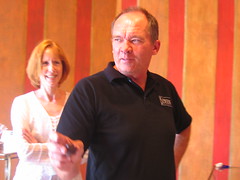
Chocolatier Michael McKenna arranges six handmade truffles for an impromptu tasting session at his new Ajijic store like a sommelier would with fine wines. He recommends a cappuccino truffle - made with coffee cream ganache and dipped in dark chocolate - to start. He finishes with a creation dubbed Camille; a lemon cream ganache with perfume of rosemary, dipped in white chocolate with rosemary sprinkles.
The founder of Sensual Chocolatiers compares slowly indulging one of his truffles to sipping a fine wine.
"It's like wine where there's a beginning, a middle and an end," he explained. "As you taste it, more flavors emerge."
McKenna recently expanded his San Miguel de Allende-based chocolate business into the Lakeside area, opening an outlet in Ajijic after a year of searching for an ideal location -- meaning a spot lacking direct sunlight -- and overcoming shipping problems.
"The biggest problem was transporting chocolates in Mexico," he said.
To keep his chocolates from melting during the six-hour journey from the Bajio to Lakeside, he now packs the truffles in specially-designed Styrofoam coolers.
Sensual Chocolatiers' small Ajijic store sells dark, milk and white chocolate truffles and keepsake boxes, designed by McKenna and his partner Barbara Hartinger, a graphic designer.
Although each store offers approximately 20 different truffles at any given time, Sensual Chocolatiers' kitchen produces more than 200 varieties, which include traditional combinations like dark chocolate and orange and eclectic fusions like white chocolate and guava. Always looking to make something creative and incorporate Mexican delights in his truffles, McKenna's ingredient list includes mango, guayaba and coffee roasted in Ajijic by Jose Romero of the Oaxaca Coffee Company. And, of course, he uses cocoa from Oaxaca, a gritty, but flavorful product, which he mixes with fine imported chocolates. Some of his best creations though resulted from either accidents or pure experimentation.
"It's pretty much alchemy," he said laughingly.
"It's definitely an art -- a very complicated art."
It's also becoming a big business, with orders flowing in from fine hotels, San Miguel de Allende civic officials, the Guanajuato state government and even Los Pinos (the president's residence).
While uncertain of exactly how his truffles ended up in Los Pinos, McKenna suspects President Vicente Fox (a former governor of Guanajuato) tasted a chocolate at a wedding or that the mayor of San Miguel de Allende presented truffles as a gift. Los Pinos now gives Sensual Chocolatiers' truffles as gifts to visiting dignitaries.
"(The San Miguel de Allende municipal government) has been good to us," McKenna said.
"They've introduced us to a lot of contacts."
McKenna will open a new 500-square-meter kitchen in Jalpa, a pueblo near San Miguel de Allende later this month to meet the growing demand of supplying his four retail outlets and fulfilling wholesale orders. It will also offer badly needed jobs for local women, many of whom head households while their husbands work in the United States.
"One of our goals is to provide employment," McKenna explained.
An unconventional workplace, McKenna's employees participate in the kitchen's hiring decisions and even name many of the truffles they create. One employee christened a milk chocolate and espresso creation, "Sexy." Some truffles like "Rosa Mexicana" are named after the women who created the treats. In the case of the "Catalina" truffle, the namesake inadvertently created a caramel brittle "while daydreaming at the stove." The brittle was mixed with coconut to make a popular truffle.
"Everyone is free to say, 'I have an idea,' " McKenna said.
The management approach, in part, comes from the fact McKenna never set out to build a chocolate empire in Mexico. Originally from Hamilton, Ontario, he ran a successful industrial heating business prior to moving to Mexico. Although he never formally studied confectionery, McKenna has long made his own candies.
"I liked to cook and I had a sweet tooth," he said of his motivations.
McKenna started making truffles four years ago as a hobby, selling his first batches from a tray at the San Miguel de Allende public library. He later opened his first stores in the Bajio, a region with a dry, moderate climate ideal for making and selling chocolates.
If he finds a location without direct sunlight, McKenna will open his next retail store in Puerto Vallarta.
Each week, Sensual Chocolatiers produces 4,000 to 5,000 truffles. But even with that production, his inventory often runs low.
"There are times we don't have a single chocolate in our stores," he said.
While some chocolate makers freeze their products for future sales, Sensual Chocolatiers only sells freshly made truffles. Products stay in the display case for only 10 days. The quality becomes evident after slowly enjoying a truffle. More than 15 minutes after finishing the small indulgence, "You'll still taste it."
From the Guadalajara Colony Reporter
Subscribe to:
Posts (Atom)
