
Story by : DAVID AGREN
‘I should have listened to my mother. She told me not to take candy from a stranger.’
Colin Godwin thought nothing of accepting candy from a stranger after boarding a Michoacan-bound bus in Guadalajara. The complimentary mint, however, knocked him out for 30 hours, more than enough time for the supposedly-generous man, who had given the candy and helped Godwin stow a bag in the overhead rack, to steal the Canadian’s laptop computer, money and passport.
“I should have listened to my mother,” Godwin, 67, said in an interview from his home in Coquitlam, British Columbia.
“She told me not to take candy from a stranger.”
Godwin, a prospector, climbed aboard an Omnibus de Occidente bus in Guadalajara on June 2 for a six-hour trip towards Cuatro Caminos, Michoacan, where he and a Mexican partner have been scouting for copper deposits. A frequent traveler to Mexico, who had just arrived in Guadalajara the night before from Vancouver, Godwin, swallowed the mint, which he now believes was laced with Rohypnol – the infamous date rape drug – at the beginning of his trip to Michoacan. He awoke in a hospital bed 30 hours later in Apatzingan, remembering nothing of his journey.
Fortunately, Godwin left an itinerary – something he recommends all travelers do – which allowed his Mexican partner to track him down. He also backed up his laptop data, losing only a day’s work. Securing a replacement passport for his trip home proved difficult as he said Michoacan authorities wouldn’t issue a police report.
Despite his misfortune, Godwin plans on returning to Mexico to extract drilling samples after the rainy season ends.
“I’m not down on Mexico at all,” he said. “I think this could have happened anywhere.
“Just be a little more intelligent than me,” he advised.
From the Guadalajara Reporter
Showing posts sorted by relevance for query mint. Sort by date Show all posts
Showing posts sorted by relevance for query mint. Sort by date Show all posts
28 June 2006


07 June 2010
Federal Police bust heads in Cananea

Members of Mexico's mining and metalworkers' union show support for their fugitive leader, Napoleón Gómez Urrutia, during a rally at union headquarters in Mexico City. Gómez is living in Vancouver to avoid apprehension on charges pertaining to the alleged mismanagement of a $55 million trust fund.
The Federal Police evicted the remaining striking workers at the giant copper pit in Cananea, Sonora, where miners loyal to fugitive mining union boss Napoleón Gómez Urrutia had shut down the lucrative Grupo México property for nearly three years. The miners originally went on strike over health and wage issues, but the labour stoppage became a show of support for Gómez, who is accused of misappropriating a $55 million workers' trust fund and has lived in Vancouver to avoid apprehension on fraud and embezzlement charges.
Mine owner Grupo México - a bitter enemy of Gómez Urrutia - charged that the strike at Cananea was nothing more than an attempt to pressure the Mexican government to drop charges against the union boss as the health and wage issues were resolved long ago. Other rivals of Gómez agreed.
"We regret that things were resolved in this way, (but) the only person to blame is Napoleón Gómez Urrutia," Carlos Pavón, the union's former director of political matters, told W Radio. "He never wanted to resolve the problem through dialogue. Napoleón always wanted to insert (the issue) of the apprehension orders against him."
Pavón was arrested in late 2008 for fraud and extortion and left the union a short time later.
The most recent raid on Cananea once again put the spotlight on Gómez Urrutia, perhaps the most colourful, controversial and maverick union leader of the past ten years.
Gómez is reviled by a group of dissidents for allegedly making off with their trust fund and was reputedly responsible for derailing the labour reforms proposed during the administration of former president Vicente Fox.
Chihuahua-based Veta de Plata, a cooperative of former mining union members and trust fund holders say Gomez has failed to provide an adequate explanation for what happened to their money and improperly dissolved the trust fund by acting as a signatory for both the union and the trust fund holders.
Court documents provided by the cooperative in 2008 show trust fund money being moved out of the country and being used to pay for shopping excursions in Dallas and personal credit card debts of Gómez's relatives.
Gómez's backers say the union's accounts have been audited and no mismanagement occurred.
The trust fund was established after the Cananea mine was privatized in 1989, when then-president Carlos Salina launched the widespread sale of many government-run enterprises. Workers' in a number of privatized mines received five percent of the shares, which were held in a trust fund.
Although controversial, Gómez draws fierce support from some quarters for his tough negotiating tactics, which produce contracts better than other unions - a rarity in a country notorious for wealthy union bosses and poorly paid workers, and a history of unions being little more than turn-out-the vote machines for the Institutional Revolutionary Party (PRI). Supporters say Mexican mining and smelting executives still travel to Vancouver to negotiate collective agreements with him - even though he's not recognized by the Mexican government as a union leader.
"He's a different kind of union man," said Aldo Muñoz Armenta, a labour expert at the Autonomous University of the State of Mexico in Toluca. Muñoz says many Mexican union contracts are based on the national minimum wage and the inflation rate, but Gómez - who previously ran the national mint and a government mining company in Autlán, Jalisco - would tie wages to the price of minerals.
The Interior Ministry said in a June 7 statement the operation began the previous day and was carried out by some 2,000 federal police officers; seven arrests were made for an arson at the mine. The Labour Secretariat had declared the strike illegal back in January 2008.
The mining union blasted the expulsion as illegal. A coalition of so-called "independent unions" - the telephone workers, electrical workers, UNAM workers and other unions generally not affiliated with either the PRI or governing National Action Party (PAN) - broke dialogue with the federal government in response to the raid. Foreign unions such as the USW, blasted the expulsion, too. The left-wing Democratic Revolution Party (PRD) promised demonstrations at the Supreme Court and outside the Grupo México offices in the upscale Polanco district to protest both the action at Cananea and the ongoing struggle of the SME, the union whose members were tossed out of work when the federal government closed down the money-losing and notoriously inefficient Mexico City utility, Luz y Fuerza, last fall.
POLITICALLY UNPOPULAR
The SME and its allies branded the decision to dissolve Luz y Fuerza, "Political," as the union's leadership - which would threaten disruptive strikes every spring that would have left Mexico City and the surrounding states in the dark - is considered close with scorned 2006 presidential runner up Andrés Manuel López Obrador, the nation's self-proclaimed "legitimate president." (It's suspected SME money helped finance López Obrador's "legitimate government.")
Independents unions such as the SME have backed the mine and metalworkers for various for reasons, including a mutual dislike of the conservative and pro-business PAN and an unwillingness to join PRI-affiliated labour groups such as the CROC, CROM and CTM, which have long been pillars in the PRI's corporatist system and headed by leaders accused of not acting in the best interest of the rank-and-file.
Muñoz says the recognition of union leaders is a "judicial process" in most countries, while in Mexico, "It's a political process."
The Labour Secretariat refused to recognize Gómez's 2008 re-election as leader of the mining union, saying he was not a member in good standing and he never worked as a miner - a prerequisite for assuming the position.
Gómez took over the union after the death of his father, Napoleón Gómez Sada nearly 10 years ago. The elder Gómez was extremely popular among the membership, including those now expressing a dislike for his son.
He assumed control after submitting a document to the Labour Secretariat saying that Gómez - who went to Oxford, was a pre-candidate for the 1992 PRI gubernatorial race in Nuevo León and would appear in the society pages of Monterrey-area society publications - worked in the accounting department of a gold mine in the state of Durango for the salary of 28 pesos per day.
Some union dissidents found that a little hard to believe, including one Veta de Plata member who called the story, "A lie as big as all of Texas."
Others fighting for labour rights in Mexico take an equally unfavourable view of Gómez, who has frequently accused Grupo México of "industrial homicide" for the February 2006 mine disaster at Pasta de Conchos in the northern state of Coahuila. The blast killed 65 miners; the bodies of 63 workers remain trapped in the coal mine.
"If Napoleón Gómez Urrutia were such a good union leader, Pasta de Conchos wouldn't have happened," said one widow, who lost her husband in the mine, told me in 2009. Another widows, Elvira Martínez, one of the most persistent advocates of having the bodies pulled from the mine, told me that many of the dead miners were not union members, but paid union dues and received little in return.
Christina Auerbach Benavides, a lawyer with the labour ministry of the Diocese of Saltillo, has worked with the widows since the mine disaster occurred. She says the mining union signed a joint health and safety report with the company and government just 12 days before the mine disaster.
She alleged in early 2010, "The union utilizes the subject of Pasta de Conchos when it wants to raise the issue of Napoleon Gomez."
The union and its Canadian backers - who include NDP leader Jack Layton - have lauded Gómez for trying to improve mine safety in Mexico and allege it has led to him being persecuted by the federal government.
17 October 2005
Chocolatier has social vision for new venture
BY DAVID AGREN/Special to The Herald Mexico
El Universal
October 17, 2005
Mike McKenna, while inaugurating his growing company's new chocolate-making kitchen in Jalpa, Guanajuato, earlier this month, pointed to an odd source of inspiration: a nearby church with four walls and no roof. Its congregation celebrated mass under a tree for seven years before finally erecting the walls. The building still lacks a roof thirteen years later.
Someone started passing around a straw hat after hearing the story and by the end of the evening the assembled crowd had raised more than 3,000 pesos (US280). The municipal government promised to match the donations. The crew that constructed McKenna's kitchen will finish the job in the coming months.
"Twenty years is long enough waiting for Jesus to give them an answer," McKenna said laughingly, after the hat made its way around the grounds.
Although the story amused the assembled crowd, who nibbled on handmade truffles and artisan cheeses from Queretaro and sipped Texas wines imported by a San Miguel grape grower, McKenna's girlfriend Barbara Hartinger gently reminded him during the middle of his anecdote: "We're here to talk about chocolate."
María Elena Morena, McKenna's first employee, cut the ribbon, officially opening Sensual Chocolatiers' 500 square-meter facility.
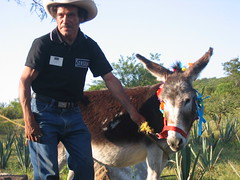
The new kitchen, built on a hectare of land 20 minutes from San Miguel de Allende, includes environmentally-friendly designs, gardens and three pet burros. More than 4,000 agave plants surround the building. Twenty beds of herbs yield lavender, rosemary, sage, chilies and mint key ingredients in McKenna's eclectic creations. Sensual Chocolatiers also recycles its gray and black waters for irrigation purposes.
"I wanted this place to be 100-percent environmentally friendly," McKenna said proudly.
He also wanted to create jobs in an area with few employment opportunities.
"One of the reasons I came to Jalpa is because there's a lot of poverty," he explained.
His company now employs thirty people – most from the nearby area. Between two and five job seekers arrive at the kitchen each day. Some carry machetes to ward off snakes while trekking across the countryside.
"They come over these mountains in all directions," McKenna said. "There's a lot of walking in the Jalpa Valley."
An unconventional workplace, employees often christen the truffles they create and participate in hiring decisions. Employee-inspired truffles include: "Rosa Mexicana," a mixture of dark chocolate ganache spiced with cinnamon, almond and coffee and dipped in dark chocolate; and "Catalina," a combination of caramel brittle and coconut.
GROWING STEADILY In addition to the church with no roof, McKenna draws inspiration from the kitchen's bucolic setting and expects it will provide the same for his employees.
"These surroundings are for the people who work here," he explained. "This place will probably be closed to the public eventually" in order to maintain tough hygienic standards.
The kitchen's construction also created jobs, but McKenna, thinking in the long term, hired many of the same locals, who initially cleared rocks from the property. In the process, the men learned a skill. McKenna, a mason by trade, now considers many of them masters.
But McKenna situated his business in Jalpa for more reasons than altruism. The local women, he noticed, were especially adept at rolling masa, or tortilla dough: a skill similar to parts of the truffle-marking process.
Although the company is enjoying success nowadays, growth came slowly for Sensual Chocolatiers. Five years ago, McKenna, who has no profession confectionery training, sold his truffles from a tray in the San Miguel de Allende Public Library, making US12 a day.
Morena, who was working in McKenna's housing complex, joined him early on, forgoing a paycheck for the first year of operations. It took McKenna two years to perfect his first batch of recipes, which now incorporate Mexican staples like guava, chilies and agave and unique pairings like white chocolate with lemon and rosemary.
Through word of mouth advertising and a promotional assist from the municipal government, the business slowly started to expand.
Sensual Chocolatiers now produces approximately 6,000 truffles a week, selling the small indulgences through retail outlets in San Miguel de Allende, Guanajuato, Queretaro and Ajijic, Jalisco and directly to wholesale customers. The local municipality, the Guanajuato state government and Los Pinos (the president's residence) now gift Sensual Chocolates' truffles to visiting dignitaries.
The Canadian expatriate aspires to greater things though.
"My goal is to franchise in the United States," he said, adding that he's fielded inquiries from the as far way as Hawaii and the Middle East.
"If we can do that then we've got the capability of expanding four fold."
And even more importantly to McKenna, it would create more jobs.
From the Miami Herald, Mexico Edition.
Subscribe to:
Posts (Atom)
