
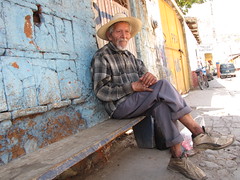
Anselmo Alcazar, 82, of Cotija, Michoacán, was sent by his parents to study at a seminary/school run by Legionaries of Christ founder Marcial Maciel in the 1940s. He says he fled after Maciel attempted to sexually abuse him.
A lawmaker from Mexico’s largest left-wing political party filed a criminal complaint with the federal Attorney General’s Office (PGR) against the Legionaries of Christ for pedophilia, the corruption of minors, money laundering and organized crime - among other allegations.
The Legionaries, in a May 31 statement, rejected the allegations as “irresponsible” and a smear campaign against members that “have chosen the path of service.”
“In the judicial system, we can’t tolerate gratuitous accusations whose intent is to generate … a media lynching lacking legal substance.”
Such is the state of affairs for the Legion as it has come under attack - often in a gratuitous fashion - for the crimes of its founder, the late Father Marcial Maciel, and its polemic role in Mexican society over the past seven decades.
Maciel, it has been revealed, sexually abused seminarians and fathered at least three children during his time as leader of the Legion, which he founded in 1941 in the Tlalpan borough of Mexico City.
Maciel and the Legion have generated controversy ever since the order's founding.
Much of the controversy stems from Maciel's strategy of courting the business elite. The Legion founded expensive educational institutions, which, according to detractors, have functioned as a sort of vetting service for membership in the upper classes - along with providing quality educations.
The order, it has been said, "Celebrated wealth," at a time when left-wing strains of thought were gaining traction in the church in other parts of Latin America. Those currently involved with the Legion say its strategy has been to develop leaders, who go on to use their money to do good deeds. They point to charity projects such as the Mano Amiga schools, which provide quality educations to children in impoverished municipalities such as Valle de Chalco, and low-cost universities - which have reputedly been provided with funding by Carlos Slim, the world's wealthiest man.
Schadenfreuder has been common of late, too, as Legion critics - whose voices were kept silent by media outlets, whose owners were either Legion members or fearful of losing advertising from companies owned by Legion members - and media outlets release stories ranging from the supposedly slave-like treatment of consecrated Regnum Christi members to accounts of Maciel fathering children and subsequently abusing them to news the Legion has hired a public relations firm to highlight the charitable work of its members and students in its schools.
Some reports have been scathing and the Legion's motives have been questioned: The sincerity of a statement, which denounced its founder and was released on the eve of Holy Week, was questioned as it came as much of the country was decamping for a week of vacations at the beach.
As ITAM political science professor Federico Estévez says of the fascination with the Legion's largely self-inflicted problems: "This is a Tiger Woods story, but with an institution."
CRIMINAL ISSUE?
The criminal complaint, filed with the PGR May 31, asks for a criminal investigation into the order, along with Legionaries director Father Alvaro Corcuera; Legionaries secretary general Father Evaristo Sada; the rector of the Legionaries-run Anahuac University Father Jesus Quirce; Cardinal Norberto Rivera Carera of Mexico City and Bishop Ricardo Watty of Tepic.
“We want that the investigation gets to the bottom of this,” Democratic Revolutionary Party lawmaker Leticia Quezada Contreras told reporters May 31 of both the order and of allegations of a possible cover up.
But her complaint contains no new proof and, she acknowledges, is based on various media stories that have emerged about Maciel and the Legion over the past 13 years. Two other women already have filed similar complaints, she said PGR officials told her. Furthermore, Quezada said she had had no contact with any of Maciel's victims.
How far her complaint goes remains to be seen. A new law approved in the Senate in late April would give victims the opportunity to go after the institutions that failed to protect them.
The latest complaint also alleges a cover-up on the part of Bishop Watty and Cardinal Rivera.
Watty was part of a five-member apostolic visitation team that investigated the Legion and recommended the order be put under the control of outside leadership and have its charism rewritten. The Vatican acted on those recommendations last month.
How Watty allegedly participated in a cover-up is unclear as he said during a May press conference the Legion had been dominated by Maciel for too many years and a "refoundation" was necessary.
One of Maciel's original accusers, José Antonio Olvera, took issue with going after Watty. He told Milenio, "We found a sincere man that was concerned by the testimony he heard."
Rivera, meanwhile, has a long history of fending off allegations he knowingly sent a pedophile priest more than two decades ago to Los Angeles, where sexual abuse crimes against children were subsequently committed against children. Rivera is known to be close with the Legion and has vigorously defended Maciel. In May 2006, after the Vatican, acting on allegations of abuse against Maciel, ordered Maciel to stop practicing his ministry in public and lead a life of prayer and penance, Rivera denied it was punishment and called such claims that it was, "Pure fiction."
The Archdiocese of Mexico City blasted the latest allegations as "irresponsible" and politically motivated.
HOMETOWN HERO
Legion defenders have been in short supply of late, although residents of Maciel's hometown of Cotija, Michoacán, have jumped to his defence. A recent trip to Cotija - a town 500 kilometres west of Mexico City on the Jalisco-state line known for farmers making a salty, crumbly cheese (queso cotija) - found few residents willing to make negative comments about Maciel, who is considered a local benefactor.
Maciel plowed Legion money back into Cotija, where he was responsible for the construction of a community centre, health clinic, low-cost university, library and refurbished parish in a nearby rancho that was the site of the final Mass said before soldiers in the Cristero Rebellion - a Catholic uprising against anti-clerical measures - laid down their arms in 1929. Legion largesse helped Cotija keep up with other nearby towns such as Tacumbo, home to the ice cream makers responsible for the ubiquitous La Michoacana outlets, and Jiquilpán, where successive generations of the Cardenas clan put money into local projects. (One local historian, Javier Valencia, said Gen. Lázaro Cárdenas, president from 1934-1940, disliked conservative Cotija and wanted to flood it out by building a dam. Ironically, his grandson, former Michoacán Gov. Lázaro Cárdenas Bátel, supported Legion projects in Cotija with state government money.)
Maciel's public works, haven't been forgotten - at least in Cotija.
"When a man does works like this, it's proof theat God exists inside him," said María Dolores García, a nurse and Benedictine nun, who doesn't believe the allegations of improprieties against Maciel.
"The devil is working through the media to destroy all of this," she alleged.
One old-timer, Ansemlo Alcazar, who says he was sent to study with Maciel in Tlalpan in the 1940s with his siblings and ran away after there was attempted abuse, begs to differ.
"They like him here because they don't know the real Maciel."


