
From World Politics Review.
DAVID AGREN
MEXICO CITY – President Felipe Calderon raised eyebrows earlier this year, when he admonished those gathered at a meeting of the nation’s top diplomats to speak better of Mexico – in spite of the negative perceptions abroad generated by violence from the ongoing war on narcotics trafficking cartels and the 2009 outbreak of the H1N1 virus.
To emphasize his point, he mentioned Brazil, saying the emerging South American power is perceived abroad in far more favorable terms than Mexico and is spoken of well by its own citizens.
“I have never as a politician nor as president of the Republic … heard a Brazilian speak badly of Brazil. And, yet, I’ve heard many Mexicans speak badly of Mexico to the world,” he said.
“The international perception is that Mexico is in chaos … and Brazil is some sort of paradise.”
The comments were perhaps a reflection of Calderón’s frustrations in Mexico, where a three-year crackdown on narcotics trafficking cartels has claimed more than 18,000 lives, the Mexican economy has lagged – dropping 6.8 percent in 2009 – foreign direct investment has been halved over the past year and his agenda for state, labor and economic reforms were dealt a blow in the midterm elections.
But the comments reflected an envy of Brazil often repeated in Mexico.
While Mexico suffered through a miserable 2009, Brazil emerged from the global economic downturn more quickly. It also continued wielding increased regional influence – at time Mexico was mending fences other countries in Latin America such as Venezuela and Cuba – with its peacekeeping presence and Haiti and involvement in the Honduras political crisis.
Even Brazil being awarded the 2016 Olympics was another point of envy for some in Mexico.
First Lady Margarita Zavala remarked in February.
“In Brazil, there are 25 homicides for every 100,000 inhabitants. We have less than half (the homicide rate) of Río de Janeiro … and they won the Olympics and (2014) World Cup.”
Ironically, the Mexico Football Federation withdrew its early bids for the 2018 and 2022 World Cups due to funding issues.
“The average Mexican is happy for Brazil’s success, but for the elites, there’s some jealousy,” said Mexico City pollster Dan Lund, president of the Mund Group.
Along with that jealousy comes fear.
Mexico and Brazil have started exploring a free-trade agreement that some in Mexico have promoted as way of lessening the country’s dependence on United States – the destination for some 80 percent of Mexican exports.
But a 2009 poll released by a major business group found 95 percent of its members uneasy of such a deal. The fear comes even though some Mexican companies such as telecommunication giants Telmex Internacional and América Móvil – both controlled by the world’s richest man, Carlos Slim Helú – have performed strongly in the Brazilian market.
Much of Mexico’s dependence on the U.S. market is attributed to geography, but also the 1994 NAFTA agreement. The timing of NAFTA’s arrival was unavoidable for some political observers, given the current Brazil-envy on display.
“While Brazil was consumed by a deep crisis (in the early 1990s) Mexico sold itself as the best emerging market on the planet,” political analyst Juan E. Pardinas wrote last fall in the Mexico City newspaper, Reforma.
“For us, the forecast was a sweet promise; for them, a black cloud. Today, our respective national futures are no longer what they were before.”
Pardinas and other observers attribute the turnaround to economic reforms in Brazil and pragmatic governance.
Over that same time period, Mexico has been mired in political gridlock – especially since 1997, when the lower house of Congress slipped into opposition control. It has remained split between the three main parties ever since. Additionally, few significant reforms were approved during the 2000-2006 administration of President Vicente Fox.
Calderon, meanwhile, has won reforms for the criminal justice system, taxation and the energy sector, but many political observers say those overhauls were inadequate.
“As a country, we’ve taken half steps,” said Eduardo García, publisher of the online business publication, Sentido Común.
“We have a democratic system, but it’s very divided.”
Those divisions were on display during the 2008 debates to reform the energy sector – one key area in which Brazil and Mexico have taken disparate development approaches.
The Mexican reforms allowed for increased private sector participation in the state-run oil concern, Pemex, but failed to address deep-seated problems such as the dominance of the oil workers’ union or provide sufficient incentives for outside players to help discover and exploit new petroleum fields – at a time when Mexican production was in decline.
Pemex lacks the technology to exploit deep-water fields in the Gulf of Mexico, which are though to hold enormous reserves. Meanwhile, Brazil’s state-controlled oil company, Petrobras, has been hailed as a world-class company and successfully exploited deep-water reserves.
Pardinas sees lessons for Mexico – where keeping the oil industry in government hands is a pillar of national sovereignty – in Brazil’s management of its petroleum sector, but also hope the country can turn itself around like Brazil has over the past two decades.
“Brazil’s success is a motive for envy. However, its successes give us hope that history is not destiny and the future is not a mechanical repetition of the present,” he said.
Showing posts with label NAFTA. Show all posts
Showing posts with label NAFTA. Show all posts
28 April 2010


29 January 2008
A political Pandora's Box
With more NAFTA protests scheduled for Jan. 31, calls for change are getting louder
By David Agren
The News
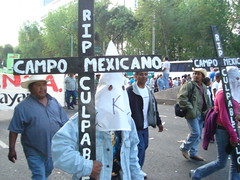
Corn farmer Pedro Galicia was girding for a fight earlier this month as he marched down Mexico City's Paseo la Reforma to the U.S. Embassy, clutching a rusty machete in his calloused right hand.
The native of San Salvador Atenco, State of Mexico, has a history of struggling against long odds. He participated in a 2002 uprising of machete-wielding campesinos that derailed plans for a new Mexico City airport, which was scheduled to be built on his ejido, or communal farm. He also scrapped with local and state police in May 2006 after vendors were removed by force from a San Salvador Atenco flower market. Galacia and his ejido members regularly wade into conflicts around the region, waving their machetes at demonstrations as a show of solidarity.
Now he's vowing to fight the 14-year-old NAFTA agreement that mandated the lifting of agricultural import tariffs on Jan. 1.
Galicia, a short man with thick stubble, proudly pointed his machete skyward has he expressed concern that a flood of duty-free corn and beans from highly subsidized U.S. producers would wipe out his livelihood and eventually drive members of his ejido from their land.
"[The opening] puts us at a disadvantage against our rivals," he said.
"We want to be able to eat … to live with dignity."
Galicia is just one of millions of campesinos facing an uncertain future as duty-free imports of white corn, beans, sugar cane and powdered milk started flowing duty-free into Mexico on New Year's Day.
The opening has provoked concerns that some of the country's poorest and most marginalized residents will be forced to abandon the countryside, unable to compete against better equipped and more highly subsidized competitors looking to claim market share south of the border.
Nationwide protests have flared since Jan. 1. The nation's largest farm group, the National Campesino Confederation, or CNC, also promised a day of action on Jan. 31, saying the new NAFTA measures would adversely affect 1.4 million campesinos in 2008.
COUNTING DOWN TO ZERO
But if everyone knew it was coming, why was no one ready?
Mexican producers have had 14 years to get ready for the arrival of foreign competition, but many corn and bean producers still seem unprepared for open markets - even though the federal government has been increasing its funding for agriculture support programs.
"It ended up being a mixed blessing to have 14 years [to prepare]," said Alberto Díaz-Cayeros, political science professor at Stanford University in Palo Alto, Calif.
"It turned out to be too long. If the timeline had been five years ... I think it would have been very clear to many of the producers that this was [more urgent]."
The angst over NAFTA's impact on the rural economy has spurred opposition politicians into action. Former presidential candidate Andrés Manuel López Obrador made the reworking of NAFTA an integral part of his 2006 president campaign. And the Permanent Commission of Congress passed a non-binding resolution on Jan. 4 urging President Felipe Calderón to revisit the parts of NAFTA governing agricultural issues.
But opening NAFTA, while possible, would put everything on the table – including the manufacturing sector and labor standards – said Sidney Weintraub, a trade expert at the Center for Strategic and International Studies in Washington.
"If they were to renegotiate agriculture they'd have to renegotiate everything," he explained.
He added that any NAFTA partner could, in theory, opt out or ask to rework sections of the agreement, but he said that wasn't likely to happen.
"You don't sign free trade agreements to renegotiate them every five years," he said.
KEEPING 'PANDORA'S BOX' SHUT
The federal government appears unwilling to propose NAFTA revisions.
Arturo Sarukhán, Mexico's ambassador in Washington, recently cautioned against reopening NAFTA, saying that doing so could "open a Pandora's Box."
Calderón also publicly dismissed calls for reworking NAFTA, telling a gathering of the country's diplomatic core: "The countries in the region now buy five times more from Mexican producers than they did in 1994."
Analysts agree with the president.
"In terms of agriculture, things have actually gone pretty decently under NAFTA," said Federico Estévez, a political science professor at ITAM.
"[Farmers] haven't adjusted fully ... but it's clear that productivity has risen - even production itself has risen in certain key areas."
Mexico now produces more corn than when NAFTA was implemented in 1994, with production jumping from 18 million tons to 33 million tons in 2007, according to the Agriculture Ministry, or Sagarpa. Productivity also improved, with corn yields going from the less than two tons per hectare 14 years ago to 2.9 tons last year.
Corn and beans were among the final products left protected by NAFTA, however. (Tariffs on other crops were slashed at earlier dates.) Agriculture Secretary Alberto Cárdenas Jimémez pointed to the removal tariffs on 40 agricultural items in 2003 as evidence that the forecasts of misery in the countryside were unfounded.
"They said there was going to be chaos and that death would come to the countryside, but what happened with the majority of those [40] crops is that production and productivity increased over a period of three to four years," he said in early January.
BEHIND THE FARMERS' FIGHT
The CNC, an organization founded in 1938 that has long been closely affiliated with the Institutional Revolutionary Party, PRI, disagreed with the favorable assessments of NAFTA, which it blamed for displacing five million campesinos. CNC spokesman Guillermo Correa accused successive federal governments of forgetting the countryside over the past 20 years and pursuing policies that would see "campesinos disappear."
Many Mexican farmers work on small plots of land – 57 percent of corn producers have less than two hectares – that were often distributed as ejidos after the Revolution. The ejidos tied farmers to their properties as they were unable to sell. (A land reform package passed during the presidency of Carlos Salinas now allows ejidos to be sold.)
The ejiditarios became dependent on government institutions for providing fertilizer, supplies and credit – often though corrupt and inefficient institutions – and sold their products to Conasupo, a government buyer. Come election time, organizations like the CNC would marshal campesino support behind the PRI.
Correa blamed many of the current problems in the countryside on a lack of infrastructure, the dismantling of Conasupo in the 1990s and the closing of agencies selling basic agriculture supplies.
Estévez, the ITAM political science professor, said that much of the money previously mandated for farm programs was gobbled up by middlemen and vast bureaucracies, leaving producers with only a trickle of funds.
He also described much of the current CNC maneuvering and some campesino behavior as a throwback to the long period of PRI rule.
"You still have a mass of people tied to the soil in the countryside that are relatively unproductive ... and they're waiting for handouts," he said.
"That's all they've ever gotten; of course they're wanting more."
The federal government will spend 20 billion pesos on agriculture in 2008 with much of the money going to farmers through the Procampo program, which pays stipends directly to those who work the land – often around election time, according to Estévez. The Procampo program was also introduced during the Salinas administration. The program was expanded under President Vincente Fox – a move that Estevez says helped boost the National Action Party's rural vote in 2006.
Iberoamericana political science professor Aldo Munoz noted that large producers in northern and western Mexico collect most of the Procampo money, but he added that the modest amount paid to small producers "deactivates protests" in the countryside.
Galicia, the machete-wielding farmer, begged to differ. At the protest, he spoke of the unrest springing from increased competition ushered in by NAFTA and the continued neglect of the countryside.
"The government is creating the conditions for rebellion," he said.
By David Agren
The News
Corn farmer Pedro Galicia was girding for a fight earlier this month as he marched down Mexico City's Paseo la Reforma to the U.S. Embassy, clutching a rusty machete in his calloused right hand.
The native of San Salvador Atenco, State of Mexico, has a history of struggling against long odds. He participated in a 2002 uprising of machete-wielding campesinos that derailed plans for a new Mexico City airport, which was scheduled to be built on his ejido, or communal farm. He also scrapped with local and state police in May 2006 after vendors were removed by force from a San Salvador Atenco flower market. Galacia and his ejido members regularly wade into conflicts around the region, waving their machetes at demonstrations as a show of solidarity.
Now he's vowing to fight the 14-year-old NAFTA agreement that mandated the lifting of agricultural import tariffs on Jan. 1.
Galicia, a short man with thick stubble, proudly pointed his machete skyward has he expressed concern that a flood of duty-free corn and beans from highly subsidized U.S. producers would wipe out his livelihood and eventually drive members of his ejido from their land.
"[The opening] puts us at a disadvantage against our rivals," he said.
"We want to be able to eat … to live with dignity."
Galicia is just one of millions of campesinos facing an uncertain future as duty-free imports of white corn, beans, sugar cane and powdered milk started flowing duty-free into Mexico on New Year's Day.
The opening has provoked concerns that some of the country's poorest and most marginalized residents will be forced to abandon the countryside, unable to compete against better equipped and more highly subsidized competitors looking to claim market share south of the border.
Nationwide protests have flared since Jan. 1. The nation's largest farm group, the National Campesino Confederation, or CNC, also promised a day of action on Jan. 31, saying the new NAFTA measures would adversely affect 1.4 million campesinos in 2008.
COUNTING DOWN TO ZERO
But if everyone knew it was coming, why was no one ready?
Mexican producers have had 14 years to get ready for the arrival of foreign competition, but many corn and bean producers still seem unprepared for open markets - even though the federal government has been increasing its funding for agriculture support programs.
"It ended up being a mixed blessing to have 14 years [to prepare]," said Alberto Díaz-Cayeros, political science professor at Stanford University in Palo Alto, Calif.
"It turned out to be too long. If the timeline had been five years ... I think it would have been very clear to many of the producers that this was [more urgent]."
The angst over NAFTA's impact on the rural economy has spurred opposition politicians into action. Former presidential candidate Andrés Manuel López Obrador made the reworking of NAFTA an integral part of his 2006 president campaign. And the Permanent Commission of Congress passed a non-binding resolution on Jan. 4 urging President Felipe Calderón to revisit the parts of NAFTA governing agricultural issues.
But opening NAFTA, while possible, would put everything on the table – including the manufacturing sector and labor standards – said Sidney Weintraub, a trade expert at the Center for Strategic and International Studies in Washington.
"If they were to renegotiate agriculture they'd have to renegotiate everything," he explained.
He added that any NAFTA partner could, in theory, opt out or ask to rework sections of the agreement, but he said that wasn't likely to happen.
"You don't sign free trade agreements to renegotiate them every five years," he said.
KEEPING 'PANDORA'S BOX' SHUT
The federal government appears unwilling to propose NAFTA revisions.
Arturo Sarukhán, Mexico's ambassador in Washington, recently cautioned against reopening NAFTA, saying that doing so could "open a Pandora's Box."
Calderón also publicly dismissed calls for reworking NAFTA, telling a gathering of the country's diplomatic core: "The countries in the region now buy five times more from Mexican producers than they did in 1994."
Analysts agree with the president.
"In terms of agriculture, things have actually gone pretty decently under NAFTA," said Federico Estévez, a political science professor at ITAM.
"[Farmers] haven't adjusted fully ... but it's clear that productivity has risen - even production itself has risen in certain key areas."
Mexico now produces more corn than when NAFTA was implemented in 1994, with production jumping from 18 million tons to 33 million tons in 2007, according to the Agriculture Ministry, or Sagarpa. Productivity also improved, with corn yields going from the less than two tons per hectare 14 years ago to 2.9 tons last year.
Corn and beans were among the final products left protected by NAFTA, however. (Tariffs on other crops were slashed at earlier dates.) Agriculture Secretary Alberto Cárdenas Jimémez pointed to the removal tariffs on 40 agricultural items in 2003 as evidence that the forecasts of misery in the countryside were unfounded.
"They said there was going to be chaos and that death would come to the countryside, but what happened with the majority of those [40] crops is that production and productivity increased over a period of three to four years," he said in early January.
BEHIND THE FARMERS' FIGHT
The CNC, an organization founded in 1938 that has long been closely affiliated with the Institutional Revolutionary Party, PRI, disagreed with the favorable assessments of NAFTA, which it blamed for displacing five million campesinos. CNC spokesman Guillermo Correa accused successive federal governments of forgetting the countryside over the past 20 years and pursuing policies that would see "campesinos disappear."
Many Mexican farmers work on small plots of land – 57 percent of corn producers have less than two hectares – that were often distributed as ejidos after the Revolution. The ejidos tied farmers to their properties as they were unable to sell. (A land reform package passed during the presidency of Carlos Salinas now allows ejidos to be sold.)
The ejiditarios became dependent on government institutions for providing fertilizer, supplies and credit – often though corrupt and inefficient institutions – and sold their products to Conasupo, a government buyer. Come election time, organizations like the CNC would marshal campesino support behind the PRI.
Correa blamed many of the current problems in the countryside on a lack of infrastructure, the dismantling of Conasupo in the 1990s and the closing of agencies selling basic agriculture supplies.
Estévez, the ITAM political science professor, said that much of the money previously mandated for farm programs was gobbled up by middlemen and vast bureaucracies, leaving producers with only a trickle of funds.
He also described much of the current CNC maneuvering and some campesino behavior as a throwback to the long period of PRI rule.
"You still have a mass of people tied to the soil in the countryside that are relatively unproductive ... and they're waiting for handouts," he said.
"That's all they've ever gotten; of course they're wanting more."
The federal government will spend 20 billion pesos on agriculture in 2008 with much of the money going to farmers through the Procampo program, which pays stipends directly to those who work the land – often around election time, according to Estévez. The Procampo program was also introduced during the Salinas administration. The program was expanded under President Vincente Fox – a move that Estevez says helped boost the National Action Party's rural vote in 2006.
Iberoamericana political science professor Aldo Munoz noted that large producers in northern and western Mexico collect most of the Procampo money, but he added that the modest amount paid to small producers "deactivates protests" in the countryside.
Galicia, the machete-wielding farmer, begged to differ. At the protest, he spoke of the unrest springing from increased competition ushered in by NAFTA and the continued neglect of the countryside.
"The government is creating the conditions for rebellion," he said.
Subscribe to:
Posts (Atom)
