26 September 2009

Where H1N1 began

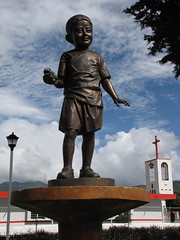
IMG_0607

H1N1 just keeps on giving in La Gloria, Veracruz, the hamlet where the virus was supposedly first detected back in April. Since the media from the across the globe first descended on La Gloria last spring, in search of the first-known H1N1 carrier, five-year-old Edgar Hernandez, the PRI state government has paved a new road through town, painted many of the public buildings and even erected a statue to young Edgar.

Locals seem indifferent to all of the attention - and many express doubts that something as sinister as H1N1 could have originated in their corner of Veracruz. (Some expressed sentiments like: "If it was so bad, why did we survive?")

Others blame the nearby pig farms - a charge hotly denied by the farm operators - and see the largess from the state government as nothing more than Gov. Fidel Herrera trying to make amends for all of the complaints about the agribusiness in the region. The boy, they complain, is an object of propaganda for the powerful state PRI and Gov. Herrera, who has given the Hernandez family a truck and given Edgar a scholarship. The governor said while unveiling the statue in August that it was a testament to the hearty folks of La Gloria, nothing more. Many speak ill of the statue, however.

I accompanied Thane Burnett of Sun Media to La Gloria in late August: here's his report.

13 September 2009

Gov't abandons plans for Guerrero dam

The Federal Electricity Commission (CFE) has canceled plans to build a massive hydroelectricproject near Acapulco known as La Parota that would have produced enough power to light up the state of Guerrero for an entire year. The project had been a crown jewel in the infrastructure plans of successive PAN administrations, but generated enormous controversy among the local campesino populations. The campesinos alleged the CFE failed to properly consult them on relocation and never made proper offers of compensation for their small plots of land near the Papagayo River.

The CFE officially canceled the project due to a lack of financing - and the dam was among a series of projects nixed by the federal government for similar reasons - but the utility had encountered stiff opposition from campesinos and human rights groups, who successfully took the case to court.

I wrote on the controversy over La Parota for The News in the fall of 2007. The story pointed out that irate campesinos and locals facing expropriation over the past 15 years had derailed projects by staging riots, taking hostages and wielding machetes. The failed attempt at building a new international airport for Mexico City earlier this decade in the State of Mexico - where machete-wielding campesinos forced the Fox administration to back down - was perhaps the most notable example. But La Parote was different: The campesinos, backed by environmental lawyers, went to court - and even obtained an injunction against parts of the project.

Whether the federal government and CFE return to La Parota remains to be seen - the dam was first proposed in 1976 and could provide drinking water for fast-growing Acapulco - but the strategy of campesinos mobilizing to fight expropriations that previously would have turfed them from their properties with scant compensation appears to gaining traction.

As examples, just witness the difficulties earlier this year in Tula, Hidalgo, where the state government was unable to expropriate ejido land in a timely enough fashion to meet the deadline for winning the construction of a Pemex refinery. (The state did win the refinery project, but only after a farcical competition with perhaps the most polluted town in Mexico - Salamanca, in the PAN stronghold of Guanajuato - to obtain the necessary land for Pemex.) Or, the Altamira port project near Tampico, where former PAN presidential candidate and legal bigwig, Diego Fernández de Cevallos, won an injuction on behalf of two ejidos facing expropriation that could cost the Transportation and Communications Secretariat billions of pesos.

The campesino skepticism of expropriation offers is understable: Ejiditarios in Tula told Notimex in April that the first time the government came for 50 hectares of their land in the 1970s, they were offered nothing more the five pickup trucks as compensation.

21 August 2009

President signs drug-decriminalization law

President Felipe Calderón finally signed a new law that decriminalizes the possession of small quantities drugs that include marijuana, cocaine and methamphetamine. The law - which Congress approved in April, despite objections from National Action Party (PAN) lawmakers in the lower house - also requires state and municipal police forces to crack down on small-time drug dealing, known in Mexico as narcomenudeo.

Calderón proposed the law last year as part of a series of measures for combating narcotics-trafficking gangs. Other measures proposed making it easier for the government to seize the assests of organized crime, overhauled the Attorney General's Office (PGR) and created a new Federal Police. The war on drugs has claimed more than 11,000 lives since Calderón took office in December 2006.

The president's original proposal called for mandatory rehabilitation stints for those caught with drugs. Democratic Revolution Party (PRD) senators balked at that proposal and made rehabilitation voluntary. PAN deputies nearly rioted when the bill arrived in the lower house, however. The deputies unsuccessfully demanded mandatory rehabilitation be included and also objected to the quantities of drugs that could be carried without incurring penalties. The amounts surpassed the original proposals called for by Calderón.

The law allows for the possession of five grams of marijuana, 50 milligrams of heroin, 40 milligrams of methamphetamine and 500 milligrams of cocaine without incurring criminal penalties.

Calderón waited months before signing the law - he also waited to sign a maximum salary law that forbids any public servant or politician from earning more than the president - fueling speculation that he might exercise the presidential veto.

One PAN lawmaker, who voted against the measure, told me back in May that Calderón would eventually sign the law since it contains provisions that force state and municipal police to begin cracking down on small-time drug dealing. Those tasks had been the exclusive jurisdictions of federal police forces. Small-time drug dealing, he added, also is becoming more common in Mexico as the cartels develop a domestic market for their product and pay their underlings in merchandise.

The law follows a previous effort in 2006 to decriminalize drug possession. Congress passed a bill that year, but President Vicented Fox vetoed it after caving to pressure from U.S. officials.

07 August 2009

Mexican government apologizes for federal police drug raid during Mass

Hummer

By David Agren
Catholic News Service

MEXICO CITY (CNS) -- The Mexican government apologized after federal police burst into a parish and interrupted Mass in the western state of Michoacan to apprehend a drug-cartel suspect.

An Aug. 4 statement from the Secretariat of Public Security apologized to the Mexican bishops' conference, Bishop Miguel Patino Velazquez of Apatzingan, and the faithful "for the circumstances in which the operation had to be carried out." The statement said that the raid in an Apatzingan parish was undertaken to avoid gunfire and a "violent incident."

The Aug. 1 raid resulted in the arrests of 33 alleged members of a cartel known as La Familia Michoacana and the seizure of cash, weapons, fragmentation grenades and luxury vehicles. The detainees include Miguel Beraza Villa -- known as "La Troca" (the Truck) -- a cartel lieutenant that Mexican and U.S. authorities allege was responsible for transporting tractor-trailers full of synthetic drugs such as "ice" and "crystal" from the cartel's clandestine laboratories to the United States via Tijuana, Mexico.

The bishops' conference had criticized the raid as a show of disrespect for the sanctity of Mass.

"We make an energetic protest against the lack of respect and the violence exercised on the part of the forces responsible for guaranteeing the security of all persons in our nation -- principally in the state of Michoacan -- by interrupting a religious act ... at the moment in which holy Mass is celebrated," the bishops said in an Aug. 3 statement signed by Auxiliary Bishop Jose Gonzalez Gonzalez of Guadalajara, conference secretary-general.

"Nothing explains this kind of action inside a religious place and much less in these moments where Mexico is noted internationally as an insecure and violent country," the bishops said.

The Aug. 1 raid marked the first time that police officers have burst into a parish to arrest suspects linked to organized crime, said Father Mateo Calvillo Paz, spokesman for the Archdiocese of Morelia, which is in Michoacan.

The raid also highlighted the increasing vulnerability of church officials and the faithful of being caught up -- inadvertently or not -- in the ongoing federal crackdown on drug cartels.

The raid continued a high-profile crackdown on drug traffickers in President Felipe Calderon's home state, where some 5,500 federal police and soldiers have been dispatched to fight organized crime. By the end of July, violence from organized crime had claimed more than 250 lives in Michoacan and more than 3,500 lives nationwide, according to the newspaper Reforma.

Federal police, arriving in armored vehicles and accompanied by two Black Hawk helicopters, raided Our Lady of Perpetual Help Parish in Apatzingan Aug. 1, interrupting a Mass being celebrated in advance of a "quinceanera." Local media reported that an estimated 250 attendees and the priest -- identified as Father Vicente Soto by the Michoacan news agency Quadratin -- were held in the parish for six hours.

Media photos of the parish showed dislodged furniture and other minor damage to property. Attempts to reach Father Soto through the Diocese of Apatzingan were unsuccessful.

Father Calvillo said police "took advantage of the Mass to assault a large number of 'narcos'" and avoid bloodshed, but showed ignorance of the importance of the Mass.

Mexico's bishops, he added, "have rejected all types of protection or calls for arming themselves. It would be a false testimony."

The threat to the well-being of prelates due to the increase in organized crime violence has been the source of some disagreement within the church. Father Hugo Valdemar, spokesman for the Archdiocese of Mexico City, told reporters in July that three bishops in Michoacan had been threatened, but both Father Calvillo and a spokesman for the Diocese of Tacambaro told Catholic News Service that the statement was false.

The U.S. Embassy in Mexico City and the U.S. Drug Enforcement Agency lauded the Aug. 1 arrests as key accomplishments in Calderon's battle against organized crime.

Security expert Pedro Isnardo de la Cruz of the National Autonomous University of Mexico said La Familia has shown a surprising resilience that "reflects poorly" on the president's war on organized crime, has demonstrated a "great ability to corrupt" local governments, and also appears to be receiving financing from unknown sources beyond Mexico.

21 July 2009

Visa demands will be costly, Mexicans say

Cdn. Ambassador to Mexico
Cdn. Ambassador to Mexico, Guillermo Rishchynski, speaks with reporters on the Canadian decision to impose visa requirements on Mexican travellers to Canada.

From the Ottawa Citizen

By David Agren
July 20, 2009

Adriana Arriaga, 28, fiddled with her iPhone and leaned impatiently along a metal barricade on a recent morning, while waiting for an entry visa outside the Canadian embassy in a posh district of the Mexican capital. A university graduate who speaks English well and works in a family medical-supply business, she booked a five-day junket to Toronto, Montreal and Niagara Falls last month and was scheduled to leave on Sunday.

She cited "Canada's natural beauty," as her main motive for heading north, but acknowledged that the ease of travelling to a country that imposed no visa restrictions on Mexicans also factored into her buying decision.

"You feel so much more welcome and respected," Arriaga said of the ability to travel without a visa. "It really gives you more of an incentive to go."

That incentive ended on July 13, when the Canadian government announced new visa requirements on Mexican travellers due to a flood of refugee claims from the Latin American country -- 89 per cent of which have been deemed invalid over the past five years.

Visa-free travel had been Canada's calling card in Mexico ever since NAFTA went into effect and been the foundation of successful promotional campaigns that have made Canada one of the preferred vacation and education destinations for Mexican travellers and students.

Past promotional efforts have included a popular education fair known as EduCanada that has toured the country for more than a decade, attracting up to 15,000 potential students each year. The Canadian Tourism Commission even imported a sappy teen telenovela (soap opera) called Rebelde to the Canadian Rockies in 2005 to film a week's worth of episodes.

Roughly 261,000 Mexican tourists visited Canada last year, according to Canadian officials. Kurt Schroeder, sales and marketing director for Banff Lake Louise Tourism, whose region benefited from the Rebelde campaign, called Mexico "one of Canada's bright spots for inbound visitors."

Other Canadian initiatives such as eliminating all visa requirements for those studying in Canada for less than six months and the continued expansion of a successful program for allowing agricultural workers to work in Canada have reinforced positive perceptions of Canada in Mexico -- and appeared to move in the opposite direction of the U.S., which has been tightening restrictions on travellers and beefing up security on its border with Mexico.

"For the last decade, trips to Canada, for work, pleasure or business, were very easy and taken for granted," said Marcela Lopez, a doctoral student in Canadian studies at University of the Americas in Puebla.

Imposing visa requirements on Mexican travellers, she said, "has injured the (Canada-Mexico) relationship."

The sudden decision to impose visa requirements has been poorly received in Mexico, where newspapers have run indignant front-page stories of long lines forming in the predawn hours outside the Canadian embassy and travellers facing the prospect of missing their flights.

The seemingly clumsy implementation of the program -- Arriaga called the visa application process "disorganized" -- and complaints that Canadian officials failed to fully explain the process to those needing travel documents only fuel the discontent.

The dissatisfaction and the long lines for visas show just how significant Mexican interest in Canada is, says Mexico City-based immigration consultant David Mendez, whose business sends students to study in foreign countries. He says that only the U.S. and Spain are more popular as destinations than Canada for Mexicans.

He predicted that over the long term, the new rules would be felt more in Canada, where an industry has mushroomed to serve Mexican students, than in Mexico.

"Thousands of jobs in Canada depend on Mexican students," he said.

08 July 2009

A blast from the past

With the PRI making such a comeback on July 5, this story originally published in early March on the PRI marking its 80th anniversary earlier this year seems apt.


80 years on, PRI strong

BY DAVID AGREN
The News

Many foreigners and Mexicans best know the Institutional Revolutionary Party for the inglorious acts carried out during its 71 years of uninterrupted rule.

Those watching Mexico from abroad will likely recall the bloody crackdown on student protesters at Tlatelolco on the eve of the 1968 Olympics. Some may remember the Dirty War of the 1970s, when hundreds or possibly even thousands of rebels and left-wing activists disappeared. Then in 1988, when change in governance seemed a possibility - even if only a remote one - a mysterious computer crash in the Interior Secretariat wiped out early election results favoring the opposition.

For those living in Mexico, the PRI's actions touched their daily lives, sometimes for the worse. Recurring peso crises derailed the country's promising ascents toward First World status. The government's inept response to the 1985 earthquake left tens of thousands to fend for themselves. And come election time, coercive vote-grabbing schemes regularly suppressed the democratic will.

But as the PRI turns 80 on Wednesday, party members are largely unapologetic for any past transgressions or excesses. And, according to recent public opinion polls, many Mexicans seem willing to forgive too.

PRI members instead speak proudly of their legacy as the party that built modern Mexico and its most cherished institutions, ushered in stability and order after the chaos of the Revolution and presided over a country that has never suffered a coup - an unmatched feat in most of Latin America.

"People from other countries in Latin America always saw the PRI as a grand example of Latin American politics," said Rafael Rodríguez, a former national party president and ex-governor of Campeche. "I don't say that with false pride, or false modesty. I say that because it's a fact."

PRI members also boast of achieving the social objectives that were demanded by those who took up arms in the Revolution: labor rights, providing education that is both secular and free of cost and the disruption of haciendas and ensuing distribution of its parcels to landless campesinos. On the economic front, the PRI oversaw an expansion that saw the gross domestic product grow six-fold between 1930 and 1970.

"There wasn't only growth, but growth with social peace, with social stability," Rodríguez said.

Of course, many in Latin America hold far less effusive opinions on the PRI and its practices. Peruvian author Mario Vargas Llosa, for instance, once branded the successive PRI governments the "perfect dictatorship."

But the political system that the PRI built - with its strong respect for the presidency and institutions - has had staying power, as have the vices from that system - which include corruption, the formation of patronage groups and the practice of rewarding friends while severely punishing foes.

The political culture developed by the PRI is so entrenched in Mexico that former presidential candidate Patricia Mercado, who captured prominence by leading a small left-wing party that bashed the PRI way of doing politics, once candidly commented while campaigning in 2006: "I think that there's an inner PRIísta in all of us."

IN THE BEGINNING

The PRI dates back to 1929, a period of chaos and political instability. The Revolution had ended barely a decade earlier, a Catholic uprising against anti-clerical measures was flaring in western Mexico and the country was still reeling from the 1928 assassination of President-elect Alvaro Obregón.

As Rodríguez and other PRI members tell it, former President Plutarco Elías Calles proposed the creation of a big-tent party that would be known as the National Revolutionary Party, or PNR.

The PNR would envelop the country's disparate political factions, impose order and solidify the gains won during the Revolution.

"It was a political movement that brought together the previous forces of the Revolution that were dispersed among military commanders and civilian groups," said PRI Deputy Alfredo Ríos Camarena. "No political body existed that represented in a uniform way all of the interests and principles produced by the Revolution and the Constitution of 1917."

Some historians, however, interpret the PNR's founding as nothing more than a naked power grab by Calles, who had served as president from 1924 to 1928 and is considered to have been the dominant political figure until 1936.

"The PNR was a party that brought together caudillos (strongmen) . [It]was the product of the most authoritarian tendencies of the Revolution," said Ilán Semo, a political historian at the Universidad Iberoamericana. "[It] was one of the greatest evils of the Revolution."

According to Semo, the new party showed its authoritarian tendencies almost immediately. The PNR's candidate in the 1929 election, Pascual Ortiz Rubio, won in a process widely considered to have been rigged.

The victory was just the first of many for the PNR and its subsequent incarnations. Allegations of fraud, too, would continue.

CREATING A SYSTEM

The PNR solidified its gains in the 1930s, but was still a work in progress when Lázaro Cárdenas took office in 1934. He rechristened the PNR as the Mexican Revolutionary Party, or PRM, and went about incorporating broad sectors of the society into the PRM, including labor unions and campesino groups. The incorporation of broad sectors of society set the stage for a corporatist system that the party would leverage for support in subsequent decades.

Cárdenas is perhaps best known for his populist measures, however. He expropriated the oil industry in 1938 and accelerated land reforms to redistribute vast tracts of hacienda land and create the "ejido" system of communal property ownership. He also introduced an education reform and expanded state ownership of numerous enterprises.

PRI members point to these initiatives as fulfilling social objectives that were fought for in the Revolution.

Semo said the moves simply reflected pragmatism: Distributing land nullified one of the main issues behind potential campesino uprisings, while expropriating the oil industry put "enormous economic power" in the hands of the state.

A leadership style known as "presidencialismo," which gave the president broad powers that would be transferred every six years to his preferred successor in a process know as the "dedazo," also took hold during that period.

INSTITUTIONAL OXYMORON

The PRI adopted its present name in 1946 under the regime of President Miguel Alemán. A new generation of leadership with few links to the Revolution had emerged; generals and revolutionary figures had largely left the government.

The Revolution had become "institutional," reflected in the party's new name, which PRI Deputy Ríos Camarena called "antithetical."

"It represented the institutionalism that emerged from the Revolution," he said.

The economy flourished and industrial activity boomed in the subsequent decades under a scheme of import substitutions. PRI presidents would expand the scope of some of the nation's most iconic public institutions - the IMSS, the public education system and a military firmly under civilian control, for instance - and exert heavy influence over institutions developed in the private sector.

Government influence over many facets of day-to-day life became even more entrenched. Newspapers bought newsprint from a government-owned supplier, while vendors belonged to unions that staunchly backed the PRI. Campesinos purchased seed and fertilizer from state-run outfits and sold their crops to government buyers. The government also ran the telephone company, railroads and post office.

Opposition parties and rebel movements were kept firmly in check. The federal government violently suppressed a railroad strike in the 1950s, while the Army hunted down rebels in southern Mexico. Students protesting in Mexico City were shot dead in the 1968 Tlatelolco Massacre.

For some, earning a livelihood also depended on backing the PRI. Newspapers that bucked the PRI line would suddenly find themselves without newsprint or find vendors unwilling to sell their papers. Campesinos who needed inputs and credit would find delivery of such necessities dependent on their support for the PRI.

A GRADUAL DECLINE

The PRI was deposed by voters in 2000, but many political observers say the origins of its downfall began in the 1960s.

Some analysts and historians attribute the party's decline to changing social attitudes that simply passed the PRI by.

"The hierarchical structure of the PRI perfectly matched the culture . the culture of the church and other institutions ... but in the 1960s, the gaps were apparent," said Mexico City pollster Dan Lund. "The world changed . the PRI just didn't keep up."

Others point to recurring economic crises that resulted in peso crises each time. "A catalogue of sins in economic matters fatally wounded [the PRI]," said ITAM political science professor Federico Estévez.

PRI members, too, acknowledge that mistakes were made. Rodríguez, the former party president, declined to offer examples of specific actions on the part of PRI governments, but said that "many things" led to the PRI's downfall, including, "a natural decline." He also cited a lack of unity and the passage of electoral reform measures - by PRI governments.

But he rejected allegations that his party had ever been undemocratic.

"It's said that the PRI was a hegemonic party . and that the opposition parties forced it to implement democracy in this country. This is totally false," Rodríguez said. "[The PRI] was responsible for its own fall."

The National Action Party, or PAN, ousted the PRI from power in 2000.

INTO THE FUTURE

The PRI suffered a rough adjustment to becoming the opposition upon losing the presidency. It also suffered disunity in the subsequent years. PRI presidential candidate Roberto Madrazo ran a distant third in the 2006 election. Some analysts would write the party off on the federal level.

Forecasts of the PRI's demise were premature, however. The party has bounced back on the local level and now leads public opinion surveys for the July midterm elections. With a plunge in the economy and surge in violence attributed to organized crime, some voters are expressing nostalgia for the order - however authoritarian it was - of the PRI years.

"In the PRI times, there were hardly any kidnappings. There weren't narcos going around killing people," said Mexico City taco stand owner Efraín García, who plans on voting PRI. "The PRI had control of all of this."

The current government of the National Action Party, García said, is run by "new people who don't know what they're doing."

PRI members are banking on that kind of public sentiment to recapture power.

"In the PRI . there's a great amount of experience," said Ríos Camarena. "The experience produces maturity and that maturity draws people in times of economic and security crises."

07 July 2009

PAN vs. PAN

DSC05046

The PAN losses suffered on July 5 extend beyond the disastrous performance in the midterm elections - and hit the conservative party hard in many of its heartland states. The party lost gubernatorial offices in San Luis Potosí and Querétaro. It lost the suburban corridor to the west of Mexico City in the State of Mexico that includes Naucalpan and Tlalnepantla. The PAN even lost municipal races in Guanajuato, the most conservative state in the Republic, as it dropped the state capital Guanajuato and San Miguel de Allende.

Party president Germán Martínez resigned Monday, when he accpeted blame for the losses - and took gratuitous barbs from disaffected party rivals such as former PAN president Manuel Espino. But dissatisfaction with the party leadership goes beyond Martínez and the PAN National Executive Committee and has been expressed on the state level.

Take Jalisco, for example, where the Panistas in Guadalajara turned out in force to protest ... the PAN! (Pardon the Grupo Reforma-style headline.)

The PAN lost its majority in the state congress and all six mayoral races in the Guadalajara metropolitan area on Sunday - a reversal of the PAN sweep just three years ago. On Tuesday, the Mural newspaper reported that some 400 Panistas protested outside the party offices in Guadalajara's Col. Americana to demand the ouster of PAN Jalisco president Eduardo Rosales. A few colonias away, another group of Panistas armed with eggs protested outside the governor's official residence against the leadership of PAN Gov. Emilio González, who they blamed for the July 5 defeat.

Ironically, the local PRI had been rocked by internal conflicts that involved irate members taking over the party headquarters in central Guadalajara last April after the state PRI president - who eventually resigned - welshed on a deal for registering municipal councilors.

This week, it was the PAN's turn for conflict - not entirely unusual for Jalisco, where the party is split between a faction known as the "paquistas" that is loyal to former governor and former interior minister Francisco Ramírez Acuña - who won a seat in Chamber of Deputies and is being mentioned as the potential PAN leader in the Chamber - and González, whose PAN faction tilts decidedly in the conservative-Catholic direction.

The scorn for González is obvious. He courted controversy over the first two years of his term by mouthing off on contentious social issues - questioning if an AIDS prevention program that distributed condoms should also give away hotel vouchers and "un six de cerveza," for example - and pledging 90 million pesos of government money for the construction of a Catholic sanctuary in Tlaquepaque that would pay homage to the martyrs of the Cristero Rebellion. (The money was returned by the church; González made things worse by saying at an audience of business and religious types, "Me vale madre," which politely translates: "I don't give a flying ..."

But blaming González is not entirely fair. The paquista faction won the primary elections earlier this year. The losing PAN mayoral candidate in Guadalajara, Jorge Salinas, also happens to be the brother-in-law of Jalisco PAN president Eduardo Rosales. The runner up in the primary contest for the mayoral nomination - a former mayor of Guadalajara - alleged nepotism and quit the party. 

The PAN ran into other problems in Jalisco, most notably the mayor of Tonala being removed due to his alleged involvement in a homicide and the operation of an illegal slot machine operation.

Still, it must be said that this is far from being the end of the PAN in Jalisco, where it has governed since 1995. Six years ago, the PRI made gains in the 2003 Jalisco midterm and municipal elections, but the party was soundly thumped in 2006. The state also has a solid two-party political system in which the third-place PRD is divided and non-existent in places, the Green Party is on the rise and the PRI is said by some observers to be more conservative - and friendly with influential church leader, Cardinal Juan Sandoval - than the PAN.