Showing posts with label war on drugs. Show all posts

29 January 2011

'Acapulco is both heaven and hell'

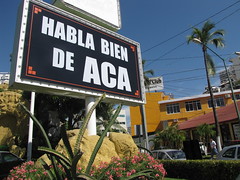
Habla bien de Aca
A campaign launched by Acapulco night club owners encourages people to speak well of Acapulco. It comes as the granddaddy of Mexican tourist destinations suffers through a wave of organized crime bloodshed that has involved beheadings and mass abductions. Tourist officials say the violence takes place far away from tourist areas and doesn't impact visitors. They complain, too, that violence in other parts of Guerrero often is erroneously reported as somehow involving or being near Acapulco. I went to Acapulco recently to report on the situation for USA TODAY; read my dispatch by clicking on the headline for this blog post.

08 April 2010

Cash, status lure youths to drug trade in troubled parts of Mexico

Hummer

By David Agren, Catholic News Service

APATZINGÁN, Mexico (CNS) -- Father Javier Cortés vividly recalls being approached recently with an unusual request by a group of teenagers in this agricultural town 300 miles west of Mexico City. There, La Familia Michoacana, a quasi-religious drug cartel, dumped four human heads at a prominent public monument during Holy Week as a warning to its rivals.

"Some young people said, 'Father, I've come so that you will bless me because I'm going to kill Zetas,'" he said, referring to the gang of rogue former soldiers and police officers that La Familia members consider their mortal enemies.

Father Cortés, who is rector of the local seminary, rebuked the plan and refused to bless the killing spree.

Such violence has become common, however, and has contributed to more than 19,000 deaths since President Felipe Calderón took office in December 2006 and promised to crack down on violent drug cartels. The violence increasingly is claiming young lives as well. Authorities blame the cartels and gangs affiliated with them for massacres such as the January murder of 15 youths at a birthday party in Ciudad Juárez and the Palm Sunday murders in Durango state of 10 young people who were returning to their communal farm.

But the request made of Father Cortés highlighted an even more disturbing trend in drug-related violence, as young people are increasingly recruited by the cartels and lured into the seemingly easy money of the drug trade.

"We're talking about a lost generation of young people that is falling into the networks of narcotics trafficking," said security expert Pedro Isnardo de la Cruz, who teaches at the National Autonomous University of Mexico.

He attributed the recruitment of young people to a combination of factors that include Mexico's long-underperforming economy, family breakdowns and the seduction of the cartels.

Church leaders and young people concurred and said such factors are at play in Apatzingán, the hub of an economically neglected region of downtrodden communal farms and lemon groves known as Tierra Caliente, or Hot Earth.

Read more here.

29 September 2009

Mexican bishops look to Colombians for help fighting drug violence

IMG_0350

Mexican bishops look to Colombians for help fighting drug violence

By David Agren
Catholic News Service

MEXICO CITY (CNS) -- At a press conference earlier this year, Archbishop Hector Gonzalez Martinez of Durango had planned to denounce extortion attempts against priests in his archdiocese. He instead stunned reporters -- and the whole country -- by announcing that cartel kingpin Joaquin "El Chapo" Guzman, Mexico's most-wanted man, was residing in a remote corner of Durango state. Even more stunning, he insisted, "Everyone knows it, except the authorities."

His candor generated nationwide headlines and a warning from presumed associates of Guzman, who dumped two bodies along with a note that advised, "No government, no priest can stand against El Chapo."

Archbishop Gonzalez, the subject of intense media scrutiny, would later respond to reporters' questions with the words, "I'm deaf and dumb."

The archbishop's latter words describe the posture of many Mexicans and church leaders when it comes to denouncing organized crime and addressing a wave of violence that has claimed more than 13,500 lives since President Felipe Calderon took office in December 2006 and sent the army to suppress Mexico's drug cartels.

But that posture may be changing for Mexican Catholics. The social ministry secretariat of the Mexican bishops' conference is preparing a comprehensive report on violence in Mexico that is expected to provide both a diagnosis and an action plan for addressing the problem.

None of the report's authors wished to comment on their findings before its November publication, but the issue of organized crime has been a delicate one for the church. Equally delicate is the peril of wading into the public policy arena in a country with a history of contentious church-state relations and the risks of denouncing powerful drug cartels that act as benefactors and de facto authorities in many isolated parts of Mexico.

"They (church officials) would like to avoid confrontations with the government -- and also avoid confrontations with the narcotic traffickers," said Victor Ramos Cortes, religious studies professor at the University of Guadalajara.

Complete article posted at Catholic News Service, here.

27 September 2009

Mexican drug cartel peddles meth, preaches religion

Hummer

I travelled to the Tierra Caliente region of Michoacán last month to speak with local Catholic officials about the Aug. 1 raid on an Apatzingán parish that nabbed a cartel kingpin that federal officials say was responsible for sending truckloads of meth from clandestine labs to the United States. Church officials in Apatzinagan obviously objected to raids on religious events and being expected to play the role of detectives for the Federal Police and Army - whose intelligence gathering is woefully inadequate.

We also spoke about the supposed religiosity of "La Familia Michoacana," a drug cartel known for its acts of charity and piety - along with acts of gratuitous violence such as beheadings. La Familia leaders often speak of "imposing order," condemn the consumption of the very products they manufacture and smuggle, and even preach a homespun version of the gospel from their very own religious text. The cartel also has been the focus of an intense crackdown by federal officials - and, frankly, an embarrassment for federal officials, who had to send reinforcements to President Felipe Calderón's home state in July as a response to La Familia counterattacks.

Here's my dispatch on La Familia's supposed religiosity, published by Canwest News Service.

21 August 2009

President signs drug-decriminalization law

President Felipe Calderón finally signed a new law that decriminalizes the possession of small quantities drugs that include marijuana, cocaine and methamphetamine. The law - which Congress approved in April, despite objections from National Action Party (PAN) lawmakers in the lower house - also requires state and municipal police forces to crack down on small-time drug dealing, known in Mexico as narcomenudeo.

Calderón proposed the law last year as part of a series of measures for combating narcotics-trafficking gangs. Other measures proposed making it easier for the government to seize the assests of organized crime, overhauled the Attorney General's Office (PGR) and created a new Federal Police. The war on drugs has claimed more than 11,000 lives since Calderón took office in December 2006.

The president's original proposal called for mandatory rehabilitation stints for those caught with drugs. Democratic Revolution Party (PRD) senators balked at that proposal and made rehabilitation voluntary. PAN deputies nearly rioted when the bill arrived in the lower house, however. The deputies unsuccessfully demanded mandatory rehabilitation be included and also objected to the quantities of drugs that could be carried without incurring penalties. The amounts surpassed the original proposals called for by Calderón.

The law allows for the possession of five grams of marijuana, 50 milligrams of heroin, 40 milligrams of methamphetamine and 500 milligrams of cocaine without incurring criminal penalties.

Calderón waited months before signing the law - he also waited to sign a maximum salary law that forbids any public servant or politician from earning more than the president - fueling speculation that he might exercise the presidential veto.

One PAN lawmaker, who voted against the measure, told me back in May that Calderón would eventually sign the law since it contains provisions that force state and municipal police to begin cracking down on small-time drug dealing. Those tasks had been the exclusive jurisdictions of federal police forces. Small-time drug dealing, he added, also is becoming more common in Mexico as the cartels develop a domestic market for their product and pay their underlings in merchandise.

The law follows a previous effort in 2006 to decriminalize drug possession. Congress passed a bill that year, but President Vicented Fox vetoed it after caving to pressure from U.S. officials.

07 August 2009

Mexican government apologizes for federal police drug raid during Mass

Hummer

By David Agren
Catholic News Service

MEXICO CITY (CNS) -- The Mexican government apologized after federal police burst into a parish and interrupted Mass in the western state of Michoacan to apprehend a drug-cartel suspect.

An Aug. 4 statement from the Secretariat of Public Security apologized to the Mexican bishops' conference, Bishop Miguel Patino Velazquez of Apatzingan, and the faithful "for the circumstances in which the operation had to be carried out." The statement said that the raid in an Apatzingan parish was undertaken to avoid gunfire and a "violent incident."

The Aug. 1 raid resulted in the arrests of 33 alleged members of a cartel known as La Familia Michoacana and the seizure of cash, weapons, fragmentation grenades and luxury vehicles. The detainees include Miguel Beraza Villa -- known as "La Troca" (the Truck) -- a cartel lieutenant that Mexican and U.S. authorities allege was responsible for transporting tractor-trailers full of synthetic drugs such as "ice" and "crystal" from the cartel's clandestine laboratories to the United States via Tijuana, Mexico.

The bishops' conference had criticized the raid as a show of disrespect for the sanctity of Mass.

"We make an energetic protest against the lack of respect and the violence exercised on the part of the forces responsible for guaranteeing the security of all persons in our nation -- principally in the state of Michoacan -- by interrupting a religious act ... at the moment in which holy Mass is celebrated," the bishops said in an Aug. 3 statement signed by Auxiliary Bishop Jose Gonzalez Gonzalez of Guadalajara, conference secretary-general.

"Nothing explains this kind of action inside a religious place and much less in these moments where Mexico is noted internationally as an insecure and violent country," the bishops said.

The Aug. 1 raid marked the first time that police officers have burst into a parish to arrest suspects linked to organized crime, said Father Mateo Calvillo Paz, spokesman for the Archdiocese of Morelia, which is in Michoacan.

The raid also highlighted the increasing vulnerability of church officials and the faithful of being caught up -- inadvertently or not -- in the ongoing federal crackdown on drug cartels.

The raid continued a high-profile crackdown on drug traffickers in President Felipe Calderon's home state, where some 5,500 federal police and soldiers have been dispatched to fight organized crime. By the end of July, violence from organized crime had claimed more than 250 lives in Michoacan and more than 3,500 lives nationwide, according to the newspaper Reforma.

Federal police, arriving in armored vehicles and accompanied by two Black Hawk helicopters, raided Our Lady of Perpetual Help Parish in Apatzingan Aug. 1, interrupting a Mass being celebrated in advance of a "quinceanera." Local media reported that an estimated 250 attendees and the priest -- identified as Father Vicente Soto by the Michoacan news agency Quadratin -- were held in the parish for six hours.

Media photos of the parish showed dislodged furniture and other minor damage to property. Attempts to reach Father Soto through the Diocese of Apatzingan were unsuccessful.

Father Calvillo said police "took advantage of the Mass to assault a large number of 'narcos'" and avoid bloodshed, but showed ignorance of the importance of the Mass.

Mexico's bishops, he added, "have rejected all types of protection or calls for arming themselves. It would be a false testimony."

The threat to the well-being of prelates due to the increase in organized crime violence has been the source of some disagreement within the church. Father Hugo Valdemar, spokesman for the Archdiocese of Mexico City, told reporters in July that three bishops in Michoacan had been threatened, but both Father Calvillo and a spokesman for the Diocese of Tacambaro told Catholic News Service that the statement was false.

The U.S. Embassy in Mexico City and the U.S. Drug Enforcement Agency lauded the Aug. 1 arrests as key accomplishments in Calderon's battle against organized crime.

Security expert Pedro Isnardo de la Cruz of the National Autonomous University of Mexico said La Familia has shown a surprising resilience that "reflects poorly" on the president's war on organized crime, has demonstrated a "great ability to corrupt" local governments, and also appears to be receiving financing from unknown sources beyond Mexico.

13 June 2009

Mexico’s drug war turns political

From World Politics Review

By David Agren

MEXICO CITY – Federal officials used the word, “Historic,” to describe the May 26 detentions of 28 public officials, including 10 mayors, in the western state of Michoacán for having alleged links to La Familia, a drug cartel known for running extortion rackets, producing methamphetamines and corrupting municipal governments.

Opposition politicians and some political observers, meanwhile, expressed disquiet with the destitutions and questioned the timing of the federal action, which claimed mayors from the three main parties – including a pair from President Felipe Calderon’s National Action Party (PAN) – and came barely five weeks before the July 5 midterm elections. They also noted the arrests coincidentally took place in Calderón’s home state, where the left-wing Democratic Revolution Party (PRD) wields power and the president and the PAN have yet to establish an electoral powerbase.

For his part, PRD Michoacán Gov. Leonel Godoy, who objected to masked federal agents bursting unannounced into state government offices to arrest senior judicial advisers, called the actions, “A hostile act.” He would later say that the federal government never informed him of the crackdown – nor even gave him a courtesy call.

Such is the politically charged state of Mexico’s war on narcotics-trafficking cartels – which has claimed more than 10,000 lives since Calderón took office in December 2006, seen soldiers sent into the streets and left parts of the country virtually ungovernable – that the arrests of allegedly corrupted local officials and the disruption of a cartel-operated influence network descended into a partisan matter.

The arrests continued a string of recent high-profile arrests that have nabbed regional cartel leaders and severely weakened La Familia, a cartel suspected of infiltrating many of the 113 municipal governments in Michoacán. It also followed the arrests of several senior officials in the PAN government of Morelos state for alleged ties to organized crime.

But the Michoacán arrests came during a federal election in which the PAN is gunning for an improbable majority in the lower house of Congress that would allow Calderón to expand on his agenda of economic and public security reforms during the latter half of his six-year term. It would also allow the president to depend less on the Institutional Revolutionary Party (PRI), which has played kingmaker during the three-year legislature the ended regular sessions on April 30 and will be replaced on Sept. 1.

“The president would like to close his administration with more political capital to negotiate with the other parties,” said Pedro Isnardo de la Cruz, a security expert and political analyst at the National Autonomous University of Mexico (UNAM).

But a weak economy appears to have severely diminished PAN political fortunes over the winter. In February, a poll published by the newspaper El Universal gave the PRI a 15-point advantage over the PAN and suggested that the PRI – which has sold itself as an experienced operator in times of economic and public security crises – on the cusp on gaining a majority. Shortly thereafter, the public security issue surged to the forefront, compliments of a series of blistering attacks on the PRI from PAN president Germán Martínez.

Martínez, a close Calderón collaborator and Michoacán native, portrayed the PRI as a half-hearted partner in the war against organized crime for not embracing legislative initiatives presented by the president that included measures for seizing the assets of those affiliated with organized crime, creating a unified federal police force, and making law enforcement at all levels responsible for cracking down on small-time drug dealers. (All three initiatives were eventually approved, but with modifications to address PRD concerns over potential human rights violations and PRI concerns that the federal government was infringing on the jurisdiction of state governments, which are overwhelmingly run by PRI governors.)

But Martínez went further by blaming the escalating drug violence on previous PRI governments that he said had failed to crackdown on narcotics-trafficking cartels and possibly brokered deals to either co-opt the cartels or keep a lid on drug violence.

PRI officials rejected all the allegations of unseemly relations with narcotics-trafficking cartels, but the PAN strategy has revived the governing party’s fortunes and may stop a potential runaway PRI victory. Political science professor Federico Estévez of the Autonomous Technological Institute of Mexico (ITAM) says the PAN attacks hurt the PRI because “the [PRI] National Leadership is wishy-washy on this issue,” and “has talked out of both sides of its mouth.”

The PRI still tops most public opinion polls for the July 5 election, but the race is competitive. A poll published June 9 by El Universal gave the party a five-point advantage over the PAN, while the left-wing PRD ran a distant third at just 11 percent.

It remains to be seen how the politicizing the public security issue plays out, but de la Cruz says the president’s strategy could prove “counterproductive” if state governors from opposition parties shy away fully backing federal initiatives.

“Some governors have let it be known that they’re no longer willing to fight [the war on drugs] with the federal government,” he said.

29 April 2009

Empty seats, shutdown don't trip up drug bill


BY DAVID AGREN

The News


The Senate met behind closed doors on Tuesday to approve a bill that would permit the possession of small quantities of drugs for personal use but would not force rehabilitation for offending drug users, a key element of the proposal originally presented to the Senate by President Felipe Calderón.

Proponents said the bill would help crack down on small-time drug dealers but avoid treating drug users as criminals. "Fighting organized crime at its lowest level . where drugs are sold retail ... is one thing," said Democratic Revolution Party Senate leader Carlos Navarrete. "Young people, our young people or people of any age in this country, that regrettably have fallen into drug addiction, are another thing."

The "Ley Narcomenudeo," as the bill is known, is similar to a past failed attempt to decriminalize drug possession and its Senate approval comes amid a bloody crackdown on drug cartels. Its passage also comes amid a nationwide debate over the merits of drug legalization.

The new bill would allow possession of up to 5 grams of marijuana, 5 grams of opium, 50 milligrams of heroin, 40 milligrams of methamphetamine and 500 milligrams of cocaine. It would also make police forces at all levels responsible for combating drug dealing and impose sanctions of five to 15 years in prison for those found in possession of drugs with the intention of selling.

The original proposal sent to the Senate by Calderón called for mandatory participation in rehabilitation programs for those found to be in possession of small amounts of drugs. But the PRD on Tuesday claimed credit for successfully lobbying against that proposal. Under the new bill, rehabilitation would be voluntary, except for those caught in possession of drugs at least three times. The bill now heads to the Chamber of Deputies for a vote.

24 January 2008

The rise of Jesus Malverde reveals a downside of Mexico's drug war

Malverde busts for sale

By David Agren
The News

Six months ago, Cesar Moreno was flat broke. His paycheck was already three days overdue. Desperate and hungry, he visited a sidewalk shrine in the Colonia Doctores dedicated to Jesús Malverde, the patron saint of narcotics traffickers, where he asked for a miracle. While walking home, he stumbled upon a 100-peso note.

"It wasn't much ... but it was something," he recalled while clutching a green candle during a monthly celebration at a Mexico City Malverde shrine.

Today, Moreno regularly prays to the figure. Dressed in western clothing with pale skin, a full mustache and a thick shock of dark hair, Malverde is a pseudo saint beloved by some of Mexico's most unsavory characters.

Moreno is one of a growing number of believers in Malverde, a stagecoach bandit, who supposedly carried out his misdeeds in the hills of Sinaloa a century ago. In spite of his notorious handle – the patron saint of narcotics traffickers – or perhaps even because of it, Malverde's appeal has spread in recent years from the narco heartland of northwestern Mexico and spilled into the nation's capital, immigrant communities in the United States.

The surge in Malverde's prominence coincides with an escalation in drug-related violence in Mexico, which claimed more than 2,500 lives during 2007. Since taking office, President Felipe Calderon has sent more than 30,000 federal troops and policemen to various states throughout the country to crack down on organized crime.

Experts say Malverde's rise to prominence is no coincidence, directly attributing Malverde's appeal to the growing influence of the drug business and the culture that surrounds it.

"The phenomenon of Malverde has been promoted in other parts of Mexico thanks to narcotics traffickers. There's no other explanation for this," said César López, a history professor at the University of Guadalajara.

"Narcotics trafficking is a growing industry in this country and the saint's popularity has been growing along with it," he said.

In a country where drug culture has spawned celebrities, perhaps Malverde's popularity really isn't that surprising.  Sandra Avila Beltran, otherwise known as "La Reina del Pacifico," was known to dine in some of Mexico City's swankiest restaurants. Before her 2007 arrest – the cops tracked her down through her usual eating haunts – her rise to power in the male-dominated world of drug-trafficking had created a cult of personality embraced by feminists around the country.

Narcocorridos,  a subgenre of Nortena music featuring lyrics about kidnappings, drug deals and local narco bosses, are sold in markets throughout the nation's most drug-plagued states.  Various YouTube sites are dedicated to drug-traffickers like "Chapo" Guzman. Just as gang culture is celebrated by some in the United States,  narcos are increasingly admired by many in Mexico.

But the Malverde phenomenon currently appears to be in a league of its own.

For one, it has become big business. Guadalajara brewery Cervecería Minerva recently launched a pilsner with the label, "Malverde," and a chain of "kitsch" bars in the capital region has adopted the unofficial saint's name. (The Condesa branch features one of his busts inside.) Malverde's entered the art world too: a Malverde-inspired piece won acclaim at a recent national exhibition. Even the Mexican military has placed a Malverde bust in its Mexico City museum.

THE FAITHFUL
Most Malverde followers insist he isn't just for narcos. Alberto Jiménez, a vendor in the Mercado Sonora – a hub for witchcraft-related items, dubious miracle cures and folk saints unrecognized by the Catholic Church - said Malverde images began appearing at the market about five years ago and became popular with people going through rough spells.

"Jesús Malverde is who you turn to when things are tough," the market veteran explained. Jiménez, like many Malverde followers, acknowledged the narco saint's murky background as a bandit, who, like Robin Hood, reputedly stole from the rich and gave to the poor. And while most adherents also identify themselves as Catholics and profess a belief in the Virgin of Guadalupe, few express misgivings about Malverde's unrecognized status as a saint.

"[The Catholic Church] doesn't like him," said Sabino Martínez, a musician playing guitar at the shrine, who referred to Malverde as "a saint for the poor.

"They won't make a saint out of someone who robbed to help the poor."

Thief or not, no solid proof of Malverde's existence has ever surfaced, although his image resembles famed actor and Sinaloa native Pedro Infante.

THE MAN MALVERDE
The story has it that Malverde was born JesúsJuárez in 1870 and was hanged from a tree on May 3, 1909. His legend, however, lives on, especially in Sinaloa, a western state with a long coastline, some of Mexico's most abundant agricultural regions and a rugged sierra. Sinaloa officially lives for agriculture and the state license plate boasts an image of a tomato. But with the advent of marijuana and other smuggling activities, Malverde's fame grew throughout the state.

"He might not have existed before, but he sure exists now," said James Griffith, a retired University of Arizona professor and expert on Mexican folk saints.

A shrine built in Malverde's honor was moved in the 1970s, but only in order to accommodate the construction of a new state legislature. Maps provided by the Culicacán tourism board give directions to the new shrine. Outside, vendors hawk Malverde trinkets – wallets, key chains and pendants. Bands milling around the exterior play narcocorridas.

Inside, people wait patiently to enter a dimly-lit central room adorned with wood paneling and red carpeting that houses a venerated Malverde bust, which most followers kneel in front of and gingerly touch with an outstretched hand.

The narco saint's adherents fail to fit any one stereotype, according to an elderly woman named Doña Tere, a long-time vendor, peddling Malverde paraphernalia-like busts, necklaces and belt-buckles in a corner.

"All sorts of people come here ... famous people, important people, poor people [and] rich people," she said, pulling out a stack of photos featuring banda musicians and famous actors who had paid a visit.

Some followers leave Polaroid photos taken at the shrine. Others leave notes. Consider one from Daniel, Alejandro and Miguel. "Jesús Malverde, help us with our objective and care for us on this road we have chosen and permit us to return to give thanks for our fortune and health," wrote the trio.

Those returning with cash sometimes pay for plaques, which speak of "favors received" and "success in business." Visitors also leave behind donations that fund the shrine, charity projects like burials for those who lack money and an annual party on May 3. At the bash, bands play narcocorridos and the attendees are showered with giveaways, including toys and household items.

A similar, but lower-key scene plays out at the Colonia Doctores shrine on the third day of each month, when some 30 to 70 adherents gather. At dusk, a life-size statue of Malverde – with a noose around its neck and dollar bill tucked in its shirt pocket – is loaded into a pickup truck for a spin around Doctores, a tough barrio known for chop shops and Arena Mexico, home of the Lucha Libre.

María Alicia Pulido Sánchez erected the shrine last fall after her teenage son recovered from an automobile accident more quickly than expected. She turned to Malverde at the recommendation of a friend. But with growing commercialization, it's not only the disenfranchised who are turning to Malverde. Fresas, or snobs, are increasingly indulging in the naco – the tacky or low class, side of Mexico's popular culture.

At Bar Malverde in Mexico City's hip Colonia Condesa the house specialty is an 80-peso Martini Malverde, a mix of vodka, melon liqueur, Cointreau and lime juice.

Apparently ignoring narco-saint Malverde's bust right next to him on the bar, bartender Luis Mondragón insisted the name "isn't about glorifying narcos."

Cervecería Minerva, which leveraged the narco saint's name, branding its newest pilsner "Malverde," claims that sales are doing well.

Malverde was mostly unknown outside of Northwestern Mexico a decade ago, according to sales manager Alejandro Orozco, but now he's "known by everyone." He attributed Malverde's popularity to the national trend of embracing "kitschy" things rather than the tendency to glorify criminals.

But he did compare his brewery's feting of Malverde to marketing efforts north of the border that have leveraged the notoriety of gangster Al Capone and other nefarious characters.

"[Malverde] isn't just liked by narcos, but by honorable people too," he said.

06 April 2007

Another journalist killed in Mexico

A friend and fellow reporter once attended a seminar in Nuevo Laredo on the growing threats against journalists covering areas plagued with narcotics trafficking violence. A short time later, the newspaper that hosted the event was shot up.

Mexico is now the most dangerous places in the hemisphere to be a journalist with 10 reporters meeting untimely ends in 2006. Sadly, Mexico passed Colombia for that dubious distinction. Somewhat ironically, the Mexican press now regularly scrutinizes the government and hard-hitting stories regularly blanket the front pages. (Compare that to 15 years ago when many journalists had patrons, or even further back when a newsprint monopoly wouldn't sell paper to those whose views went against the PRI government.) But anyone writing on the escalating war on drugs, or, more specifically, delving into narcotics gangs, is basically signing a death wish. Unfortunate, but it's true. And no surprise here, no journalist I know in Mexico - and I include myself - wants to investigate anything pertaining to drug activity.

Now, Televisa's Acapulco correspondent, Amado Ramirez, was assassinated earlier today after completing a radio program. An editor in Guadalajara once suggested to me in an interview that many of the fallen reporters worked for smaller, less-prestigious outfits in provincial cities - which made them easier targets. Not this time around. In Mexico, Televisa is as big as it gets. While maligned in the past - and still disliked by many, especially PRD supporters - the station isn't quite the nefarious government-propaganda beast it was during the PRI years. It's widely watched, which should keep this case in the spotlight for some time to come.

Perhaps worst in all of this is the lack of justice. Few - if any - crimes against journalists are solved. Former president Vicente Fox promised action, but little was accomplished. The impunity in this country is astonishing - and must end.

27 March 2007

Matamoros taxi drivers cash in on ´narcoturismo´

Don Enrique

By David Agren/Special to The Herald Mexico
El Universal
Martes 27 de marzo de 2007

MATAMOROS, Tamps. - Cab driver Mario Hinojosa and his sidekick Don Enrique operate from a two-car taxi stand in Matamoros´ Historic Center. They normally shuttle locals and tourists around the border city in a new compact sedan and an aging, yellow 1976 Ford with so many miles that Don Enrique can´t remember how many times the odometer has turned over.
Most of the tourists they serve are daytrippers, who cross the Rio Bravo from neighboring Brownsville, Texas, in search of low-rent diversions like cheap boozing and poring over trinkets.
But a few of the visitors, curious about the dark side of the border, inquire about narcoturismo (drug-trafficking tourism) - which involves visiting the sites where traffickers carried out their dirty deeds and eventually flamed out in battles with law enforcement officials.

"People come here asking about tours all the time," Hinojosa said on a quiet Monday morning, adding that he charges US$60 for narco-inspired excursions.

With drug cartel violence rife in many destinations frequented by foreigners - the northern border region, and resort areas like Acapulco and Mazatlán - some enterprising taxi drivers are cashing in on tourists´ morbid curiosity, leading informal tours to once-blood-soaked locales made infamous during the ongoing war on drugs.

While not well publicized, taxi drivers in Matamoros, a city of 450,000, report fielding queries about jaunts to the neighborhood where former Gulf cartel boss Osiel Cárdenas Guillén was apprehended.

They´ve also taken passengers to Santa Elena, the site of a ranch that was home to a group of narcosatánicos (narco-Satanists) under the sway of Cuban-American drug kingpin Adolfo de Jesús Constanza - people that Hinojosa said "had a screw loose." (The narcosatánicos carried out ritual sacrifices and smuggled marijuana until they were busted in 1989.)

Thankfully for Matamoros, the worst of its brushes with narco-violence appears to be past - unlike Nuevo Laredo, which still suffers from ongoing turf battles and assassinations.

Many taxi drivers said tourists have little to worry about, but they also cautioned that problems still linger out of sight.

"If you don´t get involved in (the drug-trafficking) business, you won´t have any problems," Mario Hinojosa said.

On the eve of spring break, Matamoros seemed placid and tidy, spare the drunken yahoos in oversized sombreros heading back to Brownsville after a night on the town. The tourist office proudly promotes the Mercado de Juárez, nearby Playa Bagdad and the well-curated Museo de Arte Contemporáneo de Tamaulipas.

But when asked of the existence of narcoturismo in Matamoros, an official at the state tourism office expressed horror - as if such things would ever occur in her hometown - and declined comment.

Tour guide Santiago Villanueva, who operates out of a green-and-white maintenance shed on the main drag coming from the border crossing, scoffed at the suggestion in a Grupo Reforma story that narcoturismo was popular in Matamoros. Brandishing a union-issued credential and wearing a green cap that read: "Tour Guide," he emphatically called the article "Mercadotecnia"(Marketing) - scribbling the word in bold letters above a copy of the story. While he didn´t deny the presence of narcoturismo, he said such stories were just a scheme to lure the wrong kind of tourism into Matamoros.

"It´s not just a problem here, but all over the world," he added, pointing to the Branch Davidian compound in Waco, Texas, scene of a botched 1993 raid, as a notorious place that attracts visitors.

Just up the street from Villanueva´s shed, Taxi driver Alfonso Tirado sometimes gives narco tours, but not as often as before. He failed to see the appeal of such trips.

"You can go, but there´s nothing to see out there ... maybe a few crosses," he said, explaining that Santa Elena is mostly abandoned and overgrown with weeds.

He also defended Matamoros as a reasonably safe spot to visit during the daytime.

"If you go to Ciudad Juárez [a border town where more than 300 women have been murdered since 1993] you won´t see people walking around like here," he commented.

Fewer tourists are coming to Matamoros than previously, according to most taxi drivers, although some thrillseekers are now asking about different novelty tours - like a trip to the wrong side of the tracks.

"They often want to see the poor barrios," Mario Hinojosa explained. They don´t believe such poverty really exists."

It sadly does exist - just like narcoturismo.

UPDATE: A short version of this also ran in The Globe and Mail.

17 January 2007

Drug war silencing journalists in Mexico


Mexico's war on drugs keeps claiming more victims. A Committee to Protect Journalists' report says seven Mexican reporters lost their lives last year and the country is now the most dangerous place to practice the craft in the hemisphere.

In the bad old days of one-party rule, the government silenced upstart journalists and newspapers with a newsprint monopoly and the withdrawal of lucrative advertising contracts. Many reporters had patrons and penned favorable articles in exchange for cash. (Reporters also sold advertising.)

Nowadays, reporters regularly criticize the government and all politicians draw scrutiny. Media-shy drug gangs, however, have effectively scared off reporters through a series of gruesome executions and disappearances. No reporter I know, will touch a drug-related story. It's a potential death wish.

30 December 2006

War on drugs heats up in Mexico

Perhaps trying to prove he's a man of action, Felipe Calderon recently ramped up Mexico's war on drugs by sending the army into his home state of Michoacan, where executions and beheadings have become disturbingly common. The president's action followed a less-than-successful scheme dubbed "Mexico Seguro" that was rolled out by his predecessor in an effort to secure northern Mexico. The results were unspectacular. It also was reported in the Reforma newspaper earlier this week that the recent operation in Michoacan has yet to do anything to stop executions in the state.

Fred Rosen, a columnist with the Miami Herald, Mexico edition, wrote almost mournfully in the opening paragraph of his last piece, "We can only wish the government well. But somehow it seems like we've been down this road before with precious little to show for it."

I could go on with calamitous examples of people's brushes with the war on drugs - some of them highly-amusing, like the mariachi musicians in Guadalajara who told me business was lousy in recent years because many of the narcotics traffickers (previously their best customers) in the city had moved on to other places, including prison. Other stories are just tragic. A former classmate from Calgary was shot dead outside a suburban Guadalajara nightclub in 2004. The main suspect is the son of a notorious drug kingpin.

It somehow seems that no matter what the Mexican government does, it won't abate this situation as the traffickers become increasingly sophisticated and brutal in their tactics. There's also a consumption problem in the U.S. and until that diminishes - or drugs are legalized - Mexico will keep on suffering.