
The PRD leadership and a coalition of left-wing parties known as the DIA continued backing their recently-arrested gubernatorial candidate in Quintana Roo, Gregorio "Greg" Sánchez, the mayor of Cancún, and has continued insisting his arrest late last month on drug, organized crime and money laundering charges is politically motivated.
Meanwhile, a new poll from GCE, published in the newspaper Milenio, shows the incumbent PRI with a commanding 30-point lead over the second place PAN candidate and the PRD-PT-Convergence coalition headed by Sánchez. The poll showed PRI candidate Roberto Borge having 51.5 per cent support, PAN candidate Alicia Ricalde, the mayor of Ilsa Mujeres, with 18.1 per cent and Sánchez's coalition drawing just 17.2 per cent
The Quintana Roo electoral institute (Ieqroo) disqualified Sánchez from the July 4 election and gave the coalition until June 8 to find a new candidate. The Dialogue for the Reconstruction of Mexico - the latest incarnation of a legislative coalition between the PRD-PT-Convergence party previously known as the Broad Progressive Front - said June 9 it would disregard the Iqeroo deadline and risk the possibility of having no candidate in the upcoming election.
"We'd rather lose votes than our principles," DIA coordinator Manuel Camacho Solis told reporters.
The arrest and disqualification of Sánchez has revived suspicions of the federal government using allegations of organized crime links to unduly influence the outcome of key elections. The Interior Ministry denies the allegations and the Attorney General's Office says the PRD and Sánchez were warned in January of its investigation.
Showing posts with label PRD. Show all posts
Showing posts with label PRD. Show all posts
09 June 2010


03 June 2010
Gregorio "Greg" Sánchez disqualified from Quintana Roo gubernatorial race

Gregorio "Greg" Sánchez - the gospel-singer-turned-Cancún mayor-turned-PRD-gubernatorial-candidate-turned-accused-drug-cartel-associate - was disqualified Thursday from the July 4 election in the southeastern state of Quintana Roo. The state electoral institute (Ieqroo) decision to disqualify Sánchez followed a previous Federal Electoral Institute (IFE) decision to remove Sánchez's name from the voters' list, a result of him being charged with drug, money laundering and organized crime offences and subsequently being jailed in Nayarit state.
Candidates charged with crimes lose their political rights, which include the right to vote and to run for public office. The Sánchez campaign said it will appeal the decision, while the Ieqroo gave the members of the coalition he headed - the Democratic Revolution Party (PRD), Labour Party (PT) and Convergence party - five days to choose a new candidate.
The PRD had insisted Sánchez would continue campaigning - even from prison - although party president Jesús Ortega conceded prior to the Ieqroo decision being handed down that other unnamed candidates were being considered.
The decision threatens to further politicize an already tense situation in Quintana Roo, where Sánchez's supporters and the PRD have alleged bias and branded the case another "Michoacanazo," a reference to the detentions of state and municipal officials with alleged cartel ties in PRD-dominated Michoacán one year ago, during the early stages of the midterm elections. Many of those officials were subsequently released from prison without being convicted of any crimes.
Sánchez's lawyers revealed June 2 the PGR file on their client alleges he attendented a "historic summit" in Acapulco last year with none other than Joaquín "El Chapo" Guzmán, leader of the Sinaloa Cartel, and the leaders of other cartels.
The incumbent Institutional Revolutionary Party (PRI) in Quintana Roo, President Felipe Calderón and Interior Secretary Fernando Gómez-Mont all have rejected allegations of bias. The Attorney General's Office (PGR), meanwhile, has stated that Sánchez and the PRD leadership knew of an ongoing investigation into the mayor of Benito Juárez - the municipality containing Cancún - since January.
The Sánchez campaign acknowledged its prior understanding of the situation as it released videos - filmed before the candidate's arrest - in which Sánchez proclaims his innocence.
UNPRECEDENTED?
No potential candidate had faced the prospect of being declared ineligible since the 2005 attempt to impeach then-Mexico City mayor Andrés Manuel López Obrador of the PRD, who fomented mass protests in the capital that ultimately forced the federal government to back down from what had largely been viewed - rightly or wrongly - as an underhanded effort to thwart the aspirations of a populist presidential frontrunner.
The judicial actions against Sánchez have been interpreted in a similar way by many in the PRD, although López Obrador himself and some of his followers have showed little support - a reflection of the former presidential candidate's cool relations with the current PRD leadership, which is headed an archenemy, Jesús Ortega, and the New Left faction. The case differs in that López Obrador was accused of failing to respect a judicial injunction pertaining to a piece of property in the Santa Fe district of Mexico City, while Sánchez is accused to being linked to the Beltrán Leyva Cartel and Los Zetas - along with various financial irregularities.
25 May 2010
PRD Candidate, Gospel singer "Greg" Sánchez detained for alleged cartel ties
Quintana Roo gubernatorial candidate and Gospel singer Gregorio "Greg" Sánchez was detained May 25 after arriving at the Cancún airport from Mexico City.
A press release from the Attorney General's Office (PGR) said Sánchez, the PRD mayor of Benito Juárez - the municipality containing Cancún - was detained for alleged links to "Los Zetas" and the Beltrán Leyva Cartel and "offering information and protection to them." The press release added the detention was by a judge's order, that he was accused of offenses related to organized crime, drugs and the use of illicit funds and he would be locked up in the western state of Nayarit.
Sánchez would we be the most high-profile politician arrested in the ongoing crackdown on drug cartels and organized crime since Felipe Calderón took office in December 2006.
Ironically, former Quintana Roo Gov. Ernesto Villanueva Madrid was extradited to the United States earlier this month to face drug charges. He allegedly facilitated the passage of cocaine through Quintana Roo in the mid to late 1990s, when he was governor.
A Twitter feed updated by the Sánchez campaign confirmed the dentention and insisted there was no order for his apprehension. One posting on the feed remarked, "They want to commit another 'michoacanazo,'" a reference to the 10 mayors and various public officials arrested in a sweep of Michoacán last May. Many of those arrested were from the left-wing PRD have since been released and were never convicted.
The Sánchez campaign denied the allegations and planned a rally for March 26 in the afternoon. The PRD called the detention politically motivated and said it was carried out so the left doesn't win Quintana Roo, one of Mexico's youngest and fastest growing states.
Sánchez was leading a PRD-PT-Covergence coalition in Quintana Roo and some in the PAN were backing his candidacy, too. At a press conference in Mexico City earlier on May 25, Sánchez and various left-wing party leaders said he was being "politically persecuted."
Sánchez, known in Cancún for his Gospel music career and derided by some critics for allegedly preaching politics from the pulpit, narrowly captured the Benito Juárez mayor's race in what was perhaps the PRD's most notably victory of 2008. He is trailing the PRI in polls for the July 4 gubernatorial election, however.
The mayor had courted controversy for much of 2010. The newspaper La Razón reported in February his brother was giving classes on extortion from behind bars in Mexico City's Reclusorio Norte. In April, the military raid discovered an espionage centre in Cancún with ties to Sánchez. The centre supposedly gathered informtion from phone calls and radio messages on businessmen, political rivals and supposedly journalist Lydia Cacho, longtime Sánchez critic.
20 March 2010
Tensions mount between Catholic Church, liberal Mexico City government
Why the Mexico City gov't and local archdiocese don't get along (originally published by Catholic New Service in March 2010 ...)
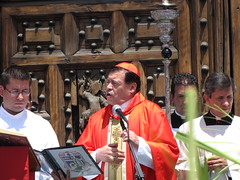
By David Agren Catholic News Service
MEXICO CITY (CNS) -- Mayor Marcelo Ebrard was witness to five same-sex marriages March 11 in Mexico City's old government building, the first such unions in the country and the first ones under new laws approved in the Mexican capital.
The Mexico City Archdiocese, meanwhile, expressed disappointment. Father Hugo Valdemar Romero, archdiocesan spokesman, said in a statement March 11, "It's clear that Mr. Marcelo Ebrard is responsible for the approval and execution of these laws that are destructive to the family and he doesn't conceal his aversion to the churches and the majority of people he governs, who profess the Christian faith and reject the perversion of their most cherished values."
The disagreement escalated tensions between the archdiocese and the local government. During the last three years Mexico City also decriminalized abortion during the first 12 weeks of pregnancy -- and paid for abortions performed in public hospitals -- and liberalized euthanasia laws.
It also marked a further departure from the good relations the archdiocese and local government shared prior to Ebrard taking office in 2006.
Previously, "Relations between the archdiocese and the Mexico City government had always been cordial," Father Jose de Jesus Aguilar Valdes, director of the radio and TV for the archdiocese, told Catholic News Service.
He emphasized that current relations with the national leadership of the left-wing Democratic Revolution Party -- which dominates politics in much of Mexico City -- are cordial. But with the Ebrard administration and local assembly, "there's been a distancing" and little direct contact, he said.
The distancing runs counter to the current thawing of relations between church and state in Mexico, where the institutions officially had been kept separate for 150 years.Relations between the two often have been strained.
Political observers say current church-state relations are marked by political parties and candidates courting church support even though Catholic leaders have said they don't take sides.
"Church support is not usually the deciding factor (in elections) ... but it helps," said Aldo Munoz Armenta, political science professor at the Autonomous University of the State of Mexico.
Munoz traced the origins of the discord to electoral politics. Specifically, he cited the tight 2006 presidential contest, which former Mayor Andres Manuel Lopez Obrador narrowly lost and considers to have been rigged.
During his 2000-2005 administration Lopez Obrador developed a cordial relationship with the archdiocese. His government even provided money for renovations to the Basilica of Our Lady of Guadalupe and the Metropolitan Cathedral.
Enoe Uranga Munoz, a Democratic Revolution Party member of Mexico's lower house of Congress, told CNS that Lopez Obrador thwarted attempts by the Mexico City Assembly to decriminalize abortion.
"He did it out of conviction, but also because he saw himself as a presidential candidate and had the need for an alliance with the church hierarchy," Uranga said.
For its part, the archdiocese disapproved of a 2005 attempt to impeach Lopez Obrador -- a move that would have disqualified the early frontrunner from the 2006 election. But false assumptions by Lopez Obrador that the church would back his presidential campaign caused relations to deteriorate, Father Aguilar said.
Lopez Obrador and his backers view the 2006 election as a "betrayal," said political historian Ilan Semo Groman of the Jesuit-run Iberoamerican University.
Semo added that the church traditionally seeks good relations with whichever party wins power and recognized President Felipe Calderon's narrow victory.
Lopez Obrador organized mass protests after the election and declared himself, "legitimate president" of Mexico. He refused to recognize the legitimacy of the Calderon administration and, like Ebrard, maintains that posture to this day.
Ebrard won office at the same time as Calderon and, almost immediately, began pursuing a socially liberal agenda. Political observers say he pursed that agenda out of a need to separate himself from Lopez Obrador and lay the groundwork for a possible presidential bid in 2012.
The pursuit of that bid could lead to a worsening of relations between the archdiocese and local government.
"They're using confrontation with the church as their primary weapon," said Uranga, who is openly gay and supports much of the Ebrard agenda -- if not his political tactics.
Some observers see political profit in antagonizing the church, however, mainly because Mexico City is more secular than other parts of the country, due to having an intellectual and political class with anti-clerical attitudes.
"The conflict between Marcelo (Ebrard) and the church is electoral," Munoz said.
"Your enemy is electorally important, and you'll use it as it suits you. Being anti-clerical, for Marcelo (Ebrard), for where he is, is something very convenient."
16 December 2009
PRD kingpin quits party

A PRD senator on the losing end of a power struggle in the Mexico City borough of Iztapalapa has quit the left-wing party.
Sen. René Arce - PRD power boss in Iztapalapa, one of the biggest local-level jurisdictions in Mexico and one of the party's most populous bastions of support - announced his departure Dec. 15 in a move that had been expected, but underscored the ongoing disunity and disarray in the Mexican left. In an open letter to PRD president Jesús Ortega, Arce expressed dismay with the refusal of the party's hardline factions to negotiate with political rivals - such as the PAN and PRI, parties that former presidential candidate Andrés Manuel López Obrador brands, "The mafia" - or advance structural reforms in areas such as taxation and the petroleum sector.
"Our country requires a left, that, without fear of the taboos of the old marxist left or of the anachronistic revolutionary nationalism, is willing to reach broad national agreements, including [agreements] with those in all sectors of society and with our political adversaries," Arce said.
The comments were pointed directly at López Obrador, who has admonished PRD members to avoid all dealings with the PAN and PRI and crusaded tirelessly - and unsuccessfully - last year against plans to allow greater private sector participation in the state-controlled petroleum sector.
Arce had crossed swords with López Obrador over the years, but the feuding between the two intensified after the latter narrowly lost the 2006 presidential election.
The senator had been a key organizer in a PRD faction known as the New Left, which is loyal to Ortega and narrowly prevented López Obrador's preferred candidate, Alejandro Encinas, from winning the 2008 internal election. (The electoral tribunal [Trife] overturned the annulled internal election and awarded the PRD presidency to Ortega.)
López Obrador, aided by ace Mexico City organizer René Bejarano and the PRD's IDN faction, took revenge on the New Left and Arce in the March 2009 primary election for PRD borough chief candidate in Iztapalapa, however. (Arce and his brother, Víctor Hugo Cirigo, were previously borough chiefs in Iztapalapa and Arce's ex-wife Silvia Oliva competed in the 2009 PRD primary.)
The former Mexico City mayor later ousted the Arce clan from Iztapalapa. He promoted the successful primary candidacy of Clara Brugada, although she was disqualified in June by the Trife due to irregularities at some of the polling stations in the primary election. The Trife decision set in motion the "Juanito" saga in which López Obrador co-opted the PT campaign of Rafael Acosta and had Acosta promise to step aside for Brugada if the PT won the election. Juanito won on July 5, held office briefly, but took leave so that Brugada could take his place. (Read about the Juanito saga here and here.)
López Obrador's Iztapalapa coup severely weakened the New Left. Ortega also appeared to be weakened as party president and unable or unwilling to intervene in Iztapalapa on Arce's behalf. According to some columnists, Ortega has stayed out of Iztapalapa in an attempt to make peace with the López Obrador factions so that he could launch a bid for the Mexico City mayor's office in 2012.
Arce is reportedly trying to form a new local party with former Chamber of Deputies speaker Ruth Zavaleta - who also resigned from the PRD - that would most likely align itself with the PRI.
Already, Adrián Rueda wrote in his La Razón newspaper column that Arce has a political association that could be converted into a political party. But even before any party is formed, Rueda reported Dec. 16 that Arce was creating headaches for the local PRD in the Mexico City Assembly, where three Arce loyalists also quit the PRD. Their departures deprive the PRD of a majority in the Assembly and thus means that the leadership in the Assembly will be rotated among the represented parties - the PRD had been in position to hold the Assembly leadership for the next three years.
28 November 2009
Former Chamber speaker resigns from PRD

Ruth Zavaleta, the former speaker of the Chamber of Deputies, who jumped into politics and activism after the 1985 earthquake destroyed her Mexico City home, resigned Friday from the left-wing party she helped to found 20 years ago.
In her resignation letter, Zavelta spoke of the Democratic Revolution Party (PRD) - which was reduced to third-place status in the Chamber after the July 5 midterm elections - as a lost cause. She also mentioned "intolerance" toward the factions that wanted the PRD to move beyond its self-imposed isolation in the legislature and its anti-establishment posturing. Zavaleta instead wanted the PRD to become part of the political establishment and broker deals with rival parties and the federal government - a federal government that loyalists of 2006 PRD presidential candidate Andrés Manuel López Obrador consider to be "illegitimate" and refuse to recognize.
"At this time and since the July 5 election, I don't share the way of doing politics in the PRD," Zavaleta said in her letter.
Zavaleta didn't mention López Obrador by name in her letter, but one long-time enemy of the self-declared "legitimate president," former PRD director of political formation, Fernando Belaunzarán, told the newspaper La Razón that she had tired of the "Stalinist intolerance against her," and, "she was attacked in a hypocritical way."
La Razón columnist Adrián Rueda, meanwhile, suggested on Friday that Zavaleta was disappointed that PRD president Jesús Ortega refused to endorse her aspirations for the 2011 gubernatorial race in her birth state of Guerrero - a move that "accelerated" her resignation.
The decision surprised many, but mostly due to the timing of Zavaleta's departure. The PRD holds a "refoundation" forum Dec. 3 - Dec. 6 that has been organized in response to the party's scandalous 2008 leadership race - that Ortega won by barely 16,000 votes and was settled by the federal electoral tribunal - and could result in disaffected factions and members heading for the exits.
Zavaleta expressed pessimism that the forum would produce results.
"I'm not willing to participate in the supposed discussion on the refounding of the PRD because I don't believe that discussion will be had," she said in her letter.
Her departure reflects the ongoing divisions in the PRD as the New Left, a faction loyal to Ortega that favors dialogue with other parties and the federal government, continues to clash with the factions loyal to López Obrador.
Zavaleta - a former New Left member - favored dialogue with the federal government and reflected that posture during her September 2007 - August 2008 tenure as Chamber speaker.
During her tenure, she said that she had a duty to act in an "institutional manner," which meant dealing with the executive branch of government and allowing debate on legislation that might offend the López Obrador faction - such as energy reform. She became the darling of the PAN and Institutional Revolution Party (PRI), however. Then PAN Chamber leader Hector Larios called her, "A star." But Zavaleta enraged parts of her own PRD, whose members so disliked her that on one occasion they failed to vigorously condemn death threats against her.
López Obrador, meanwhile, leveled misogynistic insults after she met with then interior minister Juan Camilo Mouriño - who López Obrador was trying to scalp for allegations that the Campeche native steered Pemex contracts to family businesses. Then-PRD spokesman Gerardo Noroña Fernández also uttered threats against her after she was seen exchanging pleasantries with First Lady Margarita Zavala at a forum on addictions. (Zavaleta responded to López Obrador by calling him, "A man looking for a fight.")
In some ways, though, Zavaleta was a media creation: She had long been a PRD militant and previously served as borough chief in Venustiano Carranaza, but she held a low political profile prior to her becoming speaker.
Her time as speaker was marked by turbulence; the Chamber approved sweeping reforms to the electoral and criminal justice systems, but was shutdown for 16 days by López Obrador loyalists to prevent the introduction of a bill that would reform the petroleum sector. (The bill was eventually passed in October 2008.) Zavaleta became even less popular among the PRD during the shutdown by presiding over sessions convened in an alternate location that allowed the PAN and PRI to approve legislation that weakened the PRD hammerlock on the Mexico City Assembly.
Her tenure ended with a gala departure, but her career since then has been somewhat quiet. Sources say that she had wanted to replace Javier "El Guero" González Garza as PRD leader in the Chamber, but the internal opposition was too strong. Her aspirations to run as PRD gubernatorial candidate in Guerrero also apparently floundered.
Even though Zavaleta has left the PRD, her fortunes, ironically, may be tied to what transpires in the PRD's refoundation forum next month. Rueda - whose daily column in La Razón is required reading for understanding local politics - wrote Friday that Sen. René Arce, the New Left political boss in Mexico City, has a "political association" registered in the capital that might be converted into a new local party before the 2012 elections.
"They will look to consolidate the new party by negotiating in 2012 with whoever has to gain and seek power in Mexico City," Rueda wrote. That might well be the PRI, which is gaining strength nationally, but is weak in the capital.
Zavaleta has said that she won't join another political party, although the PAN has already come calling with César Nava saying that the doors are open for "distinguished citizen" like her. (Zavaleta is reportedly friends with several senior Panístas, including Zavala and Social Development Secretary, Ernesto Cordero - the latter being a member of President Felipe Calderón's inner circle.) But with her media savvy and a cache of good will from former rivals for her work as speaker, her political future remains bright - and most likely lies with a non-left-wing party.
01 October 2009
Juanito: The rest of the story
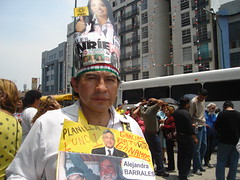
Ice cream-vend0r-turned-Iztapalapa-borough-chief-for-five-minutes Rafael Acosta - better known as "Juanito" - at the PRD 19th anniversary celebrations on May 5, 2008 in Mexico City's Col. Juárez.
Rafael Acosta, better known as "Juanito," took the oath of office as borough chief for Iztapalapa on Oct. 1. He then promptly asked for a leave of absence.
His departure ends one of the biggest political melodramas in recent memory - one that vaulted him into stardom as a sort of antihero: a headband-wearing, ice cream-vending, system-fighting, junior-high-school-educated, man-from-the-barrio, who gained widespread affection by defying the mandates of the country's so-called legitimate president and risking the wrath of a shadowy political machine that made it unsafe for him to hold public office.
Juanito showed that defiance one last time on Oct. 1, when he yelled during the swearing in ceremony, "Death to the PT for betrayal" - a jab at the left-wing party that he ran for in the July 5 election, and later pushed him aside as part of its job of doing the legitimate president's political bidding.
By taking leave, Juanito fulfilled a non-binding promise to cede control of perhaps the county's most populated local-level jurisdiction - and 3.5-billion-peso budget - to Clara Brugada, a former federal deputy and die-hard loyalist of former presidential candidate Andres Manuel López Obrador, the man who masquerades as the Mexico's, "legitimate president" and leads an alternative government.
Juanito's decision to step aside has been interpreted by many observers as an AMLO victory - one that will propel him toward another presidential candidacy in 2012, and weaken his internal rivals in the left-wing Democratic Revolution Party (PRD), whose political heartland had been Iztapalapa.
But it also highlighted the dark - and some might say, "Undemocratic" - side of AMLO, whose confederates resorted to threats of mob rule and violence and made promises to block Juanito's access to take his oath of office. Some lawmakers even devised legal tricks in the D.F. Assembly that would by hook or by crook oust Juanito from the borough office.
AMLO attack dog Valentina Batres of the PRD summed it up best by caustically warning Juanito, "It's best not to come."
(These are same people that decried the 2005 "desafuero" that would have denied AMLO a spot on the 2006 ballot, but four years later proposed pulling the same underhanded tricks on Juanito.)
Juanito basically acknowledged that fear factored into his decision to step aside. He told reporters after making his decision, "I was going to see deaths. I was going to see violence."
IMPORTANT BOROUGH
The vitriol and threats underscore the importance of Iztapalapa to Lopez Obrador - whose alternative government has been reportedly short of cash - and pretty much the entire PRD, the dominant party in the capital. Such drama probably never would had played out in another borough such as neighboring Iztacalco, for example.
Iztapalapa unfolds across the eastern part of the Federal District and long has attracted poor migrants from outlying states that come to the capital in search of better economic opportunities. It lacks many things: good water service, drainage and adequate housing, to name but three. The population now numbers roughly two million, 25 percent of all people in the Federal District.
It also had been the power base of the New Left, a PRD faction that departs from AMLO's admonishments to eschew all dealings with the federal government - a government AMLO calls "spurious" and refuses to recognize. The New Left won the disputed 2008 PRD election over AMLO's preferred candidate, Alejandro Encinas, in a race that was eventually settled by the electoral tribunal (Trife).
The New Left had governed Iztapalapa since the first borough election in 2000, when René Arce - now a PRD senator - won control. His brother, former DF Assembly speaker Victor Hugo Cirigo, would follow. For the 2009 election, Arce's wife, Sivila Oliva, was the New Left candidate for the PRD nomination. (Some voters interviewed after voting on July 5 cited "nepotism" and fatigue with the Arce clan for voting against the PRD.)
But D.F. ace organizer Rene Bejarano - the same guy caught on film accepting briefcase full of money from a developer earlier this decade - moved in and swayed it favor of Brugada, who captured the PRD nomination for borough chief. (Bejarano reputedly holds sway over PRD politics in most of the 15 other boroughs.) AMLO had seemingly bested his PRD rivials.
The New Left appealed the primary vote outcome to the Trife, which annulled results from some of the polling stations, giving the nomination to Oliva.
The ruling outraged AMLO, who - once again - branded the Trife a "political mafia" and began campaigning heavily in the borough. But he lacked a registered candidate. Even worse, the Trife ruling allowed no time for registering Brugada as a candidate for another party.
ENTER "JUANITO"
Rafael Acosta had a spot on the ballot as the PT candidate, however. Brugada supporters belittle Juanito as a "Nobody" when asked about him, but he was a familiar fixture at AMLO rallies. He would stand out with his trademark headband - complete with "Juanito" written on it in a felt pen - and placards with acerbic comments.
Juanito seemed like a die hard AMLO loyalist - one that would comply with any order from the "legitimate president." In a brief interview on May 5, 2008, he gave me business card that read: "Luchador Social" (social activist). In fact, he was a jack of all trades: waiter, vendor and B-movie actor, among other things.
He was also immensely political, according to Francisco Sánchez, a vendor selling freshly fried potato chips and bananas from the back of 1970 Chevy Malibu parked kitty-corner to Juanito's home-campaign office in the Pueblo Santa Marta Acatitla neighborhood. Juanito showed his political convictions and AMLO loyalty by resigning from the PRD after the disputed internal elections. He subsequently joined the PT and won its borough chief nomination for a race that is normally a lost cause in heavily PRD Iztapalapa.
PLUCKED FROM OBSCURITY
The Juanito campaign received little acclaim until AMLO plucked him from obscurity on June 16. In an act of quasi-legitimacy, he made Juanito swear an oath that he would resign in favor of Brudaga after winning office.
AMLO later toured each of Iztapalapa's colonias with Brugada - and often Juanito. Signs went up with AMLO and Brugadas photos that implied Brugada was the PT candidate, even though Juanito's name was on the ballot. The intense campaigning ironically forced AMLO to break his own word as he had promised to only promote PRD candidates in the Federal District. (He always intended to back PT candidates in other parts of the country, spare Tabasco, his home state.)
Juanito won on July 5, along with other candidates for Congress and the Mexico City Assembly that AMLO had been promoting.
SECOND THOUGHTS
Then, almost immediately after winning, Juanito had second thoughts. The borough chief job pays roughly 90,000 pesos per month, involves running the biggest borough in the Federal District - one with more people than municipalities such as Monterrey and Guadalajara - and offers loads of presitige.
As Juanito had second thoughts, his celebrity grew. His pronouncements generated immense media attention - much of it from outlets that AMLO disdains and accuses of bias - even if his style of speaking in the third-person and obvious lack of refinement and knowledge were embarrassing.
And, while AMLO had a dark cloud over his head - often railing against electoral fraud and the skulduggery of former president Carlos Salinas - Juanito, with his impish grin and trademark headband has a sunny disposition and simple manner that won hearts across the country, especially in the working classes and among AMLO's enemies.
Juanito even took jabs at AMLO - which generated even more media attention. He said that he was more popular than the former mayor and that he could have won Iztapalapa on his own. He also confessed to feeling used and disrespected by the Lopez Obrador.
A shopping trip to the Hugo Boss store in upscale Polanco made big news. Even trivialities were gobbled up, including an El Universal interview that revealed his immense liking of Rambo movies, obsession with the Cruz Azul soccer team and his fondness for eating "shrimp with lots of catsup."
Juanito's name even became part of the political vocabulary as media outlets branded the female federal deputies (mostly from the Green Party) that took leave in order to have male colleagues take their places - and mock gender equity rules - "Juanitas." (Juanita referring to someone elected that was never supposed to hold office.)
Some analysts began looking at the bigger of what Juanito represented. Diego Petersen Farah, editor of the Guadalajara newspaper Público called Juanito, "Our mirror," someone whose rise to prominence was essentially an attempt by AMLO to "make fun of the law" - a not infrequent thing in Mexico.
But as his celebrity grew, so did the threats. AMLO loyalists such as Assembly members Alejandro Sánchez Camacho and Aleida Alavez - who obsesses over the allegedly heavy hand of State of Mexico Gov. Enrique Peña Nieto - threatened to block access to the swearing in ceremony.
"Frentes," groups that supposedly agitate for housing, but mobilize votes in marginalized parts of Iztapalapa - read: much of the borough - began making not-so-subtle threats that Juanito better keep his word. Death threats were uttered and signs at a Brugada rally on Sept. 26 spoke of "killing" Juanito.
At a Sept. 26 rally near the Iztapalapa borough office, Brugada spoke of "non-violence" and "democracy," while members of the Frentes began screaming, "Juanito a la chingada." The murky Frente Popular Francisco Villa even began a protest camp and marched to the Zocalo. (The "Pancho Villas" have gained notoriety for its involvement in the pirate taxi business that reputedly funnels money into the local PRD and holding "political workshops" for its drivers that were instructed by the FARC.)
Juanito took refuge in a hotel shortly after winning the July 5 election. He even announced plans to live in the borough office and asked the Federal District government for additional security.
As a combatant, he seemed to give as good as he took - especially in dealing with pronouncements from a scorned López Obrador, whose hyperbole included words to the effect of: There's not enough water in the sea to wash away fraud stains.
Juanito would refer to Brugada as "spurious," the same word AMLO disparages President Felipe Calderón with. He would later say, "The people give orders," vintage AMLO language used to justify controversial acts and protests that have shut down parts of Mexico City.
Up until Sept. 27, when he was photographed at a bodybuilding competition," Juanito gave no hint of his stepping aside. He even had sat down with local National Action Party (PAN) president Mariana Gómez del Campo by that point and appeared ready to make deals with the New Left - the faction AMLO wanted out of Iztapalapa.
INTERVENTION
With Juanito set to take office, Mayor Marcelo Ebrard intervened. Details are uncertain, but after a Sept. 28 meeting with the mayor, Juanito said that he would step aside for Brugada due for health reasons. He apparently suffers from heart problems.
Adrián Rueda, local politics columnist with La Razón, said that Juanito would receive cash and the right to fill two borough secretary positions and name three local territory bosses.
Juanito supporters reacted with disgust and disappointment in comments on a Facebook page for the borough chief-elect. Vendor Francisco Sánchez said many in Pueblo Santa Marta felt the same way.
"People here feel really let down," he said.
Brugada supporters responded with an Oct. 1 rally at the borough office. Juanito was nowhere to be found. La Razón reported that he would be off to Europe and that Juanito might never again live in Iztapalapa.
Most commentators opined that AMLO emerged victorious in the whole affair, while others said that Ebrard showed deft political skill - not to mention strength.
UNCERTAIN FUTURE
Brugada inherits a borough rife with problems - and the droughts expected to hit Mexico City next spring are expected to hit Iztapalapa the hardest. Some residents expressed little confidence in either Juanito or Brugada to fix things. They include cab driver Jesús Barrera, who figured both were more interested in appropriating the budget than actually serving the people.
"No government has done anything for Iztapalapa," he said, while driving down a rutted road.
"This road (we're driving on) is proof."
29 April 2009
Empty seats, shutdown don't trip up drug bill

BY DAVID AGREN
The News
The Senate met behind closed doors on Tuesday to approve a bill that would permit the possession of small quantities of drugs for personal use but would not force rehabilitation for offending drug users, a key element of the proposal originally presented to the Senate by President Felipe Calderón.
Proponents said the bill would help crack down on small-time drug dealers but avoid treating drug users as criminals. "Fighting organized crime at its lowest level . where drugs are sold retail ... is one thing," said Democratic Revolution Party Senate leader Carlos Navarrete. "Young people, our young people or people of any age in this country, that regrettably have fallen into drug addiction, are another thing."
The "Ley Narcomenudeo," as the bill is known, is similar to a past failed attempt to decriminalize drug possession and its Senate approval comes amid a bloody crackdown on drug cartels. Its passage also comes amid a nationwide debate over the merits of drug legalization.
The new bill would allow possession of up to 5 grams of marijuana, 5 grams of opium, 50 milligrams of heroin, 40 milligrams of methamphetamine and 500 milligrams of cocaine. It would also make police forces at all levels responsible for combating drug dealing and impose sanctions of five to 15 years in prison for those found in possession of drugs with the intention of selling.
The original proposal sent to the Senate by Calderón called for mandatory participation in rehabilitation programs for those found to be in possession of small amounts of drugs. But the PRD on Tuesday claimed credit for successfully lobbying against that proposal. Under the new bill, rehabilitation would be voluntary, except for those caught in possession of drugs at least three times. The bill now heads to the Chamber of Deputies for a vote.
26 April 2009
At church conference, parties find religion
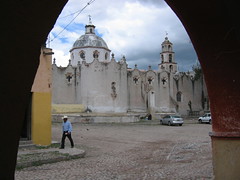
At church conference, parties find religion
The News
CUAUTITLÁN IZCALLI, State of Mexico - National Action Party president Germán Martínez reminisced about a religious upbringing in Quiroga, Michoacán, while addressing an auditorium of Catholic prelates on Wednesday in this municipality on the northwestern fringes of the Mexico City metropolitan area.
Beatriz Paredes of the Institutional Revolutionary Party followed, speaking similarly about her childhood in the state of Tlaxcala, and of fond memories of the annual patron saint festival in the municipality of Huamantla that fetes La Virgen de la Caridad with predawn pilgrimages and streets carpeted with flowers. Democratic Revolution Party president Jesús Ortega, however, skipped the religious pleasantries and nostalgia and cut straight to politics.
The appearance by the trio of senior political leaders at the annual planning session of the Mexican Bishops' Conference - during which they outlined their platforms and fielded questions on the thorny issues of abortion and religious freedom - was not with without precedent; party officials from the PAN, PRI and PRD had met with senior Catholic prelates prior to the 2006 elections.
But the latest encounter - which also included the presidents of three smaller parties - came as the church has been criticized for wading into the public policy debate with pronouncements, running sharp editorials in church-run publications and lobbying political officials.
Some of the church's hierarchy have even urged Catholics to vote against parties that back policies such as liberalized abortion laws and civil union benefits to same-sex partners.
The encounter - and the recent criticism of the church's so-called meddling - come in spite of strict laws in Mexico that forbid preaching politics from the pulpit, a measure that some church officials want scrapped and say violates their freedom of religion.
"There's a church leadership that is convinced that the church should openly intervene in politics," said Ilán Semo, a political historian at the Universidad Iberoamericana. "[They] have a mentality from the 19th century."
In the mid-19th century, the Reform Laws of Benito Juárez removed the church from the political arena. The Constitution of 1917 reinforced the separation of church and state, along with measures such as prohibitions on the church owning property and priests not being able to wear clerical robes in public.
But reforms approved in 1992 softened many of the anti-clerical restrictions. The softening of the restrictions and the advent of the Catholic-friendly PAN, said Semo, emboldened church officials to opine on public policy and advance a political agenda.
That agenda includes discarding a ban on religious organizations owning radio and television stations and the implementation of religious education in public schools - which are constitutionally mandated to provide schooling that is both secular and free of cost.
The church also wants "freedom of religion" enshrined in the Constitution, which currently only guarantees "Freedom of worship."
Church officials deny allegations that they are attempting to steer parishioners toward preferred candidates or have prelates run for political office, the latter being a violation of cannon law.
They also deny any attempt at blurring the separation of church and state.
"The Catholic Church does not want a confessional state," Archbishop Carlos Aguiar of Tlalnepantla, president of the bishops' conference, said after the meeting with the party presidents on Wednesday.
"The church," he said, "will not be for or against any political party . [and] will promote the importance of the electoral process."
PARTISAN TIES?
The PAN's Martínez on Wednesday enthusiastically backed church participation in promoting democratic values and "fighting absenteeism"
"We're a party that for 70 years has said that there should be freedom, not only of worship, not only of the profession of faith, but rather . a broad and full religious liberty," he told reporters.
Martínez's party has long been accused of being too cozy with the church hierarchy. But church observers say that other parties and political leaders also pursue close church relations.
In Jalisco, for example, the PRI threw its support behind a constitutional ban on abortion after a meeting earlier this year between Cardinal Juan Sandoval of Guadalajara and state party president Javier Guízar.
"Cardinal Sandoval himself often says that PRIístas are the ones that visit him the most," said Víctor Ramos Cortés, a religious studies professor at the University of Guadalajara.
HOT BUTTON
Unsurprisingly, the abortion issue surfaced at the bishops' conference meeting this week.
Only the PAN's Martínez declared his party, "Pro-life;" his PRI and PRD counterparts said that they personally favored the decriminalization of abortion - especially in certain circumstances - but added that blanket positions on the issue would fail to work in their parties due to diverse views on the subject and differing regional sensibilities.
Social Democratic Party, or PSD, president Jorge Díaz Cuervo, whose party is running on a platform that includes the decriminalizing abortion in the states, was less diplomatic.
Díaz Cuervo demanded that the church stay on the sidelines and butt out of people's personal lives. (The PSD platform also calls for legalizing drugs and providing expanded rights for gays and other minority groups.) He cited scripture to make his point.
"As a Catholic, It suits me to pay unto Caesar that which is Caesar's and unto God that which is God's," he said. "As a Mexican, I back the Constitution of 1917 that separates church and state."
His comments were received with a polite, tepid response from the audience. Cardinal Sandoval, for one, did not applaud.
PUBLIC STATEMENT
It remains to been seen what the consequences of the church's interventions into politics will be.
The Interior Secretariat has dismissed several recent complaints over church actions, including one from the PSD regarding a list of "electoral sins" issued by the bishop of Cuernavaca that urged the faithful to vote against any party promoting abortion and gay marriage.
But while government enthusiasm for enforcing laws against church interventions into politics has been minimal, the public has been more enthusiastic in denouncing the blurring of church and state lines.
In Jalisco, a state government donation last year for the construction of a Catholic temple generated such public outrage that the money was returned.
Religious observers say that even though most of the Mexican population is Catholic - and the church ranks as one of the country's most trustworthy institutions - the public draws a line at a certain point when it comes to power.
"People are Catholic ... [but] they don't want priests running the country," Ramos Cortés said.
04 February 2009
Parties make big promises as Congress gets under way

BY DAVID AGREN
The News
Congress on Wednesday returns for its final session before the July 5 midterm elections, when the entire 500-member Chamber of Deputies is scheduled to be renewed.
In the upcoming session, the National Action Party, or PAN, has promsed to focus on public security, the economy and credit card interest rates. The Institutional Revolutionary Party, or PRI, says it will fight for the "family economy" by freezing prices and introducing tax deductions. And the Democratic Revolution Party, or PRD, says it will propose an "emergency" law that would allow the federal government to spend money more easily, as well as push austerity measures like slashing lawmakers' salaries.
But the final session before the midterm elections seldom produces much in terms of meaningful legislation, analysts say. Deputies in the lower house - none of whom can seek re-election - often take leave to seek other elected posts.
This year is unlikely to be much different, analysts say, as most of the legislative agendas currently outlined by the eight registered parties focus on retail politics -and in some cases, veer toward populism. In some cases, parties are championing issues with little prospect of being approved. (The Green Party, for instance, is on a crusade to reintroduce the death penalty.)
"I expect to see a lot of grandstanding," ITAM political science professor Federico Estévez said.
But Estévez did admit that the economic crisis might spur cooperation that usually doesn't exist in the lead up to federal elections.
THE PAN MISSION
The PAN's congressional leaders have emphasized the importance of continuing with economic and security measures left unfinished during the last session.
The PAN's coordinator in the Chamber of Deputies, Héctor Larios, said his lawmakers will push for overhauls to laws regarding acquisitions, public works and expropriations. The overhauls, he said, will allow the government to more quickly build roads, prisons, schools and hospitals called for in the infrastructure programs presented by President Felipe Calderón as a means of pulling the country out of crisis.
"If we don't [spend] rapidly . then government action is going to be much less effective," Larios said while in Chiapas this week.
Other PAN goals include passing reforms to the Attorney General's Office, or PGR, creating a new federal police corps, and passing a law that targets the finances of organized crime.
PAN Senate leader Gustavo Madero emphasized that his party would also target banking practices considered to be predatory, particularly those concerning credit cards.
PRI POPULISM
The PRI pitched various populist proposals on Tuesday, including the sanctioning of those who hang "narcomantas," or banners with threatening, drug-crime related messages. The party also stole a page from the books of several state legislatures, urging that those who sing "narcocorridos," or drug ballads, be punished. Other PRI proposals for improving public safety include a new federal kidnapping law, although a constitutional provision still must be approved by 16 state legislatures before Congress can begin work on that issue.
PRI lawmakers also said Tuesday that they would push for a reduction in the price of diesel and electricity, make payments for medicine tax deductible, and encourage the federal government to present a labor reform package.
The PRI lawmakers offered few details, but said that after achieving the approval of an energy reform package last year, labor reform would be passable before the session ends.
LAST BUT NOT LEAST
PRD lawmakers have backed the idea of tackling labor reform. But they want it to target opacity in organizations like the heavily PRI oil workers' union and the SNTE teachers union, which has worked closely with Calderón.
"If [reforms address] the democratization of union organizations, transparency, and the electoral process inside these organizations, we'll certainly go for it," PRD Sen. Tómas Torres said.
The PRD will also present an alternative economic crisis plan.
13 December 2008
What's Next for Andrés Manuel López Obrador?
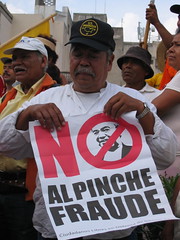
The second anniversary of President Felipe Calderon taking power passed earlier this month - along with the second anniversary of the "gobierno legitimo" being founded by election runner up and the self-proclaimed "presidente legitimo" Andres Manuel Lopez Obrador.
World Politics Review ran a pair of good analysis pieces:
Mexico's Calderón Faces More Obstacles Ahead (By Patrick Corcoran) and What's Next for Andrés Manuel López Obrador? (By David Agren.)
19 November 2008
Encinas sticking with split PRD
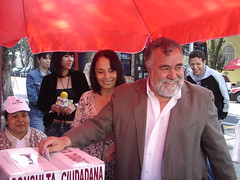
BY DAVID AGREN
The News
Democratic Revolution Party leadership runner-up Alejandro Encinas ended speculation over his political future Tuesday, announcing his intentions to stay in the PRD.
He will continue leading a coalition of factions in the nation's largest left-wing party, he said, declining to take the No. 2 position in the party's National Executive Council.
The former Mexico City mayor, who was last week confirmed the loser of the PRD's March 16 presidency contest by a federal tribunal, had floated the possibility that he might split from the PRD after his rival and leader of the moderate PRD faction known as the New Left, Jesús Ortega, was declared the winner.
But on Tuesday, he expressed solidarity with his party, if not Ortega's part of it.
"We're not leaving the PRD; this is our party, the party that we founded . It's the result of decades of work," he told supporters in Mexico City.
Encinas also announced plans for a new social movement - not unlike the petroleum defense movement launched by his political patron, Andrés Manuel López Obrador - that he would fight to rid the PRD of problems that he said included patronage and increasing bureaucratization.
"We won't leave the party to those who have been entrenched in its bureaucracy. Far from staying in the trenches, we're going to fight from inside [the party]."
The fight could prove difficult. Ortega already controls much of the party infrastructure, and can now exert increased influence over the candidate nomination process for the 2009 midterms.
The Ortega strategy, which calls for the party to cooperate with political rivals and negotiate with the federal government, is also expected to become more common with his ascent to the PRD presidency.
Ortega takes office on Nov. 30, more than eight months after PRD members went to the polls in an election that was originally annulled due to widespread irregularities. Encinas' United Left, whose members allege that the 2006 presidential election was rigged, said that the same chicanery was rife in the PRD election. Encinas unsuccessfully petitioned for the results from disputed polling stations in Ortega strongholds to be eliminated from the final vote count.
The electoral tribunal known as the Trife sided with Ortega, however. Encinas rebuked the Trife on Tuesday for intervening in an internal party matter and once again making "a political decision" against his factions. He said that accepting the No. 2 PRD position would have validated the Trife ruling.
"I can't sweep this garbage under the rug and I don't want to be an accomplice to those that commit abuses and irregularities," he said. "[The ruling] is a coup against our party by an authoritarian and intolerant state."
Encinas' decision to stick with the PRD was not entirely unexpected, as it is too late to form a new political party for 2009, and leaving would mean giving up annual public financing of more than 400 million pesos.
13 November 2008
Moderate named winner of left-wing party's elections
By DAVID AGREN
The News
The Federal Electoral Tribunal, or Trife, settled the Democratic Revolution Party´s internal leadership election on Wednesday, nearly eight months since party members cast their ballots for a president.
The decision gave three-time leadership candidate Jesús Ortega the PRD presidency, dealing a stiff blow to former presidential candidate Andrés Manuel López Obrador, who backed a rival candidate and now finds himself at odds over strategy with the new party hierarchy and lacking influence over the candidate nomination process.
Ortega, the leader of a moderate PRD faction known as the New Left, led the original vote count over rival Alejandro Encinas by some 16,000 votes, but the outcome was annulled after the committee charged with overseeing the election found irregularities in more than 20 percent of the polling station tallies. The election and leadership campaign were rife with allegations of improper campaigning, vote tampering and ballot boxes being stolen.
The Trife said in its ruling that enough of the polling stations had been installed to adequately stage the election. It also adjusted the final vote count, giving Ortega an even bigger advantage.
Encinas, who had been endorsed by López Obrador, rebuked the ruling on Wednesday, calling it "a clear intrusion by the state into the internal life of our party."
He said that the Trife ignored irregularities - votes from polling stations that were never opened were included in the final vote count, for instance - and called on Ortega to "not accept" the decision and to instead reach an agreement for governing the party.
Ortega wasted little time Wednesday in announcing that he would seek unity in his divided party, and also pursue dialogue with the federal government - a clear departure from the López Obrador strategy of eschewing all contact with and acknowledgement of the administration of President Felipe Calderón.
The New Left favors working cooperatively with other political factions, in contrast to the United Left, a coalition of factions loyal to López Obrador and Encinas.
PRD politicians loyal to Ortega also broke ranks with López Obrador over the energy reform issue last month, negotiating a deal with the politicians from other parties.
Encinas supporters on Wednesday also expressed their disgust with the Trife, a federal judicial body that referees internal party squabbles and electoral disputes - and which ruled against López Obrador´s claims of fraud in the 2006 presidential election.
10 November 2008
PRI dominates in Hidalgo
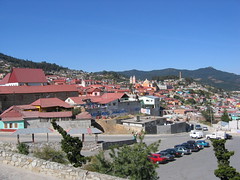
BY DAVID AGREN
The News
Early returns from the central state of Hidalgo showed voters solidly backing the Institutional Revolutionary Party in Sunday´s municipal elections.
The PRI and its election allies were leading in 50 of the 84 races; seven municipalities had yet to report returns. Notable results included the PRI leading in the capital, Pachuca, and the Democratic Revolution Party, or PRD, leading in Zimapán, where the leader of a civic group opposed to the construction of a toxic waste dump was running for the left-wing party.
Sunday´s results appeared certain to further cement the PRI´s hold on Hidalgo where it held 35 municipal governments on election day. The party swept all 18 directly elected seats in the state Congress during legislative elections earlier this year and holds the governor´s office.
Chicanery was also rife during the election period. The state Attorney General´s Office reported receiving at least 50 complaints of election-related incidents, including murder, improper police detentions and the enticing of voters with free rides and giveaways.
PAN officials in Pachuca alleged that four out-of-state election observers were detained and roughed up by local police. A Saturday confrontation between the PRI and PRD campaigns in the municipality of La Mi-sión resulted in a police commander being shot dead. Two PRI operatives - brothers of the local PRI candidate - were named as suspects in the shooting by state judicial authorities. Gunfire was also reported in the municipality of Huejutla.
Hidalgo, a small rugged state north of the Mexico City metropolitan area just beyond the State of Mexico, usually opts for the PRI, although it supported the PRD campaign of former Mexico City Mayor Andrés Manuel López Obrador in the 2006 election and opposition parties had won a few municipal races over the past decade.
Analysts predicted the PRI would benefit in Sunday´s local elections based on its party unity and its well-oiled patronage machine while its opponents were suffering from disunity and disorganization.
05 October 2008
Guerrero´s Sunday votes a litmus test for governor

Guerrero´s Sunday votes a litmus test for governor
BY DAVID AGREN
The News
Residents of the southern state of Guerrero head to the polls on Sunday in legislative and municipal elections. But rather than being just your run-of-the-mill local political process, the elections are shaping up as a referendum on Gov. Zeferino Torreblanca´s administration <00AD>- and even one on his Democratic Revolution Party, or PRD, itself.
Torreblanca rode to power in 2005 on a wave of discontent that also swept the Institutional Revolutionary Party, or PRI, out of office after 75 years of oppressive rule in the impoverished state.
The Acapulco retailing magnate ran for PRD on an agenda of change in what is one of the republic´s most marginalized, underdeveloped and conflictive states - a place where 40 percent of the homes have dirt floors, 42 percent of the population is illiterate and the murder rate is double that of the national average, according to federal government statistics.
"The election of Zeferino Torreblanca was historic," said human rights lawyer Mario Patrón, who worked in the La Montaña region of Guerrero until recently.
"After more than 75 years of PRI rule, the civil society took to the streets and voted. There were high expectations," Patrón said.
Guererro residents overwhelming opted for turfing the long-ruling incumbent party - not unlike what had occurred on the federal level five years earlier - in a result that one national broadsheet welcomed as, "Moving toward the end of the outlaw Mexico."
But local observers say that the initial euphoria diminished quickly, as few of the expectations that people had - corruption being reduced, education and social programs being fixed, and oppressive governance being stamped out, for instance - began to materialize.
"They´ve just reproduced the same old practices and the same governing policies," Patrón said. "What we have is power being alternated. There´s been a change of colors, but there has not been a transition."
Ironically - but perhaps unsurprisingly, given the left-wing PRD´s divisions stemming from internal elections both nationally and in Guerrero earlier this year - many of the ballots that could be cast against the PRD are expected to come from disaffected party members, who differ with the governor on policy and party politics.
Some in the PRD predict a humbling at the polls for their party, which is expected to lose seats in the state legislature and could lose numerous municipal races - perhaps most embarrassingly in Acapulco, the state´s largest municipality.
"There´s no possibility of the PRD keeping its majority in the legislature," Alvaro Leyva Reyes, a former campaign coordinator for Torreblanca, told the newspaper El Universal.
TOUGH COMPETITION
Making things even tougher, the PRD is now battling a rejuvenated PRI that has been winning local-level elections nationwide over the past two years, and has shown unity in Guerrero after previously being torn apart by infighting there.
Torreblanca, meanwhile, has drawn the ire of some factions of his party for not adequately financially supporting Andrés Manuel López Obrador´s alternative government, as well as working cooperatively with the PAN administration of President Felipe Calderón.
Torreblanca also has butted heads with the PRD mayor of Acapulco, Félix Salgado Macedonio, according to José Luis Rosales, director of the Rural Development Institute at the Universidad Autónoma de Guerrero.
Salgado has accused Torreblanca of sending that municipality inadequate resources for social programs and urban development projects and described the governor as "PANísta to the core," according to Rosales.
With the PRD stumbling, political observers predict a strong showing from the PRI, which sent its big guns to campaign in Guerrero.
Party president Beatriz Paredes and State of Mexico Gov. Enrique Peña Nieto both made appearances. In Acapulco last Sunday, Paredes described the PRI as united and agents of change.
Patrón, the human rights lawyer, expressed skepticism over the PRI´s pledges to carry out change, but acknowledged that the party was on the rebound in his state.
"The PRI is in the process of reconstruction, and it´s most likely that it will win various municipal governments [in Guerrero]," he said. "It´s starting to regain ground, but this isn´t a result of PRI policies. It´s a consequence of the image of poor governance by the PRD."
07 September 2008
Guadalajara rector spat highlights power struggle

Photo by Steven H. Miller
Guadalajara rector spat highlights power struggle
BY DAVID AGREN
The News
The University of Guadalajara ousted its rector Aug. 29 over vague allegations of mismanagement, sparking calls for campus demonstrations, a string of appeals and accusations of power-brokering at the nation's second-largest public university.
On Aug. 29, Rector Carlos Briseño was ousted by the university's governing council, a body packed with loyalists of Raúl Padilla, a controversial former student leader and rector who is considered by many to be the most influential figure in the university over the past 25 years.
Within hours, Marco Antonio Cortés, a Padilla ally, began occupying Briseño's office in the school's white marble rectory building.
Briseño, too, had once been a friend of Padilla, but after he began cozying up to the local governing National Action Party, or PAN, and the leading opposition Institutional Revolutionary Party, or PRI, both of whom had long been at odds with Padilla, he quickly fell out of favor.
"Carlos Briseño arrived [in the rector's] office by the decree of Raúl Padilla, but the strongman made a mistake," said El Universal columnist Jorge Zepeda, a former editor of the Guadalajara newspaper Siglo 21.
But Briseño wouldn't roll over and play dead, despite decisions by Jalisco Gov. Emilio González and the Public Education Secretariat not to intervene in the case. Instead, he immediately denounced his firing as illegal and began pleading his case to the citizens of the western state.
He convinced a local court to grant an injunction against the firing, but it was overturned Sept. 4 by a federal judge.
Meanwhile, back on campus, 1,500 sympathetic students and teachers in his support on Sept. 5, some of them chanting: "Out with the Padilla crowd!"
OLD-STYLE LEADERSHIP
Briseño assumed the post of rector in early 2007, and it did not take long before he was losing favor with his former mentor.
In late August, Briseño began suggesting reforms at the Centro Cultural Universitario, which oversees a group of successful businesses and projects including hotels, language schools, a burgeoning film festival and the prestigious International Book Fair - the second-largest event of its kind in the world.
Many of the projects had been founded by Padilla, and he had remained as the head of the center after stepping down from the rectory in 1995 at the end of a six-year term.
When asked in an Aug. 28 radio interview why the center and Padilla's leadership of it were being scrutinized, Briseño responded: "Absolute power corrupts.
"I don't have any proof, but we're investigating . we're going to audit each one of the university's businesses," he said.
The General University Council sacked Briseño a day later, citing budgetary mismanagement and insubordination.
For some observers, the firing showed how the university, despite its reputation as an institution on the vanguard of higher education, at the same time remains wedded to an old-style authoritarian leadership.
"At this university, both the past and present are very much alive," said Sergio Aguayo, a professor at the Colegio de México and a Jalisco native.
"There are parts that are excellent, but very large parts are extraordinarily backward in their political culture."
`A BENIGN STRONGMAN'
Zepeda, a University of Guadalajara graduate, called Padilla, "a benign strongman," whose use of power has been both "favorable and unfavorable."
Under Padilla's guidance, both as rector and behind-the-scenes playmaker, the school undertook modernization initiatives that included decentralizing power to regional centers beyond Guadalajara, and organizing successful cultural events.
"In many ways, it's been more at the [cultural forefront] of any other university of the country, including UNAM," Zapeda said.
But the U. de G. - as the school is known locally - has also been viewed suspiciously due to a lack of transparency in its finances. And the school's not-so-secret affiliation with the local Democratic Revolution Party, or PRD, which is headed by Padilla, also raised local hackles.
Briseño brought differing political allegiances to the Padilla inner circle. He was openly friendly to the PRI and numerous PRI functionaries, including Gov. Mario Marín of Puebla, Nayarit Gov. Ney González and party president Beatriz Paredes, attended his annual state of the university address in April 2008.
Local newspapers called the annual state of the university address "A coming-out party" for Jalisco's most prominent PRIísta.
Then, when he began forging better relations with the local PAN administration, which had previously denounced the U. de G. for a lack of transparency, he really fell out of favor.
"He had a series of political commitments, with political forces, that were inconvenient for the university . [including] the old national PRI," Zepeda said. "Briseño suddenly represented the possibility of breaking [the U. de G.] open, but for the worst reasons.
"Everyone views it as a jackpot."
29 July 2008
Citizens consulted on oil
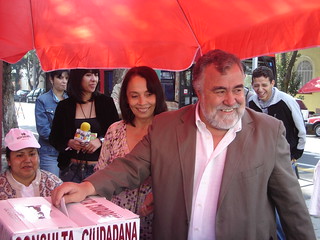
Former Mexico City mayor Alejandro Encinas casts a ballot in a non-binding referendum on energy reform promoted by opponents of the plan.
By DAVID AGREN
The News
Residents in the capital and nine states weighed in Sunday on the future of the country's petroleum sector by casting votes in a non-binding referendum sponsored by a coalition of left-wing political parties.
A Consulta Mitofsky exit poll showed more than 80 percent of respondents voting "No" on the two questions, which asked if private companies should participate in the oil industry and if the lawmakers should approve the energy reform legislation submitted in early April by President Felipe Calderón.
Mexico City Mayor Marcelo Ebrard of the Democratic Revolution Party, or PRD, unveiled the referendum two months ago as a means of derailing Calderón's plan to expand private sector involvement in the country's petroleum sector and grant the state-run oil concern Pemex more autonomy.
The consultation, or "consulta," initially captured significant media and public attention, but the buzz diminished as the capital government began dealing with public dissatisfaction over the handling of a botched nightclub raid and the PRD was forced to annul its internal election due to widespread vote tampering and allegations of dirty tricks.
Still, organizers anticipated that up to five million people nationwide would participate in the consultations, which are scheduled to be carried out in three stages through Aug. 24.
Voters began trickling into the nearly 4,400 polling stations around the capital at 8 a.m. Brigades of promoters petitioned passersby to participate, but turnout appeared light.
"It's just like the presidential election - the whole thing has already been decided," said parking attendant Roberto Pascual, who abstained from voting.
Polling stations outside of Mexico City reported even lower turnouts.
"People are really apathetic," said Guillermo Aguilar, a government employee manning a Coyoacán polling station.
"The whole thing has been discredited by the press," he added.
Some press reports said that employees in the local government were pressured into working the consultation, but Aguilar said that he willingly volunteered and only received a T-shirt, ball cap and box lunch in exchange for his services.
Consultation participants were required to show a valid voter identification, but ballots were marked with a black crayon in plain sight of the polling station workers.
City social worker Fernando Najera voted "No" on both questions, saying the Calderón plan was "privatization ... but they just gave it a different name."
21 July 2008
Annulment solves little for PRD
Annulment solves little for PRD
BY DAVID AGREN
The News
The two frontrunners in the Democratic Revolution Party´s internal election on Sunday blasted an internal decision to annul the party´s March 16 leadership vote, setting the stage for more factional infighting at the nation´s largest leftist party.
Candidate Jesús Ortega, the front man of a pragmatic faction known as the New Left, said that the party known as the PRD "is shooting itself in the foot" by annulling the election that he had led by 16,000 votes over rival Alejandro Encinas.
"With this, it´s only causing damage to the PRD and bringing about further discredit in the eyes of the media and the public," he added.
Ortega said that he would petition the federal electoral tribunal, or Trife, to overturn the annulment.
The PRD´s three-member Guarantees Committee voted late Saturday to void the internal election due to allegations of irregularities at more than 20 percent of the polling stations, among other problems.
If the Trife upholds the annulment, party bylaws say the PRD´s National Committee must meet within 30 days to set a new election date.
Encinas, who was projected as the early winner by a quick-count program and two exit polls, said the annulled election was a "triumph of cheats and scoundrels."
"They´ve stripped us of a real and legal [victory]," he said, adding that he would no longer negotiate for a compromise.
Encinas, who belongs to the party´s hard-line United Left faction, demanded another election be held within 45 days.
The annulment leaves the PRD without a permanent party president and under pressure to resolve its infighting before fielding candidates in the 2009 midterm elections.
Guadalupe Acosta will continue as interim president, but the Encinas camp refuses to recognize his leadership.
Ortega´s and Encinas´ factions are divided over whether or not they should work cooperatively with the federal government or continue in their role as an anti-establishment player in the nation´s political scene.
Allegations of vote tampering, ballot box thefts and outside interference from non-PRD state governors were rife throughout the campaign and election. Prior to the vote, former presidential candidate Andrés Manuel López Obrador drew criticism for backing Encinas and signing campaign materials deemed inappropriate by the party - a violation cited Saturday by the Guarantees Committee in its annulment decision.
The rival campaigns met last week to seek a resolution to the impasse, but talks stalled when Encinas insisted on Acosta´s ouster, El Universal reported.
The annulment did not surprise political observers.
"It was very predictable . given the irregularities and outside interference," said Aldo Muñoz, political science professor at the Universidad Iberoamericana.
Some in the PRD had been calling for an annulment prior to the Guarantees Committee´s announcement.
"It´s already been too long ... we´re no longer in a position to move forward," PRD Dep. Aleida Alavez, an Encinas supporter, told The News in a recent interview.
"No one gives an inch, no one owns up to his mistakes or errors in the internal elections," she added. "What would help most would be an annulment and later having a serious, responsible discussion in the party´s National Congress."
A National Congress is a provisional forum for PRD members to vote on leaders and statutes, she said.
18 June 2008
IFE: AMLO not "legitimate president"

David Agren
The News
The Federal Electoral Institute on Tuesday scolded the Democratic Revolution Party, or PRD, and Labor Party for referring to 2006 election runner-up Andrés Manuel López Obrador as the “legitimate president” during television commercials.
The Executive Secretary of IFE, as the election regulator is known, said using the “legitimate president” phrase was unconstitutional as the country already has an elected president, who is carrying out constitutional duties.
It added that federal electoral tribunal, or Trife, validated President Felipe Calderón’s victory. The Executive Secretary has proposed slapping the two left-wing parties with fines totaling 912,030 pesos. The full IFE board decides Wednesday if it will order the PRD and Labor Party to stop using the phrase and impose the fines.
López Obrador represented a coalition including the PRD and Labor Party in the last federal election, which he narrowly lost to President Felipe Calderón. The former candidate rejected the outcome, which he alleged was rigged, and declared himself the “legitimate president” on Nov. 20, 2006.
He also has a history of disparaging the IFE and Trife – he commented, “To hell with your institutions,” in September 2006 after the latter rejected his allegations of electoral fraud. The IFE board overseeing the 2006 election lacked PRD representation. The left-wing party walked out of 2003 negotiations for electing the board after its two main candidates were rejected.
The electoral reforms passed last fall give IFE broad powers to strike down political ads deemed negative or inappropriate.
06 May 2008
On leftist party's birthday, two factions, visions, cakes
Rafael "Juanito" Acosta shows support for the pro-AMLO factions of the PRD.
On leftist party's birthday, two factions, visions, cakes
David Agren
The News
The two candidates contesting the still-undecided Democratic Revolution Party internal vote, Alejandro Encinas and Jesús Ortega, marked the PRD's 19th anniversary by speaking of unity – an elusive objective during the party's oft-contentious leadership campaign and post-election fallout.
"We have problems, but that's not going to overshadow the anniversary of the PRD," Ortega told The News while celebrating at the Revolution Monument.
But the pair made their pronouncements at separate birthday bashes mere blocks from each other in central Mexico City, where card-carrying PRD members – and others simply accepting free junkets to the national capital – spoke ill of their opponents and even disparaged the rival celebrations.
"All of the traitors are over there," said Encinas supporter Rafael Acosta, pointing toward Ortega's celebrations.
Acosta, a self-described "social fighter," objected to the willingness of the Ortega wing of the PRD – known as "Los Chuchos" – to broker deals with the federal government, which many in the party consider illegitimate due to allegations of fraud in the 2006 presidential election.
"They're a bunch of sellouts … and trying to steal the [PRD] election," he added.
Differences over strategy threaten to split the PRD less than two decades after Cuauhtémoc Cárdenas founded the party, which has long been beset by infighting among its disparate currents.
And neither Encinas nor Ortega has been willing to entertain the possibility of stepping aside, even though the election, held March 16, has been plagued by allegations of vote tampering, improper campaigning and favoritism on the part of senior PRD officials.
The pair couldn't even agree on an interim leader as Encinas rejected the appointment of Guadalupe Acosta to the post by the PRD national council over the weekend.
Encinas, who was named the winner by a PRD committee last Tuesday – despite only 84 percent of the votes being counted – held a relatively modest party in the Colonia Juárez complete with birthday cake, yellow balloons and free T-shirts.
Rosalba Carmelita Cruz, who said she was previously offered giveaways of food and household items from the Ortega campaign, objected to the Chuchos' birthday bash.
"They're throwing a bigger party to attract more followers," she said.
"There's more of a party, more food, more giveaways."
Ortega feted the PRD anniversary at the Revolution Monument with bands, clowns and a demonstration by the masked men of the Lucha Libre. He also called for the Left to become more "modern" and "critical."
But many of the attendees, including Nezahualcóyotl resident Faustino López Benitez, appeared more interested in freebies and complimentary taco dinners than left-wing political discourse.
He confessed to boarding a bus earlier in the day at the urging of an organizer known as "the drunk" and after "a friend told me that it was the [PRD] anniversary."
When asked about Ortega and later Encinas, López Benitez responded both times "I have no idea who that is," while waiting for a plate of pastor tacos.
The lack of passionate support at the Ortega event allowed interlopers like Eligio Manuel Hernández to sell an estimated 100 straw hats with the slogan "¡Viva AMLO!" a reference to party stalwart Andrés Manuel López Obrador, who backed Encinas and raised the ire of Ortega by signing campaign propaganda deemed illegal by PRD election officials.
"Ortega's been brought in by [President Felipe] Calderón to trip up Encinas," Hernández alleged.
The elderly weaver also insisted that party members "get along fine" and would emerge united. But he wasn't sure how.
Subscribe to:
Posts (Atom)
