Showing posts with label politics. Show all posts

05 May 2009

Politics are seizing on swine flu

Politics are seizing on swine flu

Masked mariachi
BY DAVID AGREN
The News

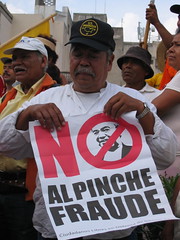
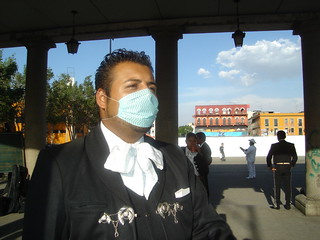
Nuevo León gubernatorial candidate for the Institutional Revolutionary Party, Rodrigo Medina, and his volunteers fanned out across Monterrey this week armed with bottles of antiseptic hand gel bearing his image and the party colors, thermometers, and face masks for prospective voters. In complete violation of federal health warnings to avoid common salutations such as kisses and handshakes, Medina enthusiastically gripped the hands of the potential supporters receiving the hand gel.

Medina made no apologies for his campaigning and campaign tactics during a time of crisis - even as many national campaigns for the midterm elections postponed inaugural events scheduled for May 3. "We're not going to shy away from this crisis," the 36-year-old candidate told reporters. "If we aim to govern this state, I think that with these acts, it shows a capacity for action and solidarity with the people."

The attempts at leveraging the flu outbreak for electoral purposes in Nuevo León, where polls say the gubernatorial contest is too close to call, highlight a near inevitable politicization of a public health emergency - just two months away from federal midterm elections.

Just as predictable has been the response from rivals. Nuevo León National Action Party candidate Fernando Elizondo suspended his campaign on Tuesday. (Radio and TV ads would continue and volunteers would still distribute fliers and brochures, he said.) He also rebuked Medina for being opportunistic and responsible for putting the health of Nuevo León residents in jeopardy.

"There were massive purchases of face masks, then suddenly [there is] a shortage because [Medina wants] to use them for a campaign," Elizondo told reporters. He preferred to take the high road. "We say that if promoting me were to cause one death, I would prefer to lose," he said.

JULY 5 FEVER
Medina and Elizondo are only peripheral players in a crisis whose handling could be judged at the July 5 polls. Politicians such as President Felipe Calderón and Mexico City Mayor Marcelo Ebrard will likely be judged by the effectiveness of their responses in tackling this public health emergency.

Both stand to gain from the crisis, according to analysts. Calderón seeks to win a majority for his PAN in the Chamber of Deputies on July 5, while Ebrard's Democratic Revolution Party, or PRD, aims to retain its dominance in the capital. Ebrard could also be preparing the foundation for a presidential bid in 2012. (He has yet to confirm speculation that he'll run.) But any missteps in their responses could also be used against them by opportunistic opponents.

Many analysts are already drawing comparisons to the handling of Hurricane Katrina by the administration of former U.S. President George W. Bush as an example of what might happen here. "Did the Democrats capitalize on George Bush's mishandling of Katrina?" asked ITAM political science professor Jeffrey Weldon.

BLAME GAME
Some opposition politicians already have questioned the speed of the federal government response to the flu outbreak along with confusing statistics and shortcomings in its overall communications strategy.

PRI Sen. Pedro Joaquín Coldwell called the government response "necessary for taking care of public health, but rather late." He also said, "It seems like there's been a concealment of information and mistimed actions by the government." Calderón enemy and Democratic Revolution Party Deputy Alejandro Sánchez Camacho, meanwhile, issued a press released that alleged, "[Calderón] has sufficient resources to attend to swine flu, but has little will to confront it." And Labor Party Senate leader Ricardo Monreal, among others, expressed frustration with a lack of clarity in the government's health statistics.

"These are conservative numbers and they seem to be hiding information," the senator from Zacatecas told Reforma this week.

Some political analysts and academics have also found fault in the government's handling of the flu outbreak - and questioned its motives during a time of crisis.

John Ackerman, a professor in the Legal Research Institute at UNAM, questioned the tardiness of the government response to the flu outbreak - the first cases began appearing in mid-March - and the subsequent lack of clarity of its communications. He also questioned the legality of Calderón issuing a health emergency that suspends many civil rights without first seeking congressional approval.

"[The decree] requires the executive to inform Congress about what the real situation is," Ackerman said.

Ackerman also alleged that declaring a health emergency without first going to Congress was another Calderón attempt at the "reconsolidation of the authoritarian president."

Some dispute those arguments, however. "The president has always had the power to declare health emergencies," Weldon said, explaining that such decrees are permitted in most countries and can include such measures as putting sick people into quarantine.

The assumption of more powers by declaring an emergency, he added, brings risks: Calderón will be open to much more criticism - much of it legitimate - from lawmakers and the Mexican City government for any sweeping decisions made during this crisis.

SPINNING THE CRISIS
It remains uncertain how the flu outbreak will alter the political landscape - or when the outbreak itself will end. Ackerman said the spin cycle would determine the winners and losers.

"Is this going to be framed as a natural disaster and the federal government coming in as the savior or is this going to be attributed to institutional failure ... [and] seen as something that could have been prevented?" he asked.

If the latter, he predicted the PRD might launch attacks against the government; the PRI would then ride to the government's rescue, but at a steep price.

"All this strengthens the hand of the PRI and strengthens their ability to negotiate key issues with the government," he said.

Others disagree. George W. Grayson, a Mexico expert at the College of William & Mary in Virginia, thinks Calderón has been perceived as handling the crisis well so far, particularly by Washington - which could give him and the PAN the upper hand going into July 5.

"While [the] PRI was poised to deliver a lethal blow in the mid-year showdown, astute management of the health challenge could reverse the political momentum and strengthen Calderón's hand," Grayson said.

In any special sessions of Congress held before July 5, Grayson said, a good image after the flu crisis could give Calderón leverage over the often-obstructionist PRI.

Political analyst Alejandro Schtulmann, of the Empra risk consultancy, added that attacks by lawmakers on the federal government would be "a high-risk proposition" that could "backfire." The only cover for lawmakers, he said, would be widespread international criticism of the federal government after the outbreak ends, but even that might not be sufficient to harm the president.

"It's unlikely that Calderón would be politically harmed by the crisis because the scapegoat would be the health secretary," Schtulmann said.

04 February 2009

Critics seek to fell gov't tree program

DSC01418

BY DAVID AGREN
The News

The federal government launched ProArbol amid much fanfare back in January 2007. Through this ambitious program, the country would replant hundreds of millions of trees, reverse environmental degradation and arrest rampant deforestation. ProArbol also promised to pull some of the country's most marginalized communities out of poverty.

But two years on, the program is under fire. ProArbol is plagued by corruption, poor planning and a dismal success rate, according to studies by Greenpeace México and recent investigations by the newspaper El Universal.

The recent scandalous headlines and allegations of mismanagement and failure are a strict departure from the praise given to President Felipe Calderón for his environmental initiatives in the past two years. He has won U.N. recognition for spearheading reforestation efforts and has been lauded for his initiative to help developing nations confront global warming. He has used ProArbol to further burnish those green credentials.

Still, while environmental activists, woodcutters' groups and opposition politicians offer damning criticism of ProArbol and the president's environmental record, others - forestry experts among them - are calling for patience before passing judgment. They still defend the program as a sincere attempt to overcome decades of neglect and mismanagement of the nation's forests.

"It's a program with good objectives," said José María Chávez Anaya, a forestry professor at the University of Guadalajara. "But we can't say that something is successful [or not] when it's only the first or second year."

Officials have largely remained silent in the face of the allegations, which broke in January. But Environment Secretary Juan Rafael Elvira Quesada, for one, has disputed many of Greenpeace's assessments.

ProArbol is more than just a reforestation program, he argues, as it includes conservation and anti-poverty objectives.

"It's been [called] a reforestation program, but that's not what it is. It's a general environmental protection program," he told El Universal recently. "It's a social development instrument that tries to preserve the environment."

'GREEN CORRUPTION'
The Greenpeace report on ProArbol's early results paint a grim picture. The group alleges that 90 percent of the more than 289.6 million trees planted in 2007 have already died. And some 56 percent of the trees planted under the auspices of ProArbol were actually not trees, but included species such as cactus, agave and maguey, Greenpeace says. The environmental group also alleges that species not native to Mexico have been planted.

El Universal - which titled one of its stories, "Green corruption in Chiapas" - profiled an impoverished village in the southern state, where local woodcutters said that ProArbol funds could not be accounted for. The federal Comptroller, the paper reported, had launched an investigation into the misappropriation of funds.

Politicians have since jumped on the issue, calling for an account from ProArbol administrators. They also revived longstanding allegations that the governing National Action Party is using the program - among other anti-poverty measures - to build up rural support bases.

"Support arrives in a partial manner . and isn't supporting the presented projects in a way that's transparent or uniform," Democratic Revolution Party Sen. Rubén Velázquez told The News.

Others in the forestry industry have their own gripes with ProArbol. Gustavo Sánchez, president of the Mexican Network of Campesino Forest Organizations, or Red Mocaf, believes the program has failed to live up to its promise and fails to offer enough new initiatives to those who make a living through small logging operations.

"What ProArbol does is take all of the resources that previously existed and put them all in one bag. It's presented as a new program, but in reality, it's a messy sum of programs that already existed," he said. "There are almost no new components [to] ProArbol . only the name."

Red Mocaf also alleges that groups who receive funding from Conafor have gotten preferential treatment from ProArbol - violating laws regarding government programs.

HISTORY OF FAILED EFFORTS

ProArbol is hardly the first federal attempt at reforestation and forest preservation. During the regime of then-President Porfirio Díaz in the early 1900s, Miguel Angel Quevedo founded the Viveros de Coyoacán, one of many nurseries that would produce millions of seedlings. Known as the "Tree Apostle," Quevedo later had small forests planted near railroad stations across the country and founded the Mexico Forest Society.

Later efforts have been described with less romanticism by forestry experts, who say that reforestation attempts over the past 50 years have been plagued by a lack of planning, little monitoring of reforested areas and the introduction of exotic species.

Federal enthusiasm for tree planting has also ebbed and flowed. In 1992, then-President Carlos Salinas launched "Forest Solidarity," which focused on urban and suburban forests. From 1998 to 2000, some 283 million trees - 70 percent of which were native species - were planted annually during the administration of Ernesto Zedillo, according to Julia Carabias, an UNAM biology professor and environment secretary at the time.

She argues that inconsistent government action is a key problem. "The lack of continuity in the reforestation programs has not permitted the consolidation of a true, long-term policy of environmental restoration," she wrote in a recent column in Reforma.

Indeed, deforestation continued unabated in the decades leading up to ProArbol's launch. Mexico ranks fifth in terms of annual deforestation, according to the United Nations, and loses an estimated 360,000 hectares of forested area each year due to illegal logging, development, forest fires and the felling of trees to make way for farms and ranches. Between 1976 and 1993, the country lost forested areas equivalent to the area of Guanajuato state, according to Chávez Anaya. By 2000, it had lost another forested area about the size of Campeche.

But experts attribute reforestation difficulties to factors that go beyond corruptions and ineptness. Restoration, they say, is complicated for various reasons.

For one, Mexico's forests boast incredible diversity. The landscape ranges from jungles and mangroves to hills covered with pines, cloud forests and even groves of maple trees. There are 170 kinds of oaks native to Mexico - the richest diversity of any country - said Dante Rodríguez Trejo, a forestry professor at the Universidad Autónoma Chapingo in Texcoco, State of Mexico.

"It's a very complex country," said the specialist in forest fires who has studied parts of the ProArbol program for the National Forest Commission, or Conafor.

ProArbol oversees the planting of 52 types of trees. Ninety-four percent of the seedlings are native species. ProArbol also oversees the planting of the many non-trees that are a point of contention with Greenpeace and are included in the program's reforestation numbers.

Rodríguez Trejo defended the planting of non-trees, saying that plants such as cactus, agave and maguey are ideal for arid parts of the country, help rebuild soil and prevent erosion and can be harvested for commercial purposes. "It's very important to have different plants for different situations," he said.

Many experts also laud ProArbol - as well as federal programs such as Zero Tolerance, which combats illegal logging - for attempting to preserve the country's forests as well as planting new trees. ProArbol equips and funds teams of rapid-response firefighters on ejidos, or communal properties, and indigenous communities.

In a study for Conafor, Rodríguez Trejo found that for every peso invested in the 288 rapid-response teams, the federal government saved 166 pesos, primarily in loss prevention. For every hectare charred by blazes, another 13.4 hectares were saved.

Still, Rodríguez Trejo expressed some caution over the fact that trees are being planted at such a blistering pace. "Although it's well-intentioned to plant a lot of trees, [it might be better] to plant less, [and] try to take better care of what's reforested," he said.

Defenders of the program like to cite a recently released study from the Colegio de Postgraduados in Texcoco, which found that the survival rate of trees planted through ProArbol in 2007 was 57.6 percent. Carabias noted the study in her column. "I consider ProArbol to be the best integrated program in forest management to come out of the public sector," she wrote.

FOREST FIGHT

On the ground, in the nation's wooded areas, critics of ProArbol and federal tree-planting efforts and forestry policies are making themselves heard.

Gina Uribe, a founder of the NGO Fuerza Ambiental, works on reforestation and creek bed restoration projects in Chihuahua. In the ejidos and small communities where she works, planning is often lacking, Uribe said. Planting sometimes occurs toward the end of the rainy season, giving the seedlings a diminished chance of survival; seedlings also arrive from Conafor nurseries located in desert regions - in other words, transplanted to different microclimates - which jeopardizes survival rates, she said.

Perhaps most disappointing for Uribe, the authorities "haven't managed to integrate the program into the communities."

Sánchez, of Red Mocaf, expressed similar frustrations. But, he acknowledged, "There were high expectations in the beginning."

His hopes faded as members of his group - which mainly represents small woodcutters and promotes sustainable forestry - began complaining of ProArbol shortcomings. Costs for transactions were high, they had to wait more than a year for the program to deliver payment for services rendered and getting anything done required wading through endless red tape. Some Red Mocaf members, Sánchez said, now prefer to enroll in agriculture programs, which can be more profitable and involve less bureaucracy.

And, like Uribe, he also finds fault with the lack of community integration on the part of ProArbol. "A problem is that [often] they're going to try reforestation in areas where people aren't sold on [the idea]," Sánchez said. "It's [often] not their plan. Someone from the government comes and wants to plant what they want, but [locals] don't have the time or money to take care of the trees. [Reforestation] works when it's in a community that already has a culture of forest management because [people] already know the benefits."

Some of ProArbol's anti-poverty objectives also bother Red Mocaf members. Sánchez said that changes in forest management policies - making permits easier to obtain, for instance - would do more to alleviate poverty. "In the medium term, if you develop a scheme of sustainable forest development, you're contributing to the reduction of poverty," he said.

'A TITANIC JOB'

It remains to be seen whether the outcry over the Greenpeace and El Universal report manage to fell ProArbol entirely. Attempts to obtain comment from Conafor, which oversees ProArbol, were unsuccessful.

Calderón still regularly highlights ProArbol as a pillar of his anti-poverty measures. And he has gained political mileage out of his administration's reforestation efforts. The United Nations Environment Programme recognized Calderón and the "Mexican people" on World Environment Day 2008 for showing "global leadership" and planting 250 million trees in 2007. Calderón himself even planted the 250 millionth tree - a rare blue pine - on Dec. 23, 2007.

Elvira Quesada, the environment secretary, vehemently denied that the program had any political ends and told El Universal it had been audited at least 100 times. He also acknowledged the enormous challenges that ProArbol faces. "In the reforestation process, we're restoring what we lost in past decades," he told the daily.

Optimistic experts like Rodríguez Trejo of the Universidad Autónoma Chapingo, too, are adamant that it is too early to write the program off.

"It's a titanic job. We still haven't offset commercial [logging] with reforestation and restoration, we still haven't offset the rate of deforestation that we have," he said. "In three years, there's going to be a completely different picture."

05 October 2008

Guerrero´s Sunday votes a litmus test for governor

Tlamacazapa

Guerrero´s Sunday votes a litmus test for governor


BY DAVID AGREN
The News

Residents of the southern state of Guerrero head to the polls on Sunday in legislative and municipal elections. But rather than being just your run-of-the-mill local political process, the elections are shaping up as a referendum on Gov. Zeferino Torreblanca´s administration <00AD>- and even one on his Democratic Revolution Party, or PRD, itself.

Torreblanca rode to power in 2005 on a wave of discontent that also swept the Institutional Revolutionary Party, or PRI, out of office after 75 years of oppressive rule in the impoverished state.

The Acapulco retailing magnate ran for PRD on an agenda of change in what is one of the republic´s most marginalized, underdeveloped and conflictive states - a place where 40 percent of the homes have dirt floors, 42 percent of the population is illiterate and the murder rate is double that of the national average, according to federal government statistics.

"The election of Zeferino Torreblanca was historic," said human rights lawyer Mario Patrón, who worked in the La Montaña region of Guerrero until recently.

"After more than 75 years of PRI rule, the civil society took to the streets and voted. There were high expectations," Patrón said.

Guererro residents overwhelming opted for turfing the long-ruling incumbent party - not unlike what had occurred on the federal level five years earlier - in a result that one national broadsheet welcomed as, "Moving toward the end of the outlaw Mexico."

But local observers say that the initial euphoria diminished quickly, as few of the expectations that people had - corruption being reduced, education and social programs being fixed, and oppressive governance being stamped out, for instance - began to materialize.

"They´ve just reproduced the same old practices and the same governing policies," Patrón said. "What we have is power being alternated. There´s been a change of colors, but there has not been a transition."

Ironically - but perhaps unsurprisingly, given the left-wing PRD´s divisions stemming from internal elections both nationally and in Guerrero earlier this year - many of the ballots that could be cast against the PRD are expected to come from disaffected party members, who differ with the governor on policy and party politics.

Some in the PRD predict a humbling at the polls for their party, which is expected to lose seats in the state legislature and could lose numerous municipal races - perhaps most embarrassingly in Acapulco, the state´s largest municipality.

"There´s no possibility of the PRD keeping its majority in the legislature," Alvaro Leyva Reyes, a former campaign coordinator for Torreblanca, told the newspaper El Universal.

TOUGH COMPETITION

Making things even tougher, the PRD is now battling a rejuvenated PRI that has been winning local-level elections nationwide over the past two years, and has shown unity in Guerrero after previously being torn apart by infighting there.

Torreblanca, meanwhile, has drawn the ire of some factions of his party for not adequately financially supporting Andrés Manuel López Obrador´s alternative government, as well as working cooperatively with the PAN administration of President Felipe Calderón.

Torreblanca also has butted heads with the PRD mayor of Acapulco, Félix Salgado Macedonio, according to José Luis Rosales, director of the Rural Development Institute at the Universidad Autónoma de Guerrero.

Salgado has accused Torreblanca of sending that municipality inadequate resources for social programs and urban development projects and described the governor as "PANísta to the core," according to Rosales.

With the PRD stumbling, political observers predict a strong showing from the PRI, which sent its big guns to campaign in Guerrero.

Party president Beatriz Paredes and State of Mexico Gov. Enrique Peña Nieto both made appearances. In Acapulco last Sunday, Paredes described the PRI as united and agents of change.

Patrón, the human rights lawyer, expressed skepticism over the PRI´s pledges to carry out change, but acknowledged that the party was on the rebound in his state.

"The PRI is in the process of reconstruction, and it´s most likely that it will win various municipal governments [in Guerrero]," he said. "It´s starting to regain ground, but this isn´t a result of PRI policies. It´s a consequence of the image of poor governance by the PRD."

06 May 2008

On leftist party's birthday, two factions, visions, cakes

Rafael Acosta "Juanito"
Rafael "Juanito" Acosta shows support for the pro-AMLO factions of the PRD.

On leftist party's birthday, two factions, visions, cakes

David Agren
The News

The two candidates contesting the still-undecided Democratic Revolution Party internal vote, Alejandro Encinas and Jesús Ortega, marked the PRD's 19th anniversary by speaking of unity – an elusive objective during the party's oft-contentious leadership campaign and post-election fallout.

"We have problems, but that's not going to overshadow the anniversary of the PRD," Ortega told The News while celebrating at the Revolution Monument.

But the pair made their pronouncements at separate birthday bashes mere blocks from each other in central Mexico City, where card-carrying PRD members – and others simply accepting free junkets to the national capital – spoke ill of their opponents and even disparaged the rival celebrations.

"All of the traitors are over there," said Encinas supporter Rafael Acosta, pointing toward Ortega's celebrations.

Acosta, a self-described "social fighter," objected to the willingness of the Ortega wing of the PRD – known as "Los Chuchos" – to broker deals with the federal government, which many in the party consider illegitimate due to allegations of fraud in the 2006 presidential election.

"They're a bunch of sellouts … and trying to steal the [PRD] election," he added.

Differences over strategy threaten to split the PRD less than two decades after Cuauhtémoc Cárdenas founded the party, which has long been beset by infighting among its disparate currents.

And neither Encinas nor Ortega has been willing to entertain the possibility of stepping aside, even though the election, held March 16, has been plagued by allegations of vote tampering, improper campaigning and favoritism on the part of senior PRD officials.

The pair couldn't even agree on an interim leader as Encinas rejected the appointment of Guadalupe Acosta to the post by the PRD national council over the weekend.

Encinas, who was named the winner by a PRD committee last Tuesday – despite only 84 percent of the votes being counted – held a relatively modest party in the Colonia Juárez complete with birthday cake, yellow balloons and free T-shirts.

Rosalba Carmelita Cruz, who said she was previously offered giveaways of food and household items from the Ortega campaign, objected to the Chuchos' birthday bash.

"They're throwing a bigger party to attract more followers," she said.

"There's more of a party, more food, more giveaways."

Ortega feted the PRD anniversary at the Revolution Monument with bands, clowns and a demonstration by the masked men of the Lucha Libre. He also called for the Left to become more "modern" and "critical."

But many of the attendees, including Nezahualcóyotl resident Faustino López Benitez, appeared more interested in freebies and complimentary taco dinners than left-wing political discourse.

He confessed to boarding a bus earlier in the day at the urging of an organizer known as "the drunk" and after "a friend told me that it was the [PRD] anniversary."

When asked about Ortega and later Encinas, López Benitez responded both times "I have no idea who that is," while waiting for a plate of pastor tacos.

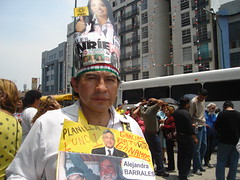
The lack of passionate support at the Ortega event allowed interlopers like Eligio Manuel Hernández to sell an estimated 100 straw hats with the slogan "¡Viva AMLO!" a reference to party stalwart Andrés Manuel López Obrador, who backed Encinas and raised the ire of Ortega by signing campaign propaganda deemed illegal by PRD election officials.

"Ortega's been brought in by [President Felipe] Calderón to trip up Encinas," Hernández alleged.
The elderly weaver also insisted that party members "get along fine" and would emerge united. But he wasn't sure how.

30 March 2008

Another left-wing party engulfed in turmoil


David Agren
The News

The Democratic Revolution Party, or PRD, staged a contentious and yet-undecided internal election on March 16 that threatens to fracture the left-wing party.

Mexico’s other left-wing party, the Social Democratic Alternative, or Alternativa, also faces a similar fate on Sunday, when it selects a new slate of national leaders.

Even worse for Alternativa is the distinct possibility that the three-year-old party could disappear entirely after the 2009 midterm elections if its official status is rescinded by the Federal Electoral Institute, or IFE.

“How it [breaks up] is problematic because it’s not big enough to split successfully [since] neither side could actually survive,” said Jeffrey Weldon, a political science professor at ITAM.

The outcome could also see Alternativa lose its best-known figure, Patricia Mercado, a prominent women’s rights crusader whose maverick 2006 presidential campaign garnered attention by highlighting controversial social issues like drug legalization, gay rights and access to abortion.

Mercado’s campaign won the Alternativa five seats in the Chamber of Deputies and enough votes to remain registered with the IFE. But her success – becoming Alternativa's public face – and agenda-driven approach to party-building sparked disquiet in the party's senior ranks.

Luciano Pascoe, the Alternativa's IFE representative described Mercado as “gold” for the party, but accused her of claiming too much credit for past successes.

“We invested every penny this party had in her image,” he said.

“She's gold because she has a team behind her.”

Mercado is vying for the Alternativa presidency against incumbent Alberto Begné, a former IFE official. Mercado accuses Begné of selling out the party’s original social democratic agenda by forging alliances with political rivals that guarantee money and legislative seats rather than pushing her social agenda forward.

Her supporters also accuse Begné of employing thug tactics at local-level conventions – six of which have resulted in complaints to the electoral tribunal, or Trife, that were dismissed on Friday.

Mercado told The News that “hired goons” from the National Polytechnic Institute were unleashed on her supporters at Alternativa’s Mexico City convention on March 16.

She also accused party leadership of swelling her opponents’ ranks with PRD supporters.

Pascoe denied Mercado's allegations. He also defended the Alternativa's party-building strategies and said Mercado was running her side of the party like a “caudilla,” or strong woman.

“We can't afford to build a party that's focused on one person,” he said, describing that strategy as the principal weakness of Mexican political parties.

A DIFFERENT KIND OF PARTY

The party was founded in 2005 with the idea of providing a “modern left” that would promote individual rights and break from the tendencies of some PRD and PRI leaders to form patronage alliances, said Alternativa Deputy Aida Marina Arvizu Rivas.

But it got off to an awkward start as a coalition of social activists pushing for minority rights, intellectuals who were previously affiliated with the Institutional Revolutionary Party, or PRI, and several campesino groups.

Tensions surfaced almost immediately as the campesino wing advanced the presidential nomination of Víctor González Torres, a discount drug baron famous for womanizing.

González Torres, a self-described populist better known as Dr. Simi, promised to bring a war chest to the Alternativa campaign, but the IFE quashed his bid by ruling in favor of Mercado. The campesino wing later crawled back to the PRI in the waning days of the campaign.

“It was oil and water. A bunch of city intellectuals that dress well and speak fancy and a bunch of rowdy [campesinos],” said Federico Estévez, also a political science professor at ITAM. “Of course they split apart.”

Mercado went on to lead a shoestring campaign that caught fire after she performed strongly in the first presidential debate. She gained further notoriety by attending a rally promoting marijuana legalization in Mexico City’s hip Condesa neighborhood.

In the end, Alternativa wound up with slightly less than 3 percent of the presidential ballots – enough to deny López Obrador the presidency.

MONEY TROUBLE

The result also allowed the Alternativa to exist as a registered political party that receives public funding from the IFE – 130 million pesos in 2008.

But spending irregularities from 2006 resulted in a 15 million-peso fine last year, forcing the party to depend on a 60-million-peso line of credit that is still being repaid, according to the El Universal newspaper.

Mercado said the party was being run as a “franchise” – a factor driving the current leadership to forge alliances with larger parties that can guarantee continued funding for the Alternativa.

Estévez attributed much of the Alternativa’s discord to money rather than ideological and strategic differences.

He also noted that Mercado has a history of being involved with upstart political parties in search of public financing and she mortgaged her house during an unsuccessful candidacy in 2000.

Estévez predicted the ongoing Alternativa row – and the turmoil engulfing the PRD – would persist due to the high stakes involved.

“National party leaders have enormous power in this country, legal power as well as financial support, so it’s worth fighting practically to the death,” he said.

14 March 2008

Mexican left on verge of splitting

DSC03332

David Agren
The News

Members of the Democratic Revolution Party select a new national president on Sunday, concluding an oft-contentious internal election.

And while the national race officially features five candidates, representing disparate factions in the center-left party, the vote is shaping up as more of a referendum on competing visions for the center-left party instead of a traditional leadership contest.

Voters will decide if the 19-year-old PRD should mature and become more institutional or whether it should continue in a perpetual anti-establishment role.

Analysts say that differences over strategy could jeopardize the future of the party, which is the second-leading force on the federal level.

“It’s very possible that after the internal elections the party will split into a current composed of [PRD moderates] and a current for those following [former presidential candidate Andrés Manuel] López Obrador,” said Aldo Muñoz, political science professor at Universidad Iberoamericana.

“The losers will almost certainly form a new party.”Both of the leading candidates – Alejandro Encinas and Jesús Ortega – often speak of unifying the PRD and downplay talk of abandoning the party. But their methods and proposals for vaulting the PRD into power and unifying the Mexican left differ radically.

Encinas, an economist by training and former American football player, represents a combative current known as the United Left, which refuses to recognize the legitimacy of President Felipe Calderón and eschews brokering deals with rival political parties.

The former Mexico City mayor kicked off his campaign by blasting the pragmatic actions of party moderates, whom he described as “nothing more than conservatives, only more desperate.”

He most notably objected to the PRD courting former members of the right-leaning National Action Party, or PAN, as potential candidates in Yucatán and Guanajuato, warning the party risked losing its identity as a left-wing party.Encinas also picked up the backing of López Obrador, an anti-establishment figure, who once commented, “To hell with their institutions,” after the nation’s electoral tribunal rejected his allegations of fraud after the 2006 election. López Obrador presently heads an alternative government that is separate from the PRD.

Jesús Ortega, Encinas’ main rival, also views the 2006 election as rigged, but many in his New Left current of the PRD – also known as Los Chuchos – have shown a willingness to work with the federal government and want the party to participate more in the country’s political institutions. They also have expressed some interest in reforming the government-controlled energy sector – a proposal that López Obrador has been tirelessly campaigning against.

Ortega recently warned that the PRD risked being viewed as “immature and violent” if it continued fomenting protests and failed to fully participate in the nation’s political life.

“Los Chuchos doesn't think the [PRD] can win power unless it cooperates more with the government,” Muñoz explained.

But members cooperating with the government and participating in legislative bargaining – most notably Ruth Zavaleta, PRD speaker of the Chamber of Deputies – have drawn intense fire from some quarters of the PRD.

Zavaleta, a member of the New Left, said she wants the PRD to “mature” and become more “institutional” – and stop excluding itself during key legislative debates.

“The PRD should become an institution … and mature within the existing structures,” she told The News.

“It should be a party based in rules, in statutes [and] in principles.”

But becoming more institutional might prove difficult given the party’s origins as a coalition of diverse groups pursuing their own agendas that initially were seeking to topple to long-governing Institutional Revolutionary Party, or PRI.

DIVERSE ORIGINS

The PRD was founded in 1989 by Cuauhtémoc Cárdenas – a former PRI governor of Michoacán and the son of a revered former president – just one year after nearly winning the presidency.

He had bolted from the PRI earlier in the decade due to ideological differences and after being passed over for the party’s presidential nomination in favor of future President Carlos Salinas.

Cárdenas formed the National Democratic Front, which quickly attracted an unlikely assortment of groups the PRI’s old corporatist structure was unable to co-opt.

The coalition ranged from social activists working on behalf of earthquake victims in the capital to guerrillas that were previously hunted by the military in the hills of Guerrero state to small left-wing political parties with socialist and communist ideologies. It also gained support from former PRI members – like López Obrador – who were dissatisfied with the party’s shift to pro-market policies and the advent of technocrats like Salinas.

“The PRD is very pluralistic. It ranges from former guerrillas to people that used to be involved heavily with the PRI,” Zavaleta explained.

Zavaleta jumped into the political arena at the age of 21 after the 1985 Mexico City earthquake destroyed her home in the Centro Historico. She was moved to a temporary camp for displaced residents near the airport, where she began agitating for better services like garbage collection and drainage and pressing the local government for credit to rebuilt damages homes.

But she and her colleagues began drifting into local politics by capturing low-level positions – like jefe de la manzana, or block captain – and eventually found themselves organizing in boroughs on the eastern side of Mexico City for the National Democratic Front.

“We started to be a different kind of struggle: The struggle for democracy in the country,” Zavaleta recalled.

“All of the groups ... decided to back Cuauhtémoc Cárdenas so he could win power and depose the old [PRI] regime.”

The movement almost succeeded in 1988 as Cárdenas, an uncharismatic figure known for his stern facial expressions, staged a popular presidential campaign.

But a mysterious computer crash in the Interior Secretariat wiped out the early voting results favoring the National Democratic Front.

Cárdenas would never recapture the same magic – although he became Mexico City’s first elected mayor in 1997 – as he ran unsuccessfully for the Presidency in 1994 and 2000, placing third in both races.

Support for the party subsequently diminished with his poor electoral performances.

Zavaleta cited the perpetual caciquismo, or dependence on a strong figurehead like Cárdenas, as one of the PRD’s main weaknesses.

“[The party] can’t be sustained in caciquismo,” she said.

“As soon as the cacique disappears, the party then divides.”

Cárdenas’ fading from the national scene created the conditions for another leader to emerge: López Obrador, who as Mexico City mayor championed social programs like stipends for seniors and single mothers and big public works projects, which included restoring the Centro Historico and constructing a second level on the Periferico expressway.

López Obrador and Cárdenas have been estranged in recent years.

The PRD nearly captured the presidency in 2006, when López Obrador fell short by less than one percentage point in an election he branded “fraudulent.” But the PRD, riding López Obrador’s coattails, won a record number of congressional seats in 2006 and supplanted the PRI as the second-leading party in Congress.

The results reaffirmed López Obrador as the face of the party – even though his tactics of belittling Calderón as the “spurious president” and chiding members for working with other political groups irritated many in the PRD. But even López Obrador’s critics recognized the benefits of having an influential front man.

“The problem we have is that Andrés Manuel needs to continue being a strong leader and we need to strengthen our [movement] and his leadership,” Camilo Valenzuela, one of the five aspirants for the PRD presidency, told The News.

“But [he] also needs a strong party,” Valenzuela added.

The candidate also expressed concern that López Obrador was positioning himself as the unofficial PRD president by endorsing Encinas, who succeeded López Obrador as Mexico City mayor in 2005.

Columnist Sergio Sarmiento noted the same thing in a recent Grupo Reforma column.

“There’s not much difference between what López Obrador is doing and what President Felipe Calderón did by placing a close confidant at the head of the [National Action Party],” he wrote.

Many analysts give Encinas an advantage in the race due to López Obrador’s support, even though Ortega’s PRD faction controls the majority of the party’s state and national leadership positions.

“The grassroots came because of López Obrador so I still expect the grassroots to follow López Obrador whatever the organizations do in the states,” said Federico Estévez, political science professor at ITAM.

Jeffrey Weldon, a political science professor at ITAM, also predicted an Encinas victory due to fears that López Obrador’s backers might break away from the PRD.

“This threat of defections is going to actually weigh pretty heavily on a lot of people,” he said.

“They all know that without López Obrador the party is going to be a lot weaker."

24 December 2007

Felipe Calderón gets his man

Felipe Calderon campaigning

By David Agren
The News

Germán Martínez Cázares, a staunch supporter of President Felipe Calderón, assumes the presidency of the National Action Party, or PAN, on Dec. 8.

Officially, the 40-year-old former federal comptroller will head the governing party for the next three years and lead it into the crucial 2009-midterm elections.

Unofficially, his ascent will sideline the party’s conservative-minded old guard, which has frequently bickered with the president and enjoyed little electoral success over the past year.

Martínez’s rise to prominence also marks a victory for Calderón and his pragmatic stream of the PAN as the president finally wrests control of his center-right party away from his detractors in the PAN’s conservative-leaning Catholic wing.

“It puts someone in who is close to the president,” said Jeffrey Weldon, a political science professor at ITAM, who noted Martínez’s moderate political views.

CLEANING UP AFTER ESPINO

Martínez inherits a badly divided party rife with ideological and personality-driven feuds that has sputtered of late in state and local elections – most notably in Yucatán and Aguascalientes, where conflicts over candidate selection and forging alliances doomed PAN campaigns in traditional party strongholds.

And his party presidency, which ushers in a younger generation of leadership, comes at a time when the PAN is making the difficult transition from being an erstwhile opposition fighting the previously entrenched Institutional Revolutionary Party, or PRI, to establishing itself as the governing party.

Martínez succeeds outgoing president Manuel Espino, a polemic figure identified with the PAN’s conservative-Catholic wing, whose term as party head ends three months earlier than scheduled. Espino frequently squabbled in public with Calderon, who represents a more moderate and pragmatic faction that until recently was not well-represented in the PAN leadership.

“[Espino] created this view of a divided PAN,” Weldon said.

The tension between Espino and Calderón dates back to before Espino became party president in 2005, when Calderón endorsed a rival candidate for the PAN's top position.

Later, the Espino-led party hierarchy, which included former president Vicente Fox, openly supported former interior secretary Santiago Creel for the PAN presidential nomination and never enthusiastically backed Calderón’s presidential bid.

Calderón responded to the lack of support by branding himself “the disobedient son” during last year’s campaign.

CALDERON’S COUP

Calderón and Martínez share many similarities, dating back their modest upbringings in Michoacán and later advancements into the upper echelons of the PAN.

“They’re both very much the same kind of person in terms of who they are and where they come from and what they’re seeking,” said Federico Estévez, a political science professor at ITAM.

Both men hail from from lower middle class backgrounds and were mentored by Catholic academic and former PAN stalwart Carlos Castillo Peraza. The pair, both self-starters, also climbed the ranks of the education system, won two terms as federal deputies, served in high-level party positions and showed sharp political instincts for advancing to the top and “staying there,” according to Estévez.

Martínez also brings less baggage to the PAN presidency than Espino, who claimed the party’s top job under cloud of controversy after being accused him of rigging the party leadership vote and employing corporatist practices during the contest.

Espino, who won with Fox’s backing, took active interest in the selection of local candidates, taking advantage of the influence wielded by the presidents of Mexico’s political parties.

“[Party presidents have] a lot of discretionary power,” Estévez said.

“You can’t get anywhere without the [party] president coming onboard.”

Relations further soured with Calderón after the July 2, 2006, when, according to Mexico expert George Grayson, “Espino became a thorn in the side” of the recently-elected president.

Grayson, a government professor at the College of William & Mary, said that Espino appointed PAN leaders in the new Congress affiliated with the party faction hostile to the president and dithered over forming an alliance with the PRI in last summer’s Chiapas gubernatorial election, which was narrowly captured by the Democratic Revolution Party, or PRD.

Espino’s tough approach to leadership also dismayed many in the PAN as internal conflicts dominated the headlines during his term. The federal Electoral Tribunal recorded complaints from 1,530 PAN members over the past year regarding the infringement of their party privileges – some 77.5 percent of all grievances filed.

It also led to mixed electoral results. The PAN successfully maintained its grip on the presidency and captured record pluralities in both houses of Congress in 2006 – accomplishments Espino frequently points out. But the PAN suffered some embarrassing losses in state and local contests afterwards, which Martínez addressed when he announced his candidacy for party president on Oct. 29.

“If we continue losing municipal governments we risk losing the presidency in 2012,” he said at the time.

According to Aldo Muñoz, a political science professor at Universidad Iberoamericana, Calderón and Martínez champion a pragmatic, “neoPANista” wing of the party, while Fox and Espino allegedly lead a religious-conservative “doctrinal” branch, which is influential on the state and local level in Western Mexico and is often referred to as “El Yunque,” or The Anvil.

Martínez recognized the PAN schisms during a campaign rally in his hometown of Quiroga, Michoacán and promised to include members from both sides of the party in the party’s executive committee. He also noted the challenge of incorporating new members drifting over to the PAN due to its proximity to power.

But pollster Dan Lund questioned whether Martínez and Calderón would be able to unite the party around themselves going forward.

Lund noted that the PAN has long lacked the underpinning of a policy agenda, which has made it more vulnerable to internal disputes and power struggles.

“I don’t think anyone has forged policy leadership,” said Lund, president of the Mund Group in Mexico City.

“And when you don’t have a plan you tend to get bogged down in personalities and fiefdoms.”

26 October 2007

The nation’s ‘legitimate president’ soldiers on in spite of facts

DSC03332

By David Agren
The News

TEPEACA, Pue. – Pedro de la Cruz García, a 72-year-old farmer from this rural community 40 kilometers east of Puebla city woke early on a recent Sunday morning, pulled on a bright yellow shirt, gray pants and a pair of well-worn sandals and started walking. Using a cane for assistance, he managed to make the kilometer-long trek to the town square in time for the start of a rally organized by 2006 presidential runner-up Andrés Manuel López Obrador of the left-leaning PRD.

Like many of the approximately 200 other supporters gathered in the square, de la Cruz calls López Obrador the “legitimate president of Mexico” and considers last year’s election – which his candidate lost to Felipe Calderón of the conservative PAN by less than a percentage point – to have been rigged.

López Obrador also believed the results were rigged, and following the election, he filed a petition asking the Federal Electoral Tribunal (TRIFE) for a vote-by-vote recount. The TRIFE denied the request two months later, but that hardly deterred the candidate popularly known as AMLO. Instead, the former Mexico City mayor vowed to defy the ruling and promised to make the nation ungovernable. He declared himself the legitimate president, formed a parallel cabinet and returned to rallying support from his die-hard constituency, drawn primarily from the poor and working classes.

A year after the Court’s ruling, the “legitimate president” tag still rings true for people like those at the Tepeaca rally. Few were willing to consider Calderón as their rightful leader, and others would only mention his name as part of an insult. One attendee, Ernesto Rodríguez, held a sign reading, “Felipe Calderón is the bastard son of [Vicente] Fox.”

The view at the rally is less commonly held across Mexico as a majority of the population has moved on from the contentious July 2, 2006 election and considers Calderón the true victor. In a poll published by Grupo Reforma on the one-year anniversary of the election, 36 percent of respondents still viewed the results as tainted, but 31 percent of López Obrador voters said they wouldn’t opt for him again. (López Obrador has long taken issue with Grupo Reforma’s polling methods and editorial policy.)

Even in the republic’s poorest and most remote municipalities, which López Obrador tours tirelessly, turnout for his events appears to be diminishing. In Tepeaca, several observers estimated the crowd size at roughly 20 percent of the total that came out for a pre-election appearance.

Despite emerging from a tight election with a precarious sense of legitimacy, Calderón’s approval rating now hovers in the 65-percent range – due in part to an aggressive stance against drug cartels. Furthermore, with backing from the PRI, Mexico’s third party, Calderón achieved passage of a pension reform bill during the spring and a comprehensive fiscal reform package last month. López Obrador urged his party to never negotiate with president, but some PRD legislators sat down with Calderón and his secretaries before eventually voting against fiscal reform. When AMLO called on PRD lawmakers to disrupt the voting, the plan fizzled. A poll by Ulises Beltrán y Asociados showed that 70 percent of respondents disagreed with AMLO’s tactics.

López Obrador’s strategy of organizing an alternative government and eschewing contact with Calderón baffles some political observers, who say that he could be more effective leading a responsible opposition instead of waiting for the economy to collapse or for the president to stumble.

“He’s hoping that Felipe Calderón will fall on his face and that the (downtrodden) will carry him on their shoulders to victory,” says George Grayson, a government professor at the College of William & Mary in Virginia and the author of a biography of López Obrador.

A ‘Cordial Relashionship’

While Calderón solidifies his grip on the presidency, López Obrador’s persistence presents challenges for members of his PRD, which made impressive gains in the last congressional elections and holds second-place status in Congress.

“It’s a love-hate relationship,” Grayson said. “He still has a lot of supporters in the PRD.”

Mexico City Mayor Marcelo Ebrard, has pledged support for López Obrador, but all five PRD governors have kept their distance and even have met with Calderón. None of the governors attended a July 1 López Obrador rally in Mexico City’s Zócalo. Only Ebrard appeared with the “legitimate president.”

There are other signs suggesting López Obrador may be losing influence within the PRD. For example, indications are his candidate for party president, Alejandro Encinas, will not win the party election. And PRD leaders in Oaxaca are calling for him to be stripped of party privileges since he campaigned for non-PRD candidates in local elections there.

Mexico City-based political analyst Dan Lund, however, disagrees with the idea that the PRD is fracturing over López Obrador.

“You’d have to be silly to view him as a liability because the PRD would have disappeared had it not been for him,” Lund said. “Everyone views him as political capital.”

Even so, Jorge Agustín Ortiz, a López Obrado coordinator, acknowledged some separation between AMLO and the PRD.

“Andrés Manuel has a cordial relationship with the PRD, but he has his own movement,” Ortiz said.

The movement, called the Convención Nacional Democrática, or National Democratic Convention, organizes López Obrador followers at the grass-roots level. It claims 1.5 million members and signs up new ones at every rally.

Lund says López Obrador’s goal is to build a pacifist social movement – something rare in a country with a history of authoritarianism and violence. Other political commentators suggest a different motive. In a recent column in the Milenio newspaper, analyst Román Revueltas speculated that López Obrador might be planning a break with the PRD in order start a new party.

It’s all being built with little fanfare, though. López Obrador’s presence in the media spotlight has diminished. As mayor of Mexico City and later a leading presidential candidate, he frequently made the front pages. His daily predawn press conferences provided timely fresh content for the capital’s electronic media outlets. Nowadays, López Obrador appears on a weekly television program Tuesday mornings at 1 a.m. on TV Azteca. His rallies receive scant coverage.

MIXED REVIEWS

Unlike the constitutional president, López Obrador travels light without much security. He arrived at the event in Tepeaca in a white SUV with no hubcaps and then casually waded through a throng of supporters toward the stage.

During his speech, he mentioned his travails from 2006, but mostly focused on populist issues like rising food and gasoline prices and lavish presidential pensions.

The message resonated with de la Cruz, the elderly farmer who walked a kilometer with a cane to hear it. Afterward, he signed up for the Convención Nacional Democrática.

When López Obrador was mayor of Mexico City, he says, “Things worked, he supported the disabled [and] he was giving money to seniors. Who’s given me even five cents? Nobody.”

After 40 minutes with the crowd in Tepeaca, López Obrador climbed back into his SUV and headed off for another six rallies scheduled for that day. He plans to eventually speak in each of the nation’s 2,438 municipalities, where his message of social justice and benefits for the poor is likely to attract at least some followers of the “legitimate president.”

Many though, have fallen away, including Mexico City taxi driver Dario Espinosa.

"I used to support him, but not any longer," Espinosa says, explaining that he disagreed with López Obrador's six-week blockade of central Mexico City last summer.

"I think he's through."

13 April 2007

PRD: AMLO lost on July 2

PRD protests

Finally, more than nine months after the July 2 presidential election, the Democratic Revolution Party (PRD) acknowledged that its candidate, Andres Manuel Lopez Obrador (AMLO), lost the contest and recognized Felipe Calderon of the National Action Party (PAN) as the president of Mexico. Neither AMLO nor the PRD initially viewed Calderon's victory as legal and AMLO was declared "legitimate president" on Nov. 20. But for AMLO, it's been a somewhat lonely struggle. Several PRD governors have recognized Calderon and within the PRD, Mexico City Mayor Marcelo Ebrard is currently outshining his predecessor.

Having the PRD's president recognize Calderon - and in a sense, turn the page - can only hurt AMLO even more. This could also be the PRD trying to project an image to the public that it's more than just an appendage of its former presidential candidate. The party made handsome gains in the last senate and congressional elections and with the Institutional Revolutionary Party (PRI) now striking deals with the PAN - witness the ISSSTE pension reforms and the unseemly alliance keeping Oaxaca Governor Ulises Ruiz in office - the PRD and its allies (the PT and Convergence) are functioning as the opposition.

The PRD also has other members harboring presidential aspirations for 2012. Ebrard would surely top that list. The next presidential election is still more than five years away, but he's the early favorite - or, at a minimum, being the mayor of Mexico City, the most visible. (This being Mexico, it's never too early to speculate, is it?)

01 March 2007

Por Fin! Jalisco's new governor takes power

Mitin del PAN en Tepatitlan de Morelos, Jalisco

Nine months after besting the PRI in a bitter gubernatorial contest, Emilio Gonzalez Marquez finally assumed power in Jalisco, succeeding Francisco "Paco" Ramirez Acuña, who departed in December for a spot in President Felipe Calderon's cabinet. Gonzalez, the former mayor of Guadalajara, heads the conservative state's third-consecutive PAN government. Originally from Lagos de Moreno in the Los Altos region east of Guadalajara (and just across the state line from Vicente Fox's San Francisco del Rincon, Guanajuato,) he's long been linked the Yunque, a secretive conservative organization sympathetic to the PAN. (Gonzalez denies the connection.)

Gonzalez takes over a state that could best be described as middle of the road. While not especially corrupt, Jalisco is hardly an innovator on the national level. Guadalajara's sleepy elite-family-dominated business scene is prospering like always and the high-tech sector is making a nice recovery after a long slump.

Paco accomplished little over his term other than bring the 2011 Pan American Games to Guadalajara - a competition won by default - crack down on the globalifobicos at a 2004 summit in the state capital and take numerous foreign junkets of dubious value. Gonzalez's track record in Guadalajara was hardly stellar as he flip-flopped constantly and revved up a dormant publicity machine. During the election, he went negative early on and blasted the University of Guadalajara, an institution with prominent PRD members in top leadership positions. Perhaps most conveniently, the PGR, acting on old allegations of fraud in the Zapopan IMSS, showed up at PRI candidate and former Zapopan mayor Arturo Zamora's upscale Valle Real home mere days before the July 2 vote.

Perhaps Gonzalez will turn out okay. He's already won his battle for an audit at the U de G. But he'll probably turn in another lackluster term - the norm for Jalisco.

05 December 2006

Adios Presidente

Vicente Fox finally left office after six unremarkable years and sadly many of things his Gobierno de Cambio promised to change stubornly persist - just witness the unrest in Oaxaca where radical lefties are battling an old-school PRI governor.

Fox isn't a bad man, he's just a lousy politician with a gift for campaigning. Here's what I wrote for Reason Online ... it's not all that complimentary.

04 December 2006

Paco heads for Gobernacion (Interior Ministry)

Former Jalisco governor Francisco "Paco" Ramirez Acuna collected on an imense political debt with his ascension to the interior ministry, perhaps the most prestigious spot in President Felipe Calderon's cabinet. Paco, who governed Jalisco from 2001 until a few weeks ago, gained a reputation as a no-nonsense character willing to have the police bust heads when necessary - principally at the May 2004 summit of European and Latin American leaders held in Guadalajara. Local and state police forcefully cracked down on globalifobicos (anti-globalization protesters) trying to enter a restricted downtown area. Human rights abuses were documented and some of the protesters were detained for months without being charged. When asked to explain things, Paco testily responded afterwards, "Nothing happened."

Few tapatios (Guadalajara residents) lost much sleep over those events as the city and region generally sees few protests and the local population is seldom enamored with causes viewed as radical.

That doesn't mean Paco was well regarded. He certainly never achieved the same levels of popularity as Alberto Cardenas, Paco's predecessor. Paco seldom spoke to the media, took numerous foreign junkets of dubious value - promoting tequila in Poland comes to mind - and accomplished little other than bring the 2011 Pan Am Games to Guadalajara. (No other cities made bids.) A fuss broke out in Chapala after the new malecon was named for the outgoing governor last month. (PAN was just voted out of city hall in Chapala after disastrous back-to-back terms and Lake Chapala has improved slightly in spite of government inaction.) New PAN governor Emilio Gonzalez Marquez won fewer votes in Jalisco than Felipe Calderon and only a deeply-negative campaign kept the state from going PRI.

Although perceived as a law-and-order guy, Paco willing broke the rules when it served his purposes. After a new transparency law was passed, he refused to show his paycheque - as required - to a constituent.

But Paco backed Felipe Calderon back in 2004, going against the PAN establishment - and Cardenas. And now Paco's collecting.

06 November 2006

Oft Underestimated Calderon Could Accomplish What Fox Couldn't

Felipe Calderon isn't really the most inspiring figure, but the man shows good political instincts. He also seems to think before speaking - unlike President Vicente Fox. He might actually accomplish a few things in his sexenio - like work constructively with congress. I penned an article on the man and his ascent to power for World Politics Watch. Check it out here.

05 November 2006

U.S. election stirs passions among ex-pats in Ajijic

254348030_3db86c0529_m

Photo by Steven H. Miller

BY DAVID AGREN
El Universal
Domingo 05 de noviembre de 2006

AJIJIC, Jal. - Wanting to cast a vote in the upcoming U.S. midterm races, St. Paul, Minnesota, native Mary Jo Oberg dropped in at a voter-registration drive being held at the Lake Chapala Society (LCS) in Ajijic to fill out an absentee ballot request just three weeks before election day.
She had requested a ballot previously, but it failed to arrive at her La Manzanilla, Jalisco, home in a timely fashion. While filling out the forms in the lush LCS garden, she described the cumbersome process as "not complicated," but "very legal."

Although the voting-abroad process generated a seemingly endless stream of complaints in Ajijic, passions flared when talk turned to the parties on the ballots - more specifically: the direction the United States is heading, the war in Iraq and the U.S. president.

"I´m very interested in the election because I´d like to see some changes in the policies coming out of the U.S.," Oberg said.

IMMENSE INTEREST

Like the 2004 contest, which produced a charged atmosphere in the Lake Chapala area (Lakeside), the 2006 election is also generating immense interest, even though it´s a mid-term election and the campaigning has been less intense.

Last time around, George P. Bush, the U.S. president´s nephew, and Diana Kerry, the sister of Democratic candidate John Kerry, stumped for expatriate votes in Mexico. U.S. Ambassador to Mexico Tony Garza drew criticism after delivering a speech in Lakeside that many Chapala-area Democrats considered partisan. Friendships reportedly dissolved over political differences.

OPINIONS DIVIDED

This time around, opinions are split once again - not so much along partisan lines, but instead about U.S. President George W. Bush and the war in Iraq.

"It´s easier to identify the pro-Bush and anti-Bush people," said Clifford Rogers, an independent voter, who resides in Ajijic.

"And the two groups aren´t speaking."

New York state native Phil Pillsworth took that description a step further, saying, "I think you could say it´s war versus anti-war."

Pillsworth, who along with his wife Mary were previously Peace Corps volunteers in Brazil, figured left-leaning voters outnumbered their conservative counterparts in Lakeside.

"There´s a certain kind of person that would live abroad and they tend to be liberal," he explained.

His assessment was echoed by Debra Lattanzi Shutika, an English professor and ethnographer at George Mason University in Virginia, who studies migration between the United States and Mexico.

"In general, the (expatriates) I encounter tend to be more liberal than conservative," she commented, referring to the migration trend for all of Mexico and not specifically Lakeside.

GAUGING SUPPORT

Norm Pifer, chair of Republicans Abroad at Lake Chapala objected to portrayals of conservatives as non-travelers. Supporters of his party, he said, generally keep their political views and affiliations to themselves. After his chapter was founded in 2004, Pifer recalled, "A lot of people discovered they weren´t the only Republicans at Lakeside."

Both Democrats Abroad and Republicans Abroad are well represented at Lakeside. Gauging which party draws more support is difficult to ascertain.

"It´s a real mixed bag," Pifer said, adding that local Democrats tend to be more "vocal" and have been organized for longer. "It´s a small fringe group making all the noise."

An Ajijic resident since 2003, he figured most long-time denizens tilt toward the Democrats or, "Whatever party extends Medicare benefits," while the more recent arrivals have diverse political views.

Even with Republicans arriving in larger numbers than before, fortunes for the party at Lakeside, like those for their counterparts north of the border, may be sagging in the short term - something Pifer acknowledged.

"A lot of people, including Republicans, are leaning away from the Republican Party."

Local Democrats, on the other hand, were decidedly upbeat about their prospects. When asked how things were going, Kathie Coull, chair of the Democrats Abroad at Lake Chapala, responded, "Fantastic."

"I´ve gotten beyond excited to just plain giddy."

VOTER DRIVES

To facilitate voting, Democrats Abroad organized a voter registration drive open to all U.S. citizens in the months leading up to the election. Many people, though, waited until the last minute to request ballots - and wound up disappointed.

"We bend over backwards to do whatever we can," said Madelyn Fisher of Democrats Abroad, who helped organize voter registration in Ajijic.

"But there´s only so much we can do."

The ease of voting seemingly depends on the state - or in some cases, the county - involved. Some jurisdictions stopped accepting ballot requests almost a month before voting.

"It´s a very messy and confusing process," said Luis Miranda, spokesman for the Democratic National Committee, which established a web site that simplified voting for expatriates.

"You have to walk people through it."

Miranda added that his party was actively courting expatriate voters. "We can´t take a single thing for granted," he said.

LOW-KEY EVENTS

Despite the presence of approximately 1 million U.S. citizens in Mexico (by some estimates), the Chapala chapters of Democrats Abroad and Republicans Abroad both seemingly arouse little attention within their parent organizations. Local Democrats tried to lure the 2007 Democrats Abroad conference to Lakeside, but lost out to Heidelberg, Germany.

"There are more Democrats Abroad in Europe and they´re working," Kathie Coull explained, adding that unlike most Lakeside Democrats, "They´re not retirees."

Fundraising and membership events are also low key, usually consisting of speeches by local speakers or, in the case of the Democrats, documentary screenings, which, according to Norm Pifer, have included offerings from Michael Moore.

"They recycle that film so many times," he commented.

He said Republican functions at Lakeside "default to the social because we simply can´t afford US$25,000 to bring a speaker down here."

But even with both parties diligently organizing their adherents - Pifer defined his organization´s mandate as "getting Republicans to vote" and not to "change minds" - he said some expatriates simply tune out and stop following U.S. affairs after spending so much time abroad.

"A lot of people here leave the U.S. back at the border."

25 October 2006

The Fox legacy: avoiding conflict

If this narrative seems old, it is. President Vicente Fox cancelled the annual Nov. 20 sports parade due to the potential for conflict with backers of election runner-up Andres Manuel Lopez Obrador, who will be coronated "legitimate president of Mexico" on the same day. The cancellation follows Fox fleeing the capital for Dolores Hidalgo back in September, when a potential confrontation with protesters in the Zocalo hastened his departure.

The decision is puzzling and once again shows Fox's dreadful political instincts. Lopez Obrador's PRD just lost the gubernatorial race in Tabasco - Lopez Obraodor's home state. The party's governors recently pledged to recognize Calderon as president - not Lopez Obrador. Lopez Obrador squandered much of his political capital - at least in the short term - with his boisterous attacks on the country's institutions and six-week shutdown of central Mexico City. And now Fox, instead of taking advantage, holes himself up in Los Pinos and cedes the public square once again to Lopez Obrador, quickening a weakened movement.

Fox vacates Los Pinos in less than six weeks and despite assertions to the contrary, he'll leave a festering conflict in Oaxaca and Lopez Obrador's antics for Felipe Calderon to deal with. The president's refusal to address pressing issues in Mexico will, no doubt, go down as his real legacy.