Showing posts with label expats. Show all posts

16 July 2007

Los extranjeros invaden Jalisco/Foreigners invade Jalisco

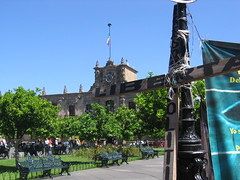
State house (Jalisco)

The National Immigration Institute (INM) released figures earlier this week showing that Jalisco has more foreign-born residents than any other Mexican state except for Baja California. (Chihuahua, which like Baja California is also on the border, placed third in the survey. It wasn't mentioned if data from the Federal District were included.)

With booming expat enclaves in the Chapala Riviera and Puerto Vallarta - the latter area spills into neighboring Nayarit state - this news about foreigners in Jalisco shouldn't come as a surprise. The INM said 56,065 foreign-born residents live in the state, a figure that's probably low as many people arriving in Jalisco simply obtain a tourist card - if anything - and stay for less than six months.

Somewhat curiously, a story announcing the INM findings in the Mural newspaper (subscription required) stated:

"La Perla Tapatia [as Guadalajara is referred to] is now considered one of the most cosmopolitan cities in the world."

Not so fast. Yes, Guadalajara is much less provincial than before, but locals still call it El Rancho Grande, in English: The Big Ranch. Many of the foreigners here, according to the INM, are studying in one of the seven local universities. But the city doesn't attract many expats that work and/or run businesses - spare some tech industry workers. (The average age of the foreign-born population is supposedly younger than the average Mexican, but this must simply reflect children born to Mexicans in the U.S. that now live down here.)

Foreign retirees now opt in much larger numbers to settle in the Lake Chapala area. (Take a look at the dwindling membership at the American Society of Jalisco if you don't believe me.) Adding to Chapala's appeal, it has an even better climate and less pollution than Guadalajara. Still, Guadalajara is one of the most livable big cities anywhere and tastes are becoming less conservative - even if the politics and social mores still tilt in that direction.

18 May 2007

Tourist tragedies do not reflect the true Mexico


Photo by Steven H. Miller


Here's the dispatch from Ajijic, published in today's Calgary Herald: http://www.canada.com/calgaryherald/news/story.html?id=e1080d06-0d51-448d-88cf-24a14cf34a0b

Tourist tragedies do not reflect the true Mexico

David Agren, For the Calgary Herald

Published: Friday, May 18, 2007

Chris Wilshere left Toronto several years back for an orchestra job in the sweltering heat of Culiacan, Mexico, a prosperous state capital north of Mazatlan famous for a baseball team called the Tomateros (Tomato Growers) and a shrine to Jesus Malverde, the patron saint of narcotics traffickers.

Some of his colleagues never understood his motives for heading south, but he found a steady paycheque, appreciative audiences for classical music and a pretty young lawyer, whom he married six months ago.

He now promotes one of Western Mexico's largest music festivals, which showcases young Canadian talent.

Wilshere lives in a "glorified dust bowl" that even Mexicans consider dodgy. Narco-gang violence flares often.

Virtually everyone can recount stories of their brushes with narcos -- like the Hummer dealership employee who witnessed someone paying for three new vehicles with a thick wad of cash.

While acknowledging, "Mexico doesn't come without its problems," he considers his adopted home "safe" and expresses few misgivings about his personal security.

"I think that as First World (residents) we get paranoid over the tiniest, insignificant things that may threaten our health or safety."

Before arriving in Culiacan, Wilshere initially began visiting Ajijic (pronounced: Ah-hee-heek), a sedate lakeside village near Guadalajara, where his grandmother had retired. Ajijic attracts Canadian retirees in droves with its perpetual spring-like climate, access to good health care and affordable prices. (Property tax bills run about $100 per year.)

Canadian licence plates are ubiquitous, a Canadian Club chapter meets monthly and a local supermarket peddles Moosehead beer for $3.25 a six-pack.

Ajijic is one of the largest enclaves of Canadians outside of Canada.

The Canadian Embassy in Mexico City estimates some 8,000 expatriates winter in the region.

Approximately 3,000 Canadians live there year round, although with high-speed Internet, VoIP phones and satellite TV, many closely follow affairs back home.

And what they're seeing nowadays -- a spate of tourist misfortune stories -- dismays virtually everyone, including Dan McTavish, the former Canadian Club president in Ajijic.

"Everyone down here can watch City TV, which they get through their satellite systems, and see crime and shootings back in Toronto," he comments.

Crime happens in Ajijic too. A Vancouver man in a neighbouring municipality was shot dead in late 2005 for unknown reasons, although rumours abound about a water dispute. A London, Ont., couple was struck in a January hit-and-run -- an incident that reportedly happened after an evening of drinking.

The story made the front-page of a national newspaper -- as if such calamities never happen in Canada.

The incidents unfortunately blemish Ajijic and Mexico's image, but hardly sour any Canadians on their adopted country, which is generally placid -- spare parts of the northern border region -- and populated by law-abiding people.

Many Canadians express feelings of hurt and embarrassment over the provincial viewpoints streaming out of Canada these days, along with the eagerness to malign Mexico for tourist tragedies that often stemmed from irresponsible or disrespectful behaviour.

"I can't help but feel (these are) individual situations that the media have run to sell papers," says Allan Rose, the former honorary Canadian consul in Guadalajara and a 20-year Ajijic resident.

Rose was consul during NAFTA's advent, a time when "Mexicans actually discovered where Canada was."

He frequently promoted Canada to Guadalajara-area universities and business organizations, which perhaps considered the diplomat "something of a novelty . . . a new-found interest."

Mexicans discovered Canada and now travel north in sizeable numbers for tourist and study excursions, but Canadians never reciprocated to the same degree.

"I'm personally aggrieved and hurt by some of these (negative) references," he says mournfully.

Rob Parker, a former Conservative MP living near Ajijic, also objects to the unflattering portrayals of Mexico, saying,

"If it were that dangerous, Canadians wouldn't be here."

Petty aggravations are rife in Mexico -- like early morning fireworks, discourteous drivers and abusive monopolies -- but it's a fascinating, complex and culturally rich country. Canadians here accept the shortcomings, even if they don't like them, and find it unnecessary and disrespectful to scold Mexicans for how they order their affairs. "It's their country to decide. It's our decision to live here," Parker says. "We like living here."

19 January 2007

Canadians flock to western Mexico, but not necessarily San Miguel de Allende


Photo by Steven H. Miller

The Atencion newspaper in San Miguel de Allende published a feature I wrote on why so many Canadians settle in the Lake Chapala area instead of San Miguel. Basically, the Lake Chapala area is cheaper. The weather is also more agreeable. Most of us didn't leave Canada to freeze in the winter - and San Miguel can get pretty chilly. The Lake Chapala area has also been well promoted in parts of Canada and word of mouth advertising is now really spreading quickly.

Here's the top of the story:

Canadian retiree Dan McTavish, who has lived in Ajijic, Jalisco, for more than a decade, listed several reasons why so many of his fellow Canucks settle in the Lake Chapala area instead of San Miguel de Allende or any other part of Mexico’s interior.

Like many Canadian expats, he mentioned the weather as one of the main factors. The microclimate surrounding Lake Chapala is decidedly less chilly and often described as “perpetual spring.”

“Canadians come to Lake Chapala because it is not as cold as San Miguel,” the former Toronto native said. Additionally, “It is near ... Guadalajara. I can get off an airplane from the US or from Mexico City [on my way back from Canada] and be at my home in 35 to 40 minutes.”

While San Miguel de Allende has a noticeable Canadian community—estimated at about 15 percent of the expatriate population —Canadians seemingly dominate the Lake Chapala area, which is considered the largest enclave of Canadians outside of Canada, except parts of Florida in the wintertime.

Read the whole feature under the community section of Atencion's website.

10 January 2007

Allan Rose: Canadian trailblazer in Ajijic

Allan Rose

Allan Rose served as honorary Canadian consul in Guadalajara for more than a decade. The Ajijic resident was one of the early Canadian arrivals in the Lake Chapala area, which is now site of the largest enclave of expatriate Canadians outside of Canada - spare parts of Florida in the winter. He's a charming and engaging fellow, here's profile I wrote on him for the Miami Herald, Mexico edition: http://www.mexiconews.com.mx/miami/22907.html

05 November 2006

U.S. election stirs passions among ex-pats in Ajijic

254348030_3db86c0529_m

Photo by Steven H. Miller

BY DAVID AGREN
El Universal
Domingo 05 de noviembre de 2006

AJIJIC, Jal. - Wanting to cast a vote in the upcoming U.S. midterm races, St. Paul, Minnesota, native Mary Jo Oberg dropped in at a voter-registration drive being held at the Lake Chapala Society (LCS) in Ajijic to fill out an absentee ballot request just three weeks before election day.
She had requested a ballot previously, but it failed to arrive at her La Manzanilla, Jalisco, home in a timely fashion. While filling out the forms in the lush LCS garden, she described the cumbersome process as "not complicated," but "very legal."

Although the voting-abroad process generated a seemingly endless stream of complaints in Ajijic, passions flared when talk turned to the parties on the ballots - more specifically: the direction the United States is heading, the war in Iraq and the U.S. president.

"I´m very interested in the election because I´d like to see some changes in the policies coming out of the U.S.," Oberg said.

IMMENSE INTEREST

Like the 2004 contest, which produced a charged atmosphere in the Lake Chapala area (Lakeside), the 2006 election is also generating immense interest, even though it´s a mid-term election and the campaigning has been less intense.

Last time around, George P. Bush, the U.S. president´s nephew, and Diana Kerry, the sister of Democratic candidate John Kerry, stumped for expatriate votes in Mexico. U.S. Ambassador to Mexico Tony Garza drew criticism after delivering a speech in Lakeside that many Chapala-area Democrats considered partisan. Friendships reportedly dissolved over political differences.

OPINIONS DIVIDED

This time around, opinions are split once again - not so much along partisan lines, but instead about U.S. President George W. Bush and the war in Iraq.

"It´s easier to identify the pro-Bush and anti-Bush people," said Clifford Rogers, an independent voter, who resides in Ajijic.

"And the two groups aren´t speaking."

New York state native Phil Pillsworth took that description a step further, saying, "I think you could say it´s war versus anti-war."

Pillsworth, who along with his wife Mary were previously Peace Corps volunteers in Brazil, figured left-leaning voters outnumbered their conservative counterparts in Lakeside.

"There´s a certain kind of person that would live abroad and they tend to be liberal," he explained.

His assessment was echoed by Debra Lattanzi Shutika, an English professor and ethnographer at George Mason University in Virginia, who studies migration between the United States and Mexico.

"In general, the (expatriates) I encounter tend to be more liberal than conservative," she commented, referring to the migration trend for all of Mexico and not specifically Lakeside.

GAUGING SUPPORT

Norm Pifer, chair of Republicans Abroad at Lake Chapala objected to portrayals of conservatives as non-travelers. Supporters of his party, he said, generally keep their political views and affiliations to themselves. After his chapter was founded in 2004, Pifer recalled, "A lot of people discovered they weren´t the only Republicans at Lakeside."

Both Democrats Abroad and Republicans Abroad are well represented at Lakeside. Gauging which party draws more support is difficult to ascertain.

"It´s a real mixed bag," Pifer said, adding that local Democrats tend to be more "vocal" and have been organized for longer. "It´s a small fringe group making all the noise."

An Ajijic resident since 2003, he figured most long-time denizens tilt toward the Democrats or, "Whatever party extends Medicare benefits," while the more recent arrivals have diverse political views.

Even with Republicans arriving in larger numbers than before, fortunes for the party at Lakeside, like those for their counterparts north of the border, may be sagging in the short term - something Pifer acknowledged.

"A lot of people, including Republicans, are leaning away from the Republican Party."

Local Democrats, on the other hand, were decidedly upbeat about their prospects. When asked how things were going, Kathie Coull, chair of the Democrats Abroad at Lake Chapala, responded, "Fantastic."

"I´ve gotten beyond excited to just plain giddy."

VOTER DRIVES

To facilitate voting, Democrats Abroad organized a voter registration drive open to all U.S. citizens in the months leading up to the election. Many people, though, waited until the last minute to request ballots - and wound up disappointed.

"We bend over backwards to do whatever we can," said Madelyn Fisher of Democrats Abroad, who helped organize voter registration in Ajijic.

"But there´s only so much we can do."

The ease of voting seemingly depends on the state - or in some cases, the county - involved. Some jurisdictions stopped accepting ballot requests almost a month before voting.

"It´s a very messy and confusing process," said Luis Miranda, spokesman for the Democratic National Committee, which established a web site that simplified voting for expatriates.

"You have to walk people through it."

Miranda added that his party was actively courting expatriate voters. "We can´t take a single thing for granted," he said.

LOW-KEY EVENTS

Despite the presence of approximately 1 million U.S. citizens in Mexico (by some estimates), the Chapala chapters of Democrats Abroad and Republicans Abroad both seemingly arouse little attention within their parent organizations. Local Democrats tried to lure the 2007 Democrats Abroad conference to Lakeside, but lost out to Heidelberg, Germany.

"There are more Democrats Abroad in Europe and they´re working," Kathie Coull explained, adding that unlike most Lakeside Democrats, "They´re not retirees."

Fundraising and membership events are also low key, usually consisting of speeches by local speakers or, in the case of the Democrats, documentary screenings, which, according to Norm Pifer, have included offerings from Michael Moore.

"They recycle that film so many times," he commented.

He said Republican functions at Lakeside "default to the social because we simply can´t afford US$25,000 to bring a speaker down here."

But even with both parties diligently organizing their adherents - Pifer defined his organization´s mandate as "getting Republicans to vote" and not to "change minds" - he said some expatriates simply tune out and stop following U.S. affairs after spending so much time abroad.

"A lot of people here leave the U.S. back at the border."