Showing posts with label Catholic. Show all posts

28 August 2011

Padre Pistolas

IMG_4415
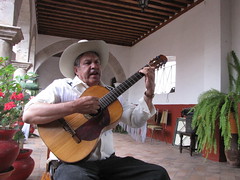
Father Jesús Alfredo Gallegos Lara is better know as Padre Pistolas, a Michoacán priest famed throughout the region for packing heat and singing ranchera and mariachi music. He also has become famous for promoting public works projects - all to the dismay of his superior, the Archbishop of Morelia. The archbishop once suspended Father Gallegos, but politicians from all sides - who regularly seek out his endorsement, including PAN gubernatorial candidate Luisa Calderón, the president's sister - have urged Padre Pistolas to run for public office, knowing his popularity, moral authority and pull with the local population surpasses that of anyone else in church.

I visited with Padre Pistolas recently - hoping, course, he wouldn't pull out his Colt 45 and, say, "Vaya con Dios, muchacho!" He's folkloric, but also very dedicated to his work - and has done more to improve life in the rundown pueblos he serves than any other public figure. The story ran in The Globe and Mail (click the title of this post to read it.)

12 April 2010

Bishop: church treated abuse cases as a "minor cold"

DSC02275

Once again, Bishop Raúl Vera López of Saltillo - fresh off of an Easter homily in which he accused the federal government of waging a phony crackdown on narcotic trafficking cartels - veered from the standard line by speaking candidly on a topic many of his colleagues would seemingly prefer to put behind them.

The bishop - one of Mexico's most outspoken religious leaders - spoke candidly April 12 on the church response to the controversy swirling over the sexual abuse of minors by clergy, saying that in past years the matter was treated as a "minor cold" and not taken seriously enough.

"It was a very superficial way of seeing things. At one time it was believed a priest that had that problem had a cold; it was thought it would go away," Bishop Vera told reporters on the eve of the annual spring planning session of the Mexican bishops' conference.

The comments come as the Vatican defends itself against allegations from a number of countries that it failed to take allegations of sexual abuse committed by clergy seriously. But it also comes as Mexico's most notorious case - that of Legionaries of Christ founder Father Marcial Maciel - receives enormous scrutiny and the order confirms the sordid details of its founder's double life, which was marked by him fathering at least three children and the sexual abuse of seminarians.

Bishop Vera's comments appeared to differ from the recent tone taken by the country's most senior Catholic official, Cardinal Norberto Rivera of Mexico City. The Cardinal, on the Thursday before Easter, read his priests the riot act, saying the Archdiocese of Mexico City would not defend any prelate against allegations of sexual abuse. Barely a week later, however, Cardinal Rivera said the church was under attack, but not in crisis. The archdiocese issued an editorial April 11, saying the church was not being damaged by a supposed crisis that had been provoked by the actions of a few "terrible priests" along with "undeniable outside enemies."


The enemies reference is a nod to the history of sour church-state relations in Mexico, although the church appears to have taken a more active role over the past decade by denouncing the changes to the Mexico City laws concerning abortion and same-sex marriages. The Archdiocese of Mexico City also has an especially sour relationship with the Mexico City government - in part because of measures such as the new same-sex marriage laws and the decriminalization of abortion, but also because the church refused to endorse allegations of electoral fraud made by 2006 presidential candidate Andrés Manuel López Obrador. (López Obrador's PRD party dominates Mexico City politics.)

The posture of the Archdiocese of Mexico on the issue of abuse has been fodder for church critics, however, and his recent admonishment was greeted with skepticism. The day after Cardinal Rivera admonished the assembly of 500 priests about abuse, the newspaper Reforma ran the headline, "Cardinal (finally) condemns pedophilia." One comment on the newspaper's website asked if the April 1 admonishment was an April Fool's prank. Cardinal Rivera had preavious defended the Legion of Christ and its founder in the strongest of terms - even after the Vatican in 2006 asked Father Maciel to renounce his public ministry and lead a life of prayer and penitence. In 2006, the cardinal called allegations the Vatican had punished Father Maciel, "Pure fiction."

The Legionaries of Christ have been a controversial order, but one that successfully courted the wealthy and powerful. (Father Maciel presided at the wedding of Carlos Slim, who would become the world's richest man.) It's fate is uncertain, however: A five-bishop investigative committee recently submitted a report to Vatican that could result in the order being disbanded - or forced to be refounded.

20 March 2010

Tensions mount between Catholic Church, liberal Mexico City government

Why the Mexico City gov't and local archdiocese don't get along (originally published by Catholic New Service in March 2010 ...)

IMG_2030

By David Agren Catholic News Service

MEXICO CITY (CNS) -- Mayor Marcelo Ebrard was witness to five same-sex marriages March 11 in Mexico City's old government building, the first such unions in the country and the first ones under new laws approved in the Mexican capital.

The Mexico City Archdiocese, meanwhile, expressed disappointment. Father Hugo Valdemar Romero, archdiocesan spokesman, said in a statement March 11, "It's clear that Mr. Marcelo Ebrard is responsible for the approval and execution of these laws that are destructive to the family and he doesn't conceal his aversion to the churches and the majority of people he governs, who profess the Christian faith and reject the perversion of their most cherished values."

The disagreement escalated tensions between the archdiocese and the local government. During the last three years Mexico City also decriminalized abortion during the first 12 weeks of pregnancy -- and paid for abortions performed in public hospitals -- and liberalized euthanasia laws.

It also marked a further departure from the good relations the archdiocese and local government shared prior to Ebrard taking office in 2006.

Previously, "Relations between the archdiocese and the Mexico City government had always been cordial," Father Jose de Jesus Aguilar Valdes, director of the radio and TV for the archdiocese, told Catholic News Service.

He emphasized that current relations with the national leadership of the left-wing Democratic Revolution Party -- which dominates politics in much of Mexico City -- are cordial. But with the Ebrard administration and local assembly, "there's been a distancing" and little direct contact, he said.

The distancing runs counter to the current thawing of relations between church and state in Mexico, where the institutions officially had been kept separate for 150 years.Relations between the two often have been strained.

Political observers say current church-state relations are marked by political parties and candidates courting church support even though Catholic leaders have said they don't take sides.

"Church support is not usually the deciding factor (in elections) ... but it helps," said Aldo Munoz Armenta, political science professor at the Autonomous University of the State of Mexico.

Munoz traced the origins of the discord to electoral politics. Specifically, he cited the tight 2006 presidential contest, which former Mayor Andres Manuel Lopez Obrador narrowly lost and considers to have been rigged.

During his 2000-2005 administration Lopez Obrador developed a cordial relationship with the archdiocese. His government even provided money for renovations to the Basilica of Our Lady of Guadalupe and the Metropolitan Cathedral.

Enoe Uranga Munoz, a Democratic Revolution Party member of Mexico's lower house of Congress, told CNS that Lopez Obrador thwarted attempts by the Mexico City Assembly to decriminalize abortion.

"He did it out of conviction, but also because he saw himself as a presidential candidate and had the need for an alliance with the church hierarchy," Uranga said.

For its part, the archdiocese disapproved of a 2005 attempt to impeach Lopez Obrador -- a move that would have disqualified the early frontrunner from the 2006 election. But false assumptions by Lopez Obrador that the church would back his presidential campaign caused relations to deteriorate, Father Aguilar said.

Lopez Obrador and his backers view the 2006 election as a "betrayal," said political historian Ilan Semo Groman of the Jesuit-run Iberoamerican University.

Semo added that the church traditionally seeks good relations with whichever party wins power and recognized President Felipe Calderon's narrow victory.

Lopez Obrador organized mass protests after the election and declared himself, "legitimate president" of Mexico. He refused to recognize the legitimacy of the Calderon administration and, like Ebrard, maintains that posture to this day.

Ebrard won office at the same time as Calderon and, almost immediately, began pursuing a socially liberal agenda. Political observers say he pursed that agenda out of a need to separate himself from Lopez Obrador and lay the groundwork for a possible presidential bid in 2012.

The pursuit of that bid could lead to a worsening of relations between the archdiocese and local government.

"They're using confrontation with the church as their primary weapon," said Uranga, who is openly gay and supports much of the Ebrard agenda -- if not his political tactics.

Some observers see political profit in antagonizing the church, however, mainly because Mexico City is more secular than other parts of the country, due to having an intellectual and political class with anti-clerical attitudes.

"The conflict between Marcelo (Ebrard) and the church is electoral," Munoz said.

"Your enemy is electorally important, and you'll use it as it suits you. Being anti-clerical, for Marcelo (Ebrard), for where he is, is something very convenient."

29 September 2009

Mexican bishops look to Colombians for help fighting drug violence

IMG_0350

Mexican bishops look to Colombians for help fighting drug violence

By David Agren
Catholic News Service

MEXICO CITY (CNS) -- At a press conference earlier this year, Archbishop Hector Gonzalez Martinez of Durango had planned to denounce extortion attempts against priests in his archdiocese. He instead stunned reporters -- and the whole country -- by announcing that cartel kingpin Joaquin "El Chapo" Guzman, Mexico's most-wanted man, was residing in a remote corner of Durango state. Even more stunning, he insisted, "Everyone knows it, except the authorities."

His candor generated nationwide headlines and a warning from presumed associates of Guzman, who dumped two bodies along with a note that advised, "No government, no priest can stand against El Chapo."

Archbishop Gonzalez, the subject of intense media scrutiny, would later respond to reporters' questions with the words, "I'm deaf and dumb."

The archbishop's latter words describe the posture of many Mexicans and church leaders when it comes to denouncing organized crime and addressing a wave of violence that has claimed more than 13,500 lives since President Felipe Calderon took office in December 2006 and sent the army to suppress Mexico's drug cartels.

But that posture may be changing for Mexican Catholics. The social ministry secretariat of the Mexican bishops' conference is preparing a comprehensive report on violence in Mexico that is expected to provide both a diagnosis and an action plan for addressing the problem.

None of the report's authors wished to comment on their findings before its November publication, but the issue of organized crime has been a delicate one for the church. Equally delicate is the peril of wading into the public policy arena in a country with a history of contentious church-state relations and the risks of denouncing powerful drug cartels that act as benefactors and de facto authorities in many isolated parts of Mexico.

"They (church officials) would like to avoid confrontations with the government -- and also avoid confrontations with the narcotic traffickers," said Victor Ramos Cortes, religious studies professor at the University of Guadalajara.

Complete article posted at Catholic News Service, here.

26 April 2009

At church conference, parties find religion

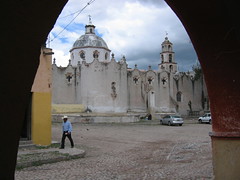
Church in Atotonilco/Iglesia en Atotonilco

At church conference, parties find religion

BY DAVID AGREN
The News

CUAUTITLÁN IZCALLI, State of Mexico - National Action Party president Germán Martínez reminisced about a religious upbringing in Quiroga, Michoacán, while addressing an auditorium of Catholic prelates on Wednesday in this municipality on the northwestern fringes of the Mexico City metropolitan area.

Beatriz Paredes of the Institutional Revolutionary Party followed, speaking similarly about her childhood in the state of Tlaxcala, and of fond memories of the annual patron saint festival in the municipality of Huamantla that fetes La Virgen de la Caridad with predawn pilgrimages and streets carpeted with flowers. Democratic Revolution Party president Jesús Ortega, however, skipped the religious pleasantries and nostalgia and cut straight to politics.

The appearance by the trio of senior political leaders at the annual planning session of the Mexican Bishops' Conference - during which they outlined their platforms and fielded questions on the thorny issues of abortion and religious freedom - was not with without precedent; party officials from the PAN, PRI and PRD had met with senior Catholic prelates prior to the 2006 elections.

But the latest encounter - which also included the presidents of three smaller parties - came as the church has been criticized for wading into the public policy debate with pronouncements, running sharp editorials in church-run publications and lobbying political officials.

Some of the church's hierarchy have even urged Catholics to vote against parties that back policies such as liberalized abortion laws and civil union benefits to same-sex partners.

The encounter - and the recent criticism of the church's so-called meddling - come in spite of strict laws in Mexico that forbid preaching politics from the pulpit, a measure that some church officials want scrapped and say violates their freedom of religion.

"There's a church leadership that is convinced that the church should openly intervene in politics," said Ilán Semo, a political historian at the Universidad Iberoamericana. "[They] have a mentality from the 19th century."

In the mid-19th century, the Reform Laws of Benito Juárez removed the church from the political arena. The Constitution of 1917 reinforced the separation of church and state, along with measures such as prohibitions on the church owning property and priests not being able to wear clerical robes in public.

But reforms approved in 1992 softened many of the anti-clerical restrictions. The softening of the restrictions and the advent of the Catholic-friendly PAN, said Semo, emboldened church officials to opine on public policy and advance a political agenda.

That agenda includes discarding a ban on religious organizations owning radio and television stations and the implementation of religious education in public schools - which are constitutionally mandated to provide schooling that is both secular and free of cost.

The church also wants "freedom of religion" enshrined in the Constitution, which currently only guarantees "Freedom of worship."

Church officials deny allegations that they are attempting to steer parishioners toward preferred candidates or have prelates run for political office, the latter being a violation of cannon law.

They also deny any attempt at blurring the separation of church and state.

"The Catholic Church does not want a confessional state," Archbishop Carlos Aguiar of Tlalnepantla, president of the bishops' conference, said after the meeting with the party presidents on Wednesday.

"The church," he said, "will not be for or against any political party . [and] will promote the importance of the electoral process."

PARTISAN TIES?
The PAN's Martínez on Wednesday enthusiastically backed church participation in promoting democratic values and "fighting absenteeism"

"We're a party that for 70 years has said that there should be freedom, not only of worship, not only of the profession of faith, but rather . a broad and full religious liberty," he told reporters.

Martínez's party has long been accused of being too cozy with the church hierarchy. But church observers say that other parties and political leaders also pursue close church relations.

In Jalisco, for example, the PRI threw its support behind a constitutional ban on abortion after a meeting earlier this year between Cardinal Juan Sandoval of Guadalajara and state party president Javier Guízar.

"Cardinal Sandoval himself often says that PRIístas are the ones that visit him the most," said Víctor Ramos Cortés, a religious studies professor at the University of Guadalajara.

HOT BUTTON
Unsurprisingly, the abortion issue surfaced at the bishops' conference meeting this week.

Only the PAN's Martínez declared his party, "Pro-life;" his PRI and PRD counterparts said that they personally favored the decriminalization of abortion - especially in certain circumstances - but added that blanket positions on the issue would fail to work in their parties due to diverse views on the subject and differing regional sensibilities.

Social Democratic Party, or PSD, president Jorge Díaz Cuervo, whose party is running on a platform that includes the decriminalizing abortion in the states, was less diplomatic.

Díaz Cuervo demanded that the church stay on the sidelines and butt out of people's personal lives. (The PSD platform also calls for legalizing drugs and providing expanded rights for gays and other minority groups.) He cited scripture to make his point.

"As a Catholic, It suits me to pay unto Caesar that which is Caesar's and unto God that which is God's," he said. "As a Mexican, I back the Constitution of 1917 that separates church and state."

His comments were received with a polite, tepid response from the audience. Cardinal Sandoval, for one, did not applaud.

PUBLIC STATEMENT
It remains to been seen what the consequences of the church's interventions into politics will be.

The Interior Secretariat has dismissed several recent complaints over church actions, including one from the PSD regarding a list of "electoral sins" issued by the bishop of Cuernavaca that urged the faithful to vote against any party promoting abortion and gay marriage.

But while government enthusiasm for enforcing laws against church interventions into politics has been minimal, the public has been more enthusiastic in denouncing the blurring of church and state lines.

In Jalisco, a state government donation last year for the construction of a Catholic temple generated such public outrage that the money was returned.

Religious observers say that even though most of the Mexican population is Catholic - and the church ranks as one of the country's most trustworthy institutions - the public draws a line at a certain point when it comes to power.

"People are Catholic ... [but] they don't want priests running the country," Ramos Cortés said.