
By David Agren, in San Miguel de Allende, Mexico
At first glance, Nina Harman's open-toe shoes with elastic straps and a small heel hardly seemed ideal for traversing the steep cobblestone streets of San Miguel de Allende, Mexico, a colonial town with a mushrooming expatriate population. In reality, she walked circles around her two visiting friends, who were wearing sports sandals, which supposedly offered plenty of support and had rubber soles.
"I hike in these," she boasted while taking a lunch break.
"I do everything in these shoes."
Everything includes going to formal events. The shoes, dubbed, "Combat, cocktail sandals," are extremely practical, yet elegant enough for classy occasions. Its deft mixture of style and functionality has won it an immense following in expatriate circles and increasing in markets beyond Mexico. The shoes combine a firm elastic upper with a sole designed for comfort and come in more than 500 styles, ranging from sandals to wedges, and 100 colors, including eclectic shades like green apple and teal. Ankle boots and mule-style models have recently been unveiled.
Harman said the shoes "really support your feet and allow them to breathe."As a bonus, "They make my Size 9 foot look like a Size 5."
"Even with high heels, your feet feel secure."
The shoes' inspiration came from an improbably source: an accountant. Santiago Gallardo along with several family members founded San Miguel Shoes 13 years ago. Gallardo previously worked as an accountant for several shoe factories before dabbling in shoe design. Despite his profession's reputation for dullness, Gallardo designed the original models. The business was based in San Miguel due to the town's tourist traffic and large expatriate population.
The expatriates brought the shoes to Canada, where footwear importer Cedric Morrice, learned of the trend. He described San Miguel Shoes as "all-age ... not necessarily a young shoe."
Although not yet one of his best-selling imports, he acknowledged, "My wife owns about six pairs."
San Miguel Shoes sell for around $35 in Mexico – depending on the model – but go for $80 - $100 in most Canadian boutiques. (Large chains generally don't stock the shoe).
Santiago Gallardo said his firm now produces some men's models, but has stayed focused on the female market because, "Women spend more."
When spotted the next day, Nina Harman, toting a bag from one of San Migue Shoes' outlets, sheepishly confessed, "I bought another pair," but later added her spend was a symptom of "an acceptable fetish."
Published in the Ottawa Citizen.
09 June 2006


03 June 2006
Isolated indigenous village keeps alive centuries-old customs

Photograph by : D. Agren
Weaving sustains the meager economy of Tlamacazapa, Guerrero. Virtually all of the town’s residents either make or peddle palm-leaf baskets. It takes Vicente Procopio at least two days to weave a large basket, which he later sells on the street in Mexico City’s San Angel district.
Story by : David Agren
Fernando Lopez’s hands move so quickly while weaving a garbage can-sized palm-leaf basket they almost dissolve into a blur. It takes two full days to craft a large basket at his single-room home made of corn stalks with a tar-paper roof in Tlamacazapa, Guerrero, a remote pueblo in the rugged hills near the tourist town of Taxco. After finishing several pieces, he carts his merchandise to nearby Cuernavaca. Each large item fetches up to 250 pesos.
“Sometimes I make sales, other times not,” he said, sitting on an overturned bucket in a smoke-filled hut next to his milpa (cornfield), a large root smoldering in the corner to cook food.
Virtually the entire adult population of Tlamacazapa, like Lopez, either weaves baskets in hillside shacks or sells baskets in Mexico’s major cities. The cottage industry sustains the town of approximately 6,000 residents, but just barely. Tlamacazapa endures on the fringes of Mexican society; an isolated village populated by Nahuatl Indians in one of Mexico’s poorest and most corrupt states, where local caciques (strongmen) have long laid down the law and development is only gradually arriving. Vices and violence are common; ill health is rife.
Lopez’s story is fairly typical. He grew up amid violence and squalor. A good-natured and gentle man with a thick mop of black hair and a mustache, he sells what he and his family weaves. When not weaving, he works a milpa during the rainy season, tilling the thin soil with a hoe. Its modest bounty keeps his family fed. He lives with his wife and two daughters in Tlamacazapa. His two sons peddle bracelets full-time in Cuernavaca. Several of his children died as infants.
He learned weaving from his father, who used to drink heavily and beat Lopez’s mother. She died when Lopez was 14. His father passed on a few years later.
“He had his vices,” Lopez, who turns 50 on June 10, said in a matter-of-fact manner.
“I used to really like working with my father.”
Unable to produce a legal document for his childhood home, Lopez and his five siblings were tossed from their family’s land after their parents’ deaths. Many years later, he gained title to the vacant plot on the outskirts of town, where he now grows corn. Most diets in Tlamacazapa consist of little more than tortillas and salt. Meat and eggs are luxuries.
Many in Tlamacazapa regularly go hungry; Lopez and his family seldom eat three meals a day. Some residents exchange baskets for food, usually on poor terms. Operatives from Mexico’s political parties take advantage of the situation come election time, trading despensas (giveaways of food, building materials and sometimes cash) for votes.
“I’m not going to vote,” Lopez declared, saying the entire despensa scheme turned him off of the electoral process. A short time later he said he might support the Democratic Revolution Party (PRD).
Along with widespread poverty and malnutrition, water problems are rampant. Arsenic and lead contaminate the town’s wells, which dry up as the spring dry season drags on. During the spring months, town residents, toting used 18-litre glue and oil cans, hike several times a day to a well high above Tlamacazapa to draw water. Towards the end of the dry season, a child is lowered deep into the lone well with water to fill the villagers’ cans.
The new PRD state government recently installed a water pipe, but it carries fluid from a contaminated source – and only once a week. Another water pipe also exists; corrupt officials, however, charge high fees to access it. Bottled water is too expensive for most households.
Tlamacazapa also lacks adequate sanitation. Animals live in the streets; dung and debris litter the steep roadways. A Canadian charity started constructing dry latrines, which turn waste material into fertilizer. Some locals apparently sleep in the small buildings to keep dry during the rainy season.
Although living in an inhospitable spot nearly three-hours drive south of Cuernavaca, the local population persists and centuries-old customs are kept alive by the virtual isolation. Many of the women in Tlamacazapa still only speak Nahuatl, an indigenous tongue, and wear traditional costumes, consisting of skirts, sandals and colorful shawls. Trips to the doctor are rare; the local curandera (healer) is frequently called upon.
The isolation began in the 1500s shortly after the Spanish arrived. Legend has it the Indian population of Taxco fled into the hills to escape Hernan Cortes’ cruelty, settling on a mountainside they dubbed Tlamacazapa, which in Nahuatl means, “People of fear.” The basket-weaving industry reputedly took hold shortly thereafter, but no one knows its exact history. According to Lopez, the locals originally made petates (coarsely-woven mats).
The isolation lasted until the first half of the 1900s, when a bumpy road connecting Tlamacazapa with the outside world was finally constructed. Electricity – enough to barely power a small appliance in the average customer’s home – and a few telephone lines also arrived.
“The people never used to leave,” Lopez said.
Nowadays, many men from the town fan out across Mexico, hawking baskets of all shapes and sizes. Prices depend mainly on the distance the sellers travel and the basket size. The women stay behind, producing additional baskets and maintaining households.
Compared to some of his peers, Lopez sticks pretty close to home. On an average weekend, he sells between one and three baskets in Cuernavaca. Foreigners sometimes take home baskets, but “Pochos,” Mexicans back visiting from the United States, purchase more.
“They’re good customers,” he commented. “They pay well.”
Foreigners buy too, “But only when they’re on vacation.”
When working in Cuernavaca, he crashes in a room rented by his sons.
In addition to haggling with stingy customers, Tlamacazapa vendors like Lopez often battle with unscrupulous local officials, who sometimes demand exorbitant fees for permits and confiscate merchandise when payment isn’t forthcoming.
“Sometimes they seize our merchandise and remove it from the area,” he explained.
Buyers frequently travel up the rocky roadway dotted with political posters, roadside crosses and impromptu garbage dumps between Tlamacazapa and Buenavista, Guerrero (another road runs to Taxco, the municipal seat), but they seldom offer fair prices. Lopez occasionally sells to the middlemen, but only when desperate.
“Sometimes if you need food, you’ll sell,” he said.
According to Lopez, “The first time a buyer comes he offers a fair price.” But with each subsequent visit, the prices become less generous. A typical buyer offers only 80 pesos for a large basket. The palm leaves needed for weaving a typical basket often cost the same amount.
To save money, Lopez and his fellow vendors sometimes forgo taking a 20-peso combi ride to Buenavista or Taxco, instead trekking three hours along a mountainous path, which connects the town with a major highway junction.
“Sometimes I walk, hauling my merchandise, when I don’t have enough bus fare,” Lopez explained.
Additionally, Lopez often scours the nearby countryside for palm leaves to save a few pesos. The palm leaves are cut and painted prior to weaving. Each piece is methodically incorporated into the design.
Although it’s a tough way to eke out a living, Lopez seldom complains. He cheerfully recounted stories of living in Tlamacazapa and his adventures selling baskets during a recent visit by foreigners. His daughter Erika, a bubbly 14-year-old with a bright smile and playful nature, acted as a guide. Like many teenagers, she stopped attending school, even though the town has a telesecundaria (a junior high school with instruction via television). Most Tlamacazapa residents marry young.
And the vast majority will continue weaving baskets for the foreseeable future. As Lopez put it: “Here, we don’t have any other work except for the baskets.”
From the Guadalajara Reporter
24 May 2006
Candid, leftish maverick wins debate, emphasizes rights, eschews populism

Story by : David Agren
Shortly after Mexico’s first presidential debate commenced, Patricia Mercado Castro, candidate for the Alternative Social Democratic and Farmers’ Party (Alternativa), broached several taboo subjects in Mexican politics and society: abortion, gay rights and human rights. The other three candidates sharing the stage with her – all of them male – steered clear of the contentious topics, instead preferring to disparage each other and make grandiose promises.
Mercado’s strategy of highlighting her maverick agenda instead of trading verbal barbs paid off. She entered last month’s showdown as a little-known also-ran, more famous for feuding with Dr. Simi – discount drug baron Victor Gonzalez Torres, a man who promised to bring an enormous campaign war chest to the fledgling Alternativa – than her political agenda. She left as one of the victors and, according to several analysts, in a position to play the spoiler role in the July 2 election.
“I think the true winner of the debate was Patricia Mercado,” said Ana Maria Salazar, a Mexico City-based commentator, who also hosts an English-language radio program.
“People had a chance to see her as a presidential candidate and not this crazy woman trying to get attention from the press.”
The latest Grupo Reforma poll pegged support for her campaign at 3.7 percent – enough potential votes to ensure her party remains eligible to contest another election. (Mexican political parties must receive two percent of the vote to stay registered).
Mercado acknowledged the debate changed perceptions and raised her profile.
“Millions of people now know me,” she said in an interview with The REPORTER.
After the debate, people began telling her: “I wasn’t going to vote for anyone, but now I’m going to vote for you.”
It’s the kind of voter Mercado pursues: an independent person, lacking affiliations with any political party or union, who expresses disenchantment with the electoral process.
“What the polls show is that many people have already decided, but the majority ... have decided not to vote,” she explained.
Adding to her independent credentials: Mercado has never been a part of the Institutional Revolutionary Party (PRI), although she said jokingly when answering a question about corruption, “I think there’s an inner priista in all of us.”
Mercado goes searching for open-minded voters in an eclectic array of locations. Mere days after President Vicente Fox vetoed a bill that would have legalized the possession of small quantities of drugs, she attended a pro-marijuana rally in Mexico City’s trendy La Condesa neighborhood – an event her government -supplied security team didn’t want to enter.
Late last month, an overflow crowd in Guadalajara, perhaps Mexico’s most conservative city, jammed a small theatre at ITESM, an elite private university, to hear her speak – far more than originally expected. Most of the students posing questions complimented her debate performance. Others expressed admiration for her decision to challenge for the presidency as the election’s only female candidate.
True to her tactics in the debate, Mercado kept speaking of the same contentious themes, even though she acknowledged, “The masses aren’t going to come out and support me.”
Her candid approach, though, often wins respect.
“Above all, people ask for sincerity ... that you believe what you say,” she commented.
Even if it means patiently explaining in a television interview after the Guadalajara event why rape victims should have access to abortion.
Although running on the political left, Mercado clarifies the differences between herself and the Democratic Revolution Party (PRD) Mexico’s dominant center-left party. While critics tag PRD candidate Andres Manuel Lopez Obrador with the populist label and compare him to Venezuelan president Hugo Chavez, Mercado associates herself with social-democratic regimes in Chile and Spain, which emphasize rights and eschew populism and nationalism.
“(The PRD’s) politics are: I’ll give money to old folks, I’ll give money to other groups,” she said, referencing Lopez Obrador’s program of giving monthly stipends to seniors, something he initiated while serving as Mexico City mayor.
“They’re forming clientelas,” she added, referring to the old PRI practice of establishing constituencies dependent on party favors.
“It’s building dependency.”
Her spot on the political spectrum could pose problems for the PRD.
“The worst thing for the left in Mexico would be if she renounces PRD candidate [Andres Manuel] Lopez Obrador,” said Andres Valdez, a political observer at the University of Guadalajara.
Salazar agreed, explaining, “Her impact is mainly going to be on who she takes votes away from and probably she’s going to be taking votes away from Andres Manuel Lopez Obrador.
“What she represents ... is another face of the Mexican left.”
A longtime champion of women’s issues, Mercado speaks of topics the PRD avoids. Lopez Obrador, who often stumps for votes in poor, traditional pueblos, seldom raises controversial social issues like abortion and gay rights. He instead speaks about jobs, social programs and fighting neo-liberal agendas – in addition to frequently denouncing el complot (conspiracies) against his previously high-flying campaign.
“(Lopez Obrador) is afraid – and I think he’s right – that it would take votes away,” Salazar commented.
The PRD campaign has shed support according to recently-published polls, but the votes appear to be shifting to the conservative National Action Party (PAN) instead of Mercado’s Alternativa party.
Although hovering around four percent in the polls, Mercado gave a one-word answer when asked about her ultimate goal: “Winning.”
From the Guadalajara Reporter
16 May 2006
More problems with Pemex
Gasoline sells for less in Mexico than in the United States, but my old buddy Jonathan Clark points out that many Mexicans prefer filling up at stations north of the border instead of at Pemex (the national oil monopoly). Put simply, Mexican gasoline is sometimes inferior. It's often adulterated and many Pemex franchisees short change their customers.
Read about it here.
Read about it here.
28 April 2006
PRI, PAN candidates trade barbs in tetchy first debate
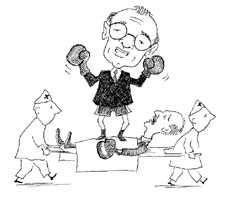
Story by : David Agren
The hype leading up to Mexico's first presidential debate on Tuesday focused on a potentially empty lectern, which Democratic Revolution Party (PRD) candidate Andres Manuel Lopez Obrador, the long-time campaign frontrunner, kept declining to stand behind. Despite being branded a coward, the self-described frontrunner and target of a spate of negative National Action Party ads declined to participate. His reason: They're all going to 'attack me.'
The debate proceeded without Lopez Obrador. Surprisingly, the PRD candidate's absence barely drew attention, spare the moderator's comments: "Andres Manuel Lopez Obrador of the Alliance for the Good of All decided not to participate," and the appearance of an empty lectern on stage.
National Action Party (PAN) candidate Felipe Calderon, who caught Lopez Obrador in the latest Grupo Reforma poll, chided his rival's absence, saying in his opening remarks, "The PRD candidate didn't appear because he doesn't have viable proposals."
Calderon and the three other presidential hopefuls, Roberto Madrazo of the Institutional Revolutionary Party (PRI), the New Alliance's Roberto Campa, and Patricia Mercado of the Social Democratic and Farmers' Alternative, outlined their economic proposals in the debate, which was at times testy, but featured little direct verbal sparring.
Each candidate entered the debate with his or her own objectives: Calderon, to establish himself as the main challenger to Lopez Obrador.
(Several recent polls put the race in a dead heat.) Madrazo, to escape third place and increasing irrelevance. Campa and Mercado, to make a name for themselves and their fledgling parties. Two candidates succeeded, although all claimed success afterwards.
Madrazo, dressed in a classic power suit with white shirt and red tie, zeroed in on Calderon from the get go. The former Tabasco governor branded Calderon, "The candidate of lost opportunities," a reference to the PAN aspirant's tenures as energy secretary and a federal diputado. In virtually every salvo, Madrazo, constantly glancing at notes but speaking firmly, opened with the impolite salutation, "Calderon." In several retorts, he disparagingly said, "Calderon, don't disguise the reality."
The PRI candidate spelled out little policy, except promises to improve Pemex through what he termed, "Modern nationalism," and simplify tramites (bureaucratic procedures) He also expressed solidarity with Mexico's sindicatos (unions that often functioned as party surrogates) and blamed the PAN government for the recent strike violence in Michoacan. Mostly, though, Madrazo attacked the PAN and mocked President Vicente Fox's oft-run TV spots, saying acerbically, "If we keep following this road, we won't even arrive in the second division."
Calderon, in comparison, looked jovial, wore a dark suit with a cheery striped tie and spoke in an upbeat, non-threatening tone. Unlike Madrazo, he often grinned. He doled out as much as he received, but in a less ominous manner. After Madrazo accused the panista of receiving an improper loan, Calderon flashed a photo of a Miami penthouse apartment supposedly owned by the PRI candidate. Calderon mainly promised a potpourri of things - not unlike the PRD campaign has been accused of doing - during his allotted time: Lower taxes, banning employment discrimination against pregnant women and opening daycare spots for working mothers.
As the only woman in the debate, Patricia Mercado advanced issues the other male-lead campaigns mostly overlooked: gay rights, access to abortion and gender issues. She summed up her views with the statement, "Inequality is more profound than poverty." The candidate also differentiated herself from the PRD and Lopez Obrador, identifying her politics with those of left-wing governments in Chile and Spain.
Mercado's new party must capture at least two percent of the vote in order to run again in future elections. A strong performance helped her cause.
Roberto Campa on the other hand looked out of place, although he made the understatement of the night, "It's difficult for a new party to win the presidency." His performance made that task even tougher. The scowling candidate spoke with a jerky cadence and gestured awkwardly. Mostly, though, he repeatedly attacked Madrazo, the man who kneecapped Elba Esther Gordillo - Campa's ally in the teachers' union - during her tenure as a PRI vice president. Most contentiously, Campa charged Madrazo with evading taxes, brandishing an SAT (revenue department) document to supposedly prove his point.
Madrazo rebuked Campa and the following day filed suit against the New Alliance candidate.
All of the candidates claimed victory after the debate. Lopez Obrador said the debate had no impact on his campaign. He later rolled out vaguely familiar conspiracy charges, alleging that two unfavorable polls released on Tuesday were just slick marketing.
Analysts were split on how Lopez Obrador's absence will impact the campaign. Most commentators in Mexico's large dailies lauded
Calderon and Mercado's performances and scorned Madrazo and Campa.
Lopez Obrador pledged to attend the second presidential debate scheduled for June 6.
From the Guadalajara Colony Reporter.
22 April 2006
Presidential campaign takes a negative turn
Story by : David Agren
Recent National Action Party (PAN) ads crudely brand longtime presidential frontrunner Andres Manuel Lopez Obrador of the Democratic Revolution Party (PRD), "A danger for Mexico." Another spot shows a grainy video from 2004 of a former Lopez Obrador associate accepting a large bribe - so much money that bills spilled out of the briefcase. Most contentiously for the PRD, one of the spots associated the left-leaning PRD's candidate with firebrand Venezuelan President Hugo Chavez.
The tenor of the PAN candidate Felipe Calderon's campaign turned negative over the past month as the right-leaning party launched a series of attack ads, an unseemly staple of politics in Canada and the United States. In Mexico, however, the long-ruling Institutional Revolutionary Party (PRI) employed all the dirty tricks - or at a minimum, had its union and media surrogates torpedo political opponents - until it began losing its grip on power in the 1990s. But in a wide-open three-way race for Los Pinos (the President's residence), the PAN resorted to what the PRD dubbed, "A dirty war." The impact of going negative is uncertain, as the PAN pioneers a new - and risky - campaign strategy.
"It's not a tried and true mechanism," said Dan Lund, president of Mund Americas, a Mexico City consulting firm, adding that Mexico is only ending its first decade of running competitive elections.
The Federal Electoral Institute (IFE) stepped in last Wednesday, ordering the PAN to withdraw two phrases from the ads, one which referred to Lopez Obrador as a danger for Mexico and the other that blamed the PRD presidential aspirant for allowing a bribery scandal to occur.
Virtually every opinion poll taken over the past month shows the presidential race tightening and Lopez Obrador losing some support, but no one knows for sure if the PAN attacks are paying dividends. Some pollsters and analysts, though, said Lopez Obrador hastened his own decline.
Roy Campos of Consulta Mitofsky, a Mexican polling firm, opined that Lopez Obrador repeatedly hurling the insult, "Callese chachalaca," towards President Vicente Fox hurt the PRD campaign. (Callese means shut up in Spanish and a chachalaca is a noisy bird.)
Lund agreed, explaining that Lopez Obrador has successfully criticized President Fox over the past five years - most notably while serving as mayor of Mexico City - but avoided disparaging the presidency.
"He kind of crossed the line," Lund said. "It was a self-inflicted wound and it might have made the negative campaigning relatively effective in this period."
Despite complaining bitterly about the PAN attacks, the Lopez Obrador campaign failed to respond in kind. Political parties in Canada and the United States often launch equally vicious counterattacks when under fire, drawing on large campaign war chests.
Lund attributed Lopez Obrador's quiet response to the fact that, "The PRD doesn't have the money. It never has."
Author Elena Poniatowska - along several other intellectuals - jumped to Lopez Obrador's defense, but she later found herself on the receiving end of PAN barbs. Lund called attacking Poniatowska a mistake, pointing out, "(The PAN) united the lukewarm intellectual left of Mexico City behind Lopez Obrador - something he hasn't been able to do on his own."
In spite of immense criticism, the PAN refused to withdraw the attack ads citing the party's right to "freedom of expression." Cesar Nava, a senior PAN official, downplayed the IFE decision. In a press release, he said, "The IFE decision isn't really going have a big impact on our campaign because people now know that Lopez Obrador is dangerous."
Although no solid proof of Venezuela interfering in Mexico's election has ever surfaced, the PAN made no apologies for linking Lopez Obrador with Hugo Chavez, a populist leader who has refused to abate a low-level feud with Fox. The South American country has accused the PAN, PRI and the Mexican media of running a smear campaign.
The PAN, and not the Calderon campaign, purchased the attack ads, something Lund viewed as a sign of possible disorder in the governing party and the Calderon camp.
"They don't have a united campaign," he observed. "They have the president, who's uncontrollable and unaccountable. They have their own party, which is far, far to the right of Calderon and they have Calderon ... and he doesn't have control of his campaign nor his party."
Lund speculated the PAN drew its ideas for a negative campaign from U.S. political consultant Dick Morris, who advised the PAN and Fox in the last presidential election. Morris recently penned a column critical of Lopez Obrador for the New York Post, which ran under the headline: "Menace in Mexico." Fox indulged in some negativity during his successful run in 2000, but Lund said the campaign was introducing a new candidate and new concepts. This time around the long-term results could be harmful.
"Negative campaigning can be survived by a strong democracy with a rich political culture," he said. "But I don't think newly-emerging formal democracies can take much of that. It becomes an overdose of bad news."
From the Guadalajara Colony Reporter.
Recent National Action Party (PAN) ads crudely brand longtime presidential frontrunner Andres Manuel Lopez Obrador of the Democratic Revolution Party (PRD), "A danger for Mexico." Another spot shows a grainy video from 2004 of a former Lopez Obrador associate accepting a large bribe - so much money that bills spilled out of the briefcase. Most contentiously for the PRD, one of the spots associated the left-leaning PRD's candidate with firebrand Venezuelan President Hugo Chavez.
The tenor of the PAN candidate Felipe Calderon's campaign turned negative over the past month as the right-leaning party launched a series of attack ads, an unseemly staple of politics in Canada and the United States. In Mexico, however, the long-ruling Institutional Revolutionary Party (PRI) employed all the dirty tricks - or at a minimum, had its union and media surrogates torpedo political opponents - until it began losing its grip on power in the 1990s. But in a wide-open three-way race for Los Pinos (the President's residence), the PAN resorted to what the PRD dubbed, "A dirty war." The impact of going negative is uncertain, as the PAN pioneers a new - and risky - campaign strategy.
"It's not a tried and true mechanism," said Dan Lund, president of Mund Americas, a Mexico City consulting firm, adding that Mexico is only ending its first decade of running competitive elections.
The Federal Electoral Institute (IFE) stepped in last Wednesday, ordering the PAN to withdraw two phrases from the ads, one which referred to Lopez Obrador as a danger for Mexico and the other that blamed the PRD presidential aspirant for allowing a bribery scandal to occur.
Virtually every opinion poll taken over the past month shows the presidential race tightening and Lopez Obrador losing some support, but no one knows for sure if the PAN attacks are paying dividends. Some pollsters and analysts, though, said Lopez Obrador hastened his own decline.
Roy Campos of Consulta Mitofsky, a Mexican polling firm, opined that Lopez Obrador repeatedly hurling the insult, "Callese chachalaca," towards President Vicente Fox hurt the PRD campaign. (Callese means shut up in Spanish and a chachalaca is a noisy bird.)
Lund agreed, explaining that Lopez Obrador has successfully criticized President Fox over the past five years - most notably while serving as mayor of Mexico City - but avoided disparaging the presidency.
"He kind of crossed the line," Lund said. "It was a self-inflicted wound and it might have made the negative campaigning relatively effective in this period."
Despite complaining bitterly about the PAN attacks, the Lopez Obrador campaign failed to respond in kind. Political parties in Canada and the United States often launch equally vicious counterattacks when under fire, drawing on large campaign war chests.
Lund attributed Lopez Obrador's quiet response to the fact that, "The PRD doesn't have the money. It never has."
Author Elena Poniatowska - along several other intellectuals - jumped to Lopez Obrador's defense, but she later found herself on the receiving end of PAN barbs. Lund called attacking Poniatowska a mistake, pointing out, "(The PAN) united the lukewarm intellectual left of Mexico City behind Lopez Obrador - something he hasn't been able to do on his own."
In spite of immense criticism, the PAN refused to withdraw the attack ads citing the party's right to "freedom of expression." Cesar Nava, a senior PAN official, downplayed the IFE decision. In a press release, he said, "The IFE decision isn't really going have a big impact on our campaign because people now know that Lopez Obrador is dangerous."
Although no solid proof of Venezuela interfering in Mexico's election has ever surfaced, the PAN made no apologies for linking Lopez Obrador with Hugo Chavez, a populist leader who has refused to abate a low-level feud with Fox. The South American country has accused the PAN, PRI and the Mexican media of running a smear campaign.
The PAN, and not the Calderon campaign, purchased the attack ads, something Lund viewed as a sign of possible disorder in the governing party and the Calderon camp.
"They don't have a united campaign," he observed. "They have the president, who's uncontrollable and unaccountable. They have their own party, which is far, far to the right of Calderon and they have Calderon ... and he doesn't have control of his campaign nor his party."
Lund speculated the PAN drew its ideas for a negative campaign from U.S. political consultant Dick Morris, who advised the PAN and Fox in the last presidential election. Morris recently penned a column critical of Lopez Obrador for the New York Post, which ran under the headline: "Menace in Mexico." Fox indulged in some negativity during his successful run in 2000, but Lund said the campaign was introducing a new candidate and new concepts. This time around the long-term results could be harmful.
"Negative campaigning can be survived by a strong democracy with a rich political culture," he said. "But I don't think newly-emerging formal democracies can take much of that. It becomes an overdose of bad news."
From the Guadalajara Colony Reporter.
20 April 2006
Opening Mexico, a review

Reviewed by David Agren
'Opening Mexico'
By Julia Preston and Samuel Dillon
Farrar, Straus and Giroux
516 pages
Young National Action Party (PAN) supporters, celebrating the country's historic vote to cast aside one-party rule at Mexico City's Angel de la Independencia on election night 2000, admonished president-elect Vicente Fox, "No nos falles" (don't let us down). Julia Preston and Samuel Dillon end their book "Opening Mexico" with an account of the scene, perhaps setting the stage for a sequel about the Fox administration, which came to power on a platform of change, but largely dashed expectations.
Their current book, however, brilliantly chronicles the long and torturous road to the point when Mexico became democratic. The book methodically highlights the key events and characters of the struggle, effectively explains the Institutional Revolutionary Party (PRI) system of governance and offers insights into the prevalent attitudes during the decades of one-party rule. The pair filled 516 pages, making "Opening Mexico" a lengthy read, but it's perhaps appropriate, considering that Mexico's fledgling democracy came about gradually.
The book opens and ends with the 2000 election, but the authors peg 1968, the year the federal government violently quelled student protests in Tlatelolco, as their starting point. Perhaps, though, the 1985 Mexico City earthquake, which claimed more than 20,000 lives would be a more appropriate place to begin. The earthquake revealed PRI ineptness and the governing party's callous nature, but on a positive note, the disaster fomented the development of a civil society. Frustrated by a lack of government action, citizens took matters into their own hands, digging through rubble to rescue survivors, while soldiers and police officers stood idly by. Prior to 1985, the PRI system discouraged individual initiative; a top-down management style pervaded all sectors of society.
Homero Aridjis, president of Grupo de los Cien Internacional, a group of intellectuals who advance environmental issues, described the reaction to his organization: "It was a group where people participated voluntarily. The government couldn't figure that out. They couldn't understand the idea of volunteer work or disinterested civic action." (Read Alan Riding's "Distant Neighbors," for a more thorough assessment of Mexican history and society.)
Mexico's press, previously held hostage by political patrons and a government-run newsprint vendor, slowly flowered thereafter, as new newspapers - most notably Siglo 21 (the predecessor to Guadalajara's Publico) - displayed growing editorial freedom. (The pages in "Opening Mexico" describing the history of Siglo 21, which made its name with its intrepid reporting on the April 22, 1992 pipeline explosion in Guadalajara, need to be read by anyone wanting to better understand the derelict nature of Mexico's press in past years).
The earthquake also laid the groundwork for the PRI's near defeat in 1988. Cuauhtemoc Cardenas, the son of a former president, capitalized on immense dissatisfaction in the country, but due in part to a mysterious computer crash at the election headquarters, he lost to Carlos Salinas. Cardenas founded the Democratic Revolution Party (PRD) afterwards and the new entity would become the dominant force in the Federal District.
Preston and Dillon, both former New York Times correspondents in Mexico during the late 1990s, focus heavily on the regimes of Salinas and Ernesto Zedillo - in addition to Carlos Salinas' "hermano incomodo" (uncomfortable brother) Raul. (Raul Salinas, charged with murder, sent the authors letters, protesting his innocence. After a decade in prison, Raul Salinas was released - without ever being convicted. Questions about suspicious foreign bank accounts remain.)
"Opening Mexico" recounts many of the calamitous events of the 1990s, but not in the same detail as Andres Oppenheimer's "Bordering on Chaos", which effectively spelled out the details of the 1994 peso crisis, the EZLN uprising in Chiapas and the murder of Carlos Salinas' chosen successor Luis Donaldo Colosio.
The "Opening Mexico" authors cast Zedillo, the "accidental president," in a hero's role. Although imperfect, Zedillo ushered in many of the reforms necessary for Fox's victory. The former president also locked horns with PRI dinosaurs (the term for old-school party operatives). While former PRI presidents and interior ministers regularly overturned opposition victories in state elections (most notably in Chihuahua in 1986 and San Luis Potosi in 1991, events the authors devote entire chapters to), Zedillo recognized unfavorable polls against his party, instituted primary campaigns and strengthened the Federal Electoral Institute (IFE).
Most effectively though, "Opening Mexico" deftly captures the spirit of the 2000 election and recounts small details of the campaign. Fox, a former Guanajuato governor, who peppered his campaign speeches and interviews with cuss words (he once told a newswire: "I'm honest, I work like a mother------ and I'm not an asshole,") and his team turned the election into a referendum on 71 years of PRI rule. They coined the slogan: ¡Ya! (loosely translated as now, or enough). A two-letter word became a rallying cry for change.
The PRI stumbled in a fair election, depending initially on the advice of several Clinton strategists, who imported the slogan, "Power to the people," which didn’t translate well into Spanish. The PRI eventually dumped the slogan along with its attempts to rebrand itself, "The new PRI."
The Fox strategy worked; he accurately judged the public’s appetite for change. Upon hearing Fox announced the victor on election night, jubilant supporters screamed, "Arriba, Abajo, el PRI se va al carajo (the PRI’s going to hell)."
Since the book was published several years after Fox took power, the authors' epilogue is especially telling. The tone of writing describes the widespread disappointment in Fox's reign better than any of the details about things not changing.
The epilogue ends with the sentences: "Mexico had seemed the perfect dictatorship. Now it was an imperfect democracy."
The 2006 elections will test if democracy has taken root. Regardless of the outcome, Mexican democracy will continue to be a work in progress for years to come.
From the Guadalajara Colony Reporter
Subscribe to:
Posts (Atom)

