25 February 2013

The Twitterverse's take on Thomas Friedman

New York Times columnist Thomas Friedman parachuted into Monterrey and pronounced Mexico the country of the future – an economic rival to India and China. Twitter lit up almost immediately; below is a sample of the reactions – positive and negative.


08 February 2013

Blast from the past: In Chiapas, Zapatistas reappear; why is unclear


By David Agren
Catholic News Service

 SAN CRISTOBAL DE LAS CASAS, Mexico (CNS) -- The National Zapatista Liberation Army once captured the public imagination with a New Year's Day uprising in the this southern Mexican state to coincide with the 1994 implementation of the North American Free Trade Agreement.

 Then-university student Gubidcha Matus recalled the enthusiasm as young people loaded up caravans with food and provisions and headed for Zapatista communities. 

 But that was 19 years ago, and past sympathizers like Matus say Mexico has moved on from the 1990s as a new generation has grown up with free trade, an imperfect democracy and few memories of one-party rule -- even if injustice and inequality persists, especially in indigenous communities.

 "Many in my generation participated" in protests and caravans, said Matus, director of communications at the Catholic-founded Fray Bartolome Human Rights Center in Chiapas. "Many (young people) of today only were born at the time this happened."
 
 The Zapatistas reappeared Dec. 21 -- the day the Mayan calendar turned over and a date erroneously interpreted as the end of the world -- when an estimated 40,000 masked members silently marched in five municipalities.
 
 The reappearance punctured a long period of quiet for the Zapatistas, although Matus said jokingly that many outsiders interpret silence from their pipe-smoking leader, Subcommandante Marcos, as the Zapatista movement disappearing or going into decline.

 Matus and other observers say the mobilization caught many off-guard but provoked no panic. They attribute the marches to symbolism, special dates on the calendar and routine political events, along with making a statement -- not any sort of indigenous uprising.

 "Did you hear?" asked a Dec. 21 statement signed by Subcommandante Marcos. "It's the sound of your world crashing down. It's of our resurgence."

 The statement also made light of new governments on the federal and state levels, ruled by the Institutional Revolutionary Party and its smaller ally, the Green Party.

 The Zapatistas have a sour history with the Institutional Revolutionary Party, or PRI, which governed Mexico for 71 straight years, until 2000, and retook power Dec. 1. 

 The group accuses previous party governments of not respecting a 1996 agreement to provide indigenous peoples with more rights, autonomy and self-governance. The agreement was negotiated with the help of then-Bishop Samuel Ruiz Garcia of San Cristobal de Las Casas, a champion of indigenous peoples but an opponent of armed actions. 

 The Zapatistas also have found fault with the failure to prevent paramilitaries from massacring 45 displaced people from a Catholic pacifist group known as Las Abejas (The Bees) during a December 1997 prayer meeting.

 "There's been no progress" in Chiapas, said Bishop Raul Vera Lopez of Saltillo, who was a coadjutor bishop in the area at the time. 

 Why the Zapatistas marched on a misty December morning remains open to interpretation. 

 Local anthropologist Gaspar Morquecho says Subcommandante Marcos launched a nationwide tour in 2006, which captured little attention or support and resulted in the Zapatistas retreating to their municipalities, where they focused on their schools, clinics and productive activities such as artisan works and producing coffee. He suspects Marcos might want to make another attempt at fomenting a nationwide movement.

 The federal government has responded indirectly to the re-emergence.

 On Jan. 21, President Enrique Pena Nieto visited an indigenous community in Chiapas -- in the heart of Zapatista territory -- to announce a "crusade" against hunger, which is expected to be the social policy focus of his six-year administration.

 He directed his message to the population at large, but the scene of the mid-January announcement suggested someone specific: the Zapatistas.

 "What the federal government did was take a politically opportunistic measure by coming to a (Zapatista) community to launch a crusade against hunger," said Jesuit Father Pedro Arriaga, spokesman for the Diocese of San Cristobal de Las Casas.

 He found it ironic, too. The government, Father Arriaga said, has launch previous anti-hunger programs and the Zapatistas "have always resisted all the government's projects."

 Marcos said the problems the president aims to resolve are not pressing in the Zapatistas' autonomous communities.

 "Our children go to schools that teach them their own history ... as well as sciences ... necessary for them to grow without ceasing to be indigenous," said a Dec. 30 statement from Marcos, who is not indigenous and has been identified by the Mexican government as Rafael Sebastian Guillen Vicente.

 "The indigenous members of PRI attend our hospitals, clinics and laboratories because in those of the government, there is no medicine, medical devices or doctors," he said.

 Father Arriaga said the Zapatistas were getting by OK and had some successes.

 "They're not living in abundance, but they're not going hungry," said Father Arriaga, pastor of the St. John the Baptist Parish in the indigenous community of San Juan Chamula.

 "The most important thing that I take away is that they've eradicated alcoholism," he added. "It's one of the ills in indigenous communities, but the Zapatistas ... they don't drink or sell alcohol in their communities. This really helps their own cause."

 How far that cause spreads remains to be seen. Morchequo sees a "conservative" Mexican population, which has been preoccupied with other matters such as security, and a more complex political landscape for the Zapatistas to confront.

 Still, he noted of the most recent mobilization, "No one thought they could move 40,000 people."

06 January 2013

Migrant workers now focus on Canada

This story ran in the Toronto Star's Weekend World section July 28, 2012, but not online. Be sure to also read the recent Washington Post story on Mexican guest workers heading to Canada. 

UPDATE Be sure to also read The Globe and Mail's excellent story from Puebla state. 

Untitled

Pablo Zamora picks lettuce in Quebec each summer through a guest worker program for Mexican farm labourers. He considers the program safer the illegally jumping the U.S.-Mexico border.

Seasonal program gives safe, more lucrative alternative to U.S.

DAVID AGREN 
Special to The Star

SAN SIMON EL ALTO, MEXICO – Pablo Zamora farmed corn and peas and lived in a shack with a dirt floor in this rancho high in the alpine air and pine forests southwest of Mexico City.


Then he discovered the lettuce fields of Quebec a decade ago and made enough money each summer to support a family back in Mexico and build a three-room residence of brick and cement.

"This isn't the most elegant place," Zamora said, while sipping pulque – a fermented maguey drink resembling a milkshake – in a kitchen adorned with family photos and pots and pans hanging on the walls. "But we're living so much better."

Zamora kissed his family goodbye last week, heading north for another summer of agricultural work near Sherrington, Quebec, where he expected to pick seven varieties of lettuce for $9.70 an hour plus benefits.

He'll join more than 15,000 fellow Mexicans toiling on Canadian farms through a seasonal agricultural program, which has operated for 38 years, been lauded as an example of orderly migration and credited with improving both wellbeing and livings standards in some of Mexico's most impoverished pockets.

Zamora expects to be back in San Simon for the October feting of St. Jude Thadeus, the patron saint of lost causes, thanks to his departing with a work visa and a return plane ticket – two documents other migrants lack when jumping the border in search of work in the United States.

"If you have documents, you're not going to have many problems," Zamora says.

Migration without documents has been a lost cause in recent years for those in San Simon and beyond as the U.S.-Mexico border has become increasingly fortified, anti-immigrant laws have been passed in places like Arizona and Alabama and jobs – especially in the construction sector that previously employed so many Mexicans – remain scant.

An April report from the Pew Hispanic Center found migration between from Mexico to the U.S. has collapsed with slightly more Mexicans returning or being deported than venturing north.

Zamora knows the difficulties and dangers of going undocumented first hand: his brother-in-law died three years ago in police custody after getting a traffic ticket in Georgia.

Such stories are distressing common in Malinalco, the municipality containing San Simon, located 100 kilometres from the national capital in outlying Mexico state.

Ellen Calmus, director of a Malinalco migrant support centre known as The Corner Project, spends much of her time helping families with kin in the United States, who have gone incommunicado – often the consequences of not having legal papers.

She prefers the seasonal Canadian program for a simple reason: "We're not bringing back bodies."

Allegations of exploitation of seasonal workers have been made in Canada – often by unions. Calmus knows the criticisms, but comments, "(The migration) alternatives are all terrible right now."

Sociologist Gustavo Verduzco of the Colegio de México also speaks well of the Canadian Seasonal Agricultural Workers Program.

His research shows program participants after six years are more likely to live in better houses, have higher incomes and are more likely keep their children in school than those staying behind in Mexico.

Safety is emerging as another success of the program.

"(Migrants) might earn more if they went to the United States," Verduzco says. "But they prefer Canada because it's legal and it's safer."

Residents from San Simon seem to know the risks – and say young men are thinking twice about departing without documents

"It's 10 times harder to go than before," said Armando Flores, a cab driver who spent 13 years working construction in Delaware.

Zamora's nineteen year old son, Alexis, expresses little enthusiasm about going north without the proper papers, saying the trip is expensive – human smugglers now charge more – and the path through the Sonora desert can be fatal.

He would prefer to follow his dad to Quebec, but spots in the Canadian seasonal worker program are limited and demand exceeds supply.

Sergio Roman recalled having a 2,000-worker backlog in 2005, when he began working in international affairs for the Mexico state government, and only being able to nominate 45 new participants for the program.

The state government, he says, subsequently began pursuing deals directly with Canadian companies to bring in job-seekers from Mexico state for activities ranging from working in slaughterhouses to processing cranberries.

Workers earn more, bring back skills to Mexico and most importantly, "Avoid loss of life and the abuses of human trafficking," Roman says.

"It's been very popular," he adds, although the 2008 economic crisis put a dent in the demand from Canada.

Zamora notices the growing popularity of Canada, too. "All the young people now say, 'Get to Canada."

01 July 2012

Election 2012 – so far

Untitled
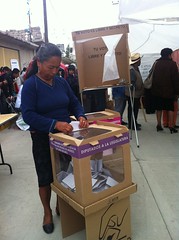
A woman votes July 1 in Chimalhuacan, on the eastern outskirts of Mexico City, for candidates in the 2012 Mexican election

Mexcans voted July 1 amid allegations of vote buying, giveaways and coersion – and ultimately elected former Mexico state Gov. Enrique Peña Nieto as president.

His victory returns the PRI to Los Pinos after 12 years in opposition – during which time it stayed strong on the state level and showed little interest in approving structural reforms.

Peña Nieto now promises those reforms – in the state-run petroleum sector, to name one place – but the PREP vote tabulation is showing it unlikely the PRI will capture majorities in Congress. The president-elect says such an electoral outcome is necessary to improve governance and achieve reforms.

Peña Nieto also captured 38.15% of the popular vote, with nearly 99% of the voting stations reporting. This tops Andrés Manuel López Obrador by 6.5 percentage points – far from the landslide predicted by the polling industry. Considering the non-stop campaigning from the Peña Nieto, the PRI and friendly media outlets, 38% seems somewhat scant. President Felipe lacked the same charm, telegenic looks and marketing muscle – and he achieved only two fewer percentage points in the 2006 election.

As one analyst suggested in a post-election chat, it's possible that the anti-PRI vote continues being alive and well in Mexico and comprising approximately 60% of the population – although, yes, there's a segment of the population very much in favour of the party.

Andrés Manuel López Obrador, trailing in second with a respectable showing, promises to contest what he says are widespread irregularities.

Here's my dispatch on the electoral process for USA TODAY. (Click on the publication title for the link.)

Like most journalists here, I've put together a number of reports for the recent elections. Here's a sampling of what I've had published. (with the link, again, embedded in the publication name.)

Mexican presidential candidates mostly mute on drug wars – USA TODAY

Leftist candidate gains among Mexico's well-off – USA TODAY

Mexicans chafe under political negativity ban – USA TODAY

The Canadian Alliance lives on ... in Mexico! – Toronto Star

Mexico's smooth frontrunner glides ahead – GlobalPost

Viva la diferencia! Mexico City tilts left – GlobalPost

Playboy model, underdog, steal Mexican debate – GlobalPost

11 May 2012

Peña Nieto booed out of the Ibero

Peña Nieto lampooned as Salinas

They booed upon Enrique Peña Nieto's arrival at the Universidad Iberoamericana May 11. They screamed, "Out," then, "Out with the PRI," and even, "Killer." When Peña Nieto finished, the assembled students chased after him chanting, "Coward," forcing him to take refuge in a university restroom.

Peña Nieto, former governor of Mexico state, previously canceled twice on the organizers of the event, ironically titled, "Good Ibero Citizen." His reception and rough ride throughout the nearly two-hour encounter explains why.

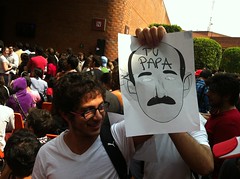
PRI supporters in the audience clutched signs and applauded, but were drowned out by students covering their faces with masks of former president Carlos Salinas de Gortari – who they allege is the brains behind Peña Nieto. Others held banners invoking controversies such as the 2006 crackdown in Atenco and, "Feminicidios," the unsolved murders of women, which critics allege is worse in Mexico state than Ciudad Juárez – something Peña Nieto denied and said was taken serious by his 2005-2011 administration.

The presidential frontrunner – up by 23 points in the May 11 Milenio-GEA/ISA tracking poll – seemed to take all of the jeers and questions in stride, politely responding, never losing his cool and even addressing questioners by name.

It marked the first public demonstrations of discontent with Peña Nieto, whose campaign had been calm and without incidents – until May 11.

But it also marked an escalation the bitter feud between the PRI and the Mexican left and the emergence of a two-man race between Peña Nieto and López Obrador – with Peña Nieto still miles ahead.

It's a natural polarization: the Mexican left hates Salinas (as do many PAN members not in the Jefe Diego faction of the party) for his privatizations and "neo-liberal policies – not to mention allegedly stealing the 1988 election.

Left-wing candidate Andrés Manuel López Obrador, whose campaign appears to be displacing the PAN for second place, unloaded on Peña Nieto in the May 6 debate and has focused his attacks on the nation's TV industry and the PRI – even though he spent much of the past six years belittling President Felipe Calderón as "spurious" and accusing the PAN president of winning a rigged 2006 election.

Some analysts had said prior to the campaign that López Obrador was aiming for a one-on-one, good-vs-evil showdown with Peña Nieto and the PRI. It appears to be emerging.

For its part, the PRI has accused PRD operatives and an unnamed Ibero professor of sabotaging the appearance – much the way the PAN has accused the PRI of planting people to sabotage appearances by its candidate Josefina Vázquez Mota. (Recall the quesadilla stand fiasco in Tres Marías on the road to Cuernavaca.) Party president Joaquín Coldwell – perhaps oblivious to the allegations of past PRI repression being protested – accused the demonstrators of showing, "intolerance."

The encounter at the Ibero followed a morning of questioning from MVS Radio host Carmen Aristegui, who has been scathing in her assessments of the journalistic practices of Mexico's TV industry.

Peña Nieto – showing a willingness to now face tough audiences after an earlier aversion to controversial circumstances – said he had no special relationships with Televisa, the country's dominant broadcaster. He then went to war with López Obrador for supposedly spending big to become known during his 2000-2005 administration as Mexico City mayor. Peña Nieto complained that the mayor of Mexico City mayor has an unfair advantage since media outlets in the capital are in effect national media outlets. He mentioned López Obrador's early morning press conferences as something unseemly, inferring there was something wrong with a politician smartly scheduling media events for a time that would allow the message to reach a mass audience – free of charge.

Peña Nieto, despite being a little-known provincial politician in 2005, somehow gained better name recognition than that of current Mexico City Mayor Marcelo Ebrard. López Obrador has stated flatly that Televisa is attempting to impose its preferred candidate on the country – and has the power to do so since TV is so influential in Mexico, where more homes have television set than a fridge, according to the last census.

Peña Nieto also denied having any special relationship with Salinas and, oddly, said the same of his old boss, Arturo Montiel, former governor of Mexico state and a man even PRI supporters talk of with distain.

The fallout of the Ibero appearance remains uncertain, along with the media spin. More likely is that the campaign is becoming a two-man race with López Obrador staking his claim as the preferred alternative for those seeking to block Peña Nieto and the PRI.

-- Updates can be found on Twitter: @el_reportero

07 May 2012

The Debate, winners and losers

The IFE edecán

WINNERS

ENRIQUE PEÑA NIETO

The Institutional Revolutionary Party (PRI) candidate entered the debate with a 20-point lead and nothing happened to impact that, even though he took repeated shots from from his two main opponents.

He left many of his thoughts on serious matters unfinished, said political science professor Aldo Muñoz Armenta of the Autonomous University of Mexico State, but none of that will hurt Peña Nieto since he adequately defended himself and had no major gaffes.

In effect: Peña Nieto wins the debate by not losing and his 20-point lead should remain in tact, Muñoz said.

A poll from El Universal gave him the win in the debate – with Andrés Manuel López Obrador, representing three left-wing parties, finishing second; Gabriel Quadri of the New Alliance placing third and Josefina Vázquez Mota of the governing National Action Party (PAN) bringing up the rear.

Anyone looking for gaffes or a repeat of the Guadalajara International Book Fair fiasco – when he couldn't name three books – was undoubtedly disappointed. The amateur hour antics of the pre-campaign period appear to be history. Somebody from the PRI campaign presumably changed the password on his daughter's Twitter account to prevent intemperate tweets, too.

Peña Nieto came in well-coached and while not especially smooth, again, his performance was sufficient.

Peña Nieto's defence of his 2005-2011 term in Mexico state seemed adequate, if not entirely convincing – although enough Mexican voters really do seem convinced that he really did complete the 608 public works projects that he's built his campaign platform on. Just don't ask anyone at a PRI rally try naming one – they usually can't.

Attempts by opponents to revive the memories of PRI dinosaurs seemed to have little impact, too.

If this synopsis seems boring, that's because Peña Nieto's performance was boring – and that's okay for him: it keeps him in the lead by a large margin.

GABRIEL QUADRI

The New Alliance party candidate had nowhere to go, but up – and he soared. He spoke directly and on the issues. He challenged his rivals over policy issues – such as energy subsidies, over which he disagreed with López Obrador – and even chastised the other candidates crushing disinterest in the environment (his main cause) by taking the segment on that topic to attack each other.

Quadri only needs two percent of the vote for the New Alliance to maintain its registration. His strong campaign performance all but assures that. The Quadri campaign now moves from being novelty news – the unveiling of the Quadri combi; his complaining about the bulletproof Volkswagen Jetta given to him by presidential security; no one appearing when he spoke at the World Economic Forum, to name three headlines – to someone to be taken halfway serious. Of course, there's no hope in hell of him winning the election. He might make a good environment minister in a PRI government, though.

If there's a flaw with Quadri, it's his party affiliation

The New Alliance does the political bidding for thew SNTE teachers' union and its boss Elba Esther Gordillo. She effectively owns the New Alliance and assigns its candidacies to her children and grandchildren.

To paraphrase what a friend tweeted during the debate: Quadri is turning in a strong performance, but his party ...

ELBA ESTHER GORDILLO

Thanks to Quadri's performance, the New Alliance should obtain the two-percent of the vote necessary for maintaining its registration. This means collecting a share of the more than $3 billion in public subsidies showered on political parties by the Federal Electoral Institute (IFE) over the past 12 years. It also means having political positions for SNTE boss Elba Esther Gordillo to give her children and relatives. Daughter Mónica Arriola and son-in-law Fernando González are running for Senate seats in Chiapas and Sinaloa respectively. A grandson is running for the Mexico City Assembly.

Gordillo's kin might have had a better shot of being elected had the New Alliance-PRI electoral alliance not unravelled due to priístas (mostly in states without a sitting PRI governor to impose order) revolting against the handing over of too many candidacies to a junior partner. Quadri's improving candidacy makes that history moot, although the Muñoz, the political science professor and labour expert, says the teachers are deft political operators and make deals to swing local races in favour of whatever candidate suits their purposes.

THE EDECÁN

The model with the cards, deciding the order the candidates would speak in, stole the show – or, more aptly, her revealing attire did, or, as the AP put it: no one was looking at the urn she was carrying. Certainly Quadri wasn't looking at the urn. As a female friend quipped on Facebook, under a photo of the model: They're more fake than the candidates.

Julia Orayen has posed for playboy and now has a new lease on her modelling life thanks to whoever hired her (apparently an IFE contractor) to work a supposedly serious political function while wearing that dress.

PERFORMED WELL

ANDRÉS MANUEL LÓPEZ OBRADOR

AMLO came out with guns blazing, even though he's been speaking of peace and love during his campaign. He invoked characters from the distant past such as General Antonio López de Santa Anna, who was president of Mexico 11 times during his calamitous career. More recent characters included former president Carlos Salinas de Gortari, a favourite whipping boy of non-PRI politicians, and Arturo Montiel, Peña Nieto's predecessor and former boss in the Mexico state governor's office.

Political analyst Fernando Dworak said AMLO had a discourse still stuck in the 1990s. That was especially obvious when AMLO brought up the scandalous banking bailout Fobaproa.

Invoking Salinas and Fobaproa incited outrage the first time López Obrador ran for president in 2006, but it would seem less so now. Equally uncertain is the impact of López Obrador alleging that the broadcasting industry is imposing its candidate (Peña Nieto) on the country or his railing against the country's privileged elite. (Even if he's correct.)

He delivered the exchange of the night. When Peña Nieto countered allegations made against PRI dinosaurs by bringing up the case of René Bejarando – the ace DF organizer caught stuffing bills into a briefcase – AMLO responded: Bejarano went to jail, unlike any priístas.

His performance makes it likely that he'll overtake ...

LOSERS

JOSEFINA VÁZQUEZ MOTA

The PAN candidate bet heavily on the debate rescuing her campaign. Given those kinds of stakes, she fell short in the debate, even though some in an audience convened by the Reforma newspaper ranked her highly – drawing ridicule from Twitter users about what debate they were watching.

Like AMLO, she went on the attack. She brought up the Coahuila debt situation. She brought up the Mexico state debt – something Peña Nieto refuted. She also brought up the fib from Peña Nieto's informe (state-of-the-state address) that the homicide rate fell 50% in Mexico state between 2005 and 2010. (Peña Nieto has since retracted the claim.)

But it's uncertain if going negative has helped Vázquez Mota so far in the campaign – and it's unlikely going negative in the debates will help any more. She appeared stiff during the debate and clumsily moved to address topics she felt important – such as her carrying on about Pemex and the CFE near the end.

Her campaign needed a miracle – which former President Vicente Fox said was necessary and in which he believes. It didn't arrive last night.

06 May 2012

The Quadri combi shifts into high gear

Nueva Alianza rally in Morelia

Talk about a revelation!

Gabriel Quadri, the man polling one percent and representing a party belonging to the powerful SNTE teachers union, cleaned up in the first presidential debate by talking issues.

His performance was reminiscent of 2006, when Patricia Mercado of the now-defunct Alternativa spoke of issues such as gay rights, equality, abortion and drug legalization – all as her opponents attacked each other and ignored her.

Her party won two percent in the election that year, enough for it to survive until the 2009 midterms and elect five lawmakers in Congress. (A civil war ultimately did in the Alternativa, renamed PSD by the anti-Mercado victors) It's survival also meant that it collected tens of millions of dollars in subsidies that are showered on Mexican political parties.

Here's my two cents on Quadri's performance – and let it be said that the "edecán" (the model in the suggestive dress at the beginning of the event) would probably win the most votes for highlight of the night.

Quadri entered the debate with low expectations. He was polling roughly one percent and making headlines by starting his campaign by reef diving in Veracruz and being offered a bulletproof Volkswagen Jetta by presidential security – his campaign was deemed that insignificant. He later ditched the Jetta for a turquoise-coloured Volkswagen van – the colours of his Nueva Alianza party, which draws its name and logo from the defunct Canadian Alliance.

Yet he stole the show.

He especially shone when tackling the issue of energy subsidies, saying correctly that the country spends more money on making gasoline cheap than alleviating poverty through the oft-acclaimed Oportunidades program – meaning the rich collect most of the cash. He later attacked the "segundo pisos," the elevated express lanes in Mexico City and the State of Mexico, saying they benefitted a privileged group: motorists – the same group benefitting from all the toll roads built by Peña Nieto in the State of Mexico, part of the 608 public works projects he takes credit for in his home state.

Quadri did some of SNTE boss Elba Esther Gordillo's dirty work during the debate, when he blasted the radicals in the "normales" (teacher training colleges) who are "La Maestra's" most bitter enemies.

He will likely surpass the two percent threshold, guaranteeing survival for the Nueva Alianza. It also means seats in the Congress and Senate for the party – and, should the vote tally rise, seats for Gordillo's relatives. Gordillo's daughter is running for the Senate in Chiapas, her son-in-law is running for the Senate in Sinaloa and her grandson is on the proportional representation list for the lower house.

It must be said that Quadri looked like a marvel compared to the Nueva Alianza's 2006 candidate Roberto Campa, who scowled through much of the first debate that year and repeatedly attacked PRI candidate Roberto Madrazo – the man who ousted Gordillo from the PRI.

It also must be said that he won – and no one was betting on that.

08 February 2012

Mexico's national voter IDs part of daily life


Anyone wishing to participate in the July 1 election must present a valid voter identification card issued by the Federal Electoral Institute (IFE). The introduction of the card largely cleaned up of the in-person voting part of Mexican elections, where poor folk in rural areas were previously given sandwiches and soft drinks and then taken to vote – as many time as necessary. (Nowadays, cash is a common inducement.)

The identification also bolstered the IFE, which only came into existence 20 years ago as part of a democratic transition in Mexico. While the IFE, which convenes elections and referees partisan political activity, has come under fire from the country's political parties – witness their sacking of the nine-member board back in 2007 and constant disagreement on choosing commissioners – the validity of the credential remains strong. In fact, many people lining up showed little enthusiasm for voting this year (mainly due to dissatisfaction with the candidates) but said they needed the IFE credential for carrying out the most mundane activities: going to the bank, getting into a bar, boarding an airplane, etc.

I wrote about the IFE credentials for USA TODAY. Click here to read it.

30 January 2012

Adios to Club Indios de Ciudad Juárez

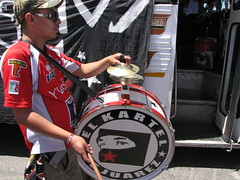
El Kartel de Juárez
Soccer fans in Ciudad Juárez go by the name, "El Kartel," in order to make fun of the violence and drug trafficking that has plagued the Mexican border city.

Club Indios de Ciudad Juárez was the little team that could, ascending to the top tier of the Mexican soccer league within three years of being founded, staving off relegation (in a system rigged to favour the incumbent franchises) and quickly reaching the semi-finals in early 2009. It all seemed to good to be true – and it was.

Ciudad Juárez lost its soccer team recently, another blow to the city, which some local observers say has showed signs of improvement. The Mexican Football Federation revoked the franchise, saying its ownership groups wasn't paying employees and players. But Mexican soccer observers say the team was always an inconvenient franchise; some teams almost refused going there to play due to the violence, while the ownership group was underfunded in a league awash with wealthy owners such as Grupo Modelo and Televisa.

The team always had plenty of support from fans, however – known as "El Kartel de Juárez" – and soccer became a diversion in a city overwhelmed with violence and bad news. I attended the final game Indios played in Ciudad Juárez as part of the top tier back in April 2010 and posted these photos to a Flickr site. I also wrote about the loss of the franchise for the Toronto Star.

13 January 2012

Why the pope is visiting Guanajuato – and during the prelude to an election

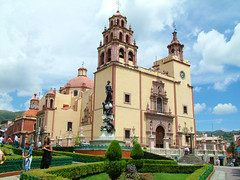
Central Guanajuato City, Mexico
Photo by Steven H. Miller

By David Agren Catholic News Service

MEXICO CITY (CNS) -- In 1941, the Mexican government -- under the control of a predecessor to the once-dominant and anti-clerical Institutional Revolutionary Party --- and the Catholic Church made peace, sealing their pact in the state of Guanajuato.

Seven decades later, with the Institutional Revolutionary Party favored to regain the presidency in elections later this year, church and government leaders will meet again in Guanajuato, where Pope Benedict XVI will visit March 23-26 -- at a time church-state relations have decidedly improved.

"It's a very emblematic state, where ... there have been the biggest conflicts ... and the biggest pacts between church and state," Ilan Semo, political historian at the Jesuit-run Iberoamerican University, said of Guanajuato.

The 1940s pact ended a quarter-century of strife marked by the Cristero Rebellion -- when fighting flared and churches closed for three years in the late 1920s. But church and state remained estranged for much of the last century, and the Vatican and Mexico only established diplomatic relations 20 years ago.

Relations, however, have warmed to the point that President Felipe Calderon -- whose Catholic-friendly National Action Party has governed since 2000 and draws strong support in Guanajuato -- will personally welcome Pope Benedict March 23 for a four-day visit to a region known for the Cristero Rebellion and conservative Catholic politics.

For church observers such as Semo, the setting and timing speak volumes, especially as Mexico moves into an era of improved church-state relations that promises to lift lingering restrictions on church-sponsored speech and potentially promises to provide prelates with a voice in the nation's political and public-policy arenas. But church officials publicly caution against reading any symbolism into the papal visit.

The visit is scheduled barely three months before state and federal elections -- a time previously unthinkable for a papal tour of Mexico, where references to Our Lady of Guadalupe during campaigns have been enough to annul elections.

Pope Benedict is scheduled to celebrate Mass for more than 300,000 Catholics at the foot of the Cerro del Cubilete, a hill topped by a massive statue of Christ considered emblematic by those remembering the Cristero Rebellion and the martyrs since canonized.

"Symbolically, (this) reinforces the presence of the church in Mexico," said church observer Victor Ramos Cortes, professor at the University of Guadalajara.

The visit to Guanajuato, he added, comes as the church has canonized some and beatified even more martyrs of the Cristero Rebellion.

"(The visit) has to be related to with this (church) attitude ... over the past decade and a half ... of putting the Cristeros at the center of their attention," he said.

The Mexican bishops' conference secretary-general, Auxiliary Bishop Victor Rodriguez Gomez of Texcoco, told reporters Jan. 1 the pontiff would visit Guanajuato because of logistical and health reasons. Silao, site of the Mass, is roughly the geographic center of Mexico, while the pope's physicians ruled out a trip to populous Mexico City due to its high elevation -- more than 7,300 feet.

Additionally, Blessed John Paul never visited the area during his five trips to Mexico. The trip to Mexico -- and later Cuba -- is Pope Benedict's first to the countries since he was elected in 2005.

Pope Benedict arrives in Mexico at a difficult time as violence attributed to warring drug cartels and organized crime has claimed more than 40,000 lives over the past five years.

In a statement, the bishops called the trip, "A motive of hope and confirmation of faith in the Lord."

Others in the church, such as Father Robert Coogan, an American ministering to prisoners in northern Mexico, wondered, "What message will he bring for nation that's suffering?"

For the many Mexican media outlets, the trip's timing and location were the message, especially given Guanajuato's stature as the country's most Catholic state -- 94 percent, according to the 2010 census -- and history of spawning conservative movements with friendly policies toward the church.

The National Action Party, founded in 1939 by those in opposition to revolutionary principles, grew strong in the region, where an especially secretive Catholic faction known as "El Yunque," or "The Anvil," supposedly still holds sway.

At the same time, a Catholic agrarian movement known as "Sinarquismo" surged, even though its leaders were openly anti-Semitic and admired fascist leaders of 1930s Europe, and its handful of followers do so to this day.

Guanajuato Gov. Juan Manuel Oliva -- who makes no secret of his piety -- accompanied Archbishop Jose Martin Robago of Leon in inaugurating a new plaza Jan. 2 near the Leon Cathedral. The plaza was built with public money and features a mural highlighting the massacre of victims protesting 1946 election fraud.

Former President Vicente Fox, who ended one-party rule in 2000, also hails from the state.

Fox's party is not favored to win the upcoming presidential elections, but observers such as Ramos say church-state relations will continue warming in the coming years, and Catholic leaders will exert ever more influence, even if the Institutional Revolutionary Party regains power.

"They (church leaders) want to be active in the direction of the country," the professor said.

08 January 2012

Politics and the "pista de hielo" (ice rink)


The Mexico City ice rink – built by the Federal District government in the middle of the expansive Zócalo – ends another wildly successful run Jan. 7, having attracted thousands of want-to-be skaters daily to what has become unlikely winter attraction and unlikely political prop.

The rink debuted in 2007, thanks to Mexico City Mayor Marcelo Ebrard. He also built urban beaches and opened weekend bike baths. The opposition National Action Party (PAN) branded the ice rink and his other projects, "Bread and circuses," given the pressing problems in the Federal District with traffic, water and garbage.

But the rink proved a smash hit with long lines forming in the pre-dawn hours. The reason: It's free – all the skaters and local officials say.

The rink occupies a spot in the Zócalo, the most prominent landmark in the capital and a seat of power dating back to Aztec times. All politicians aim to project power from the square, says local columnist Adrián Rueda, a keen observer of D.F. politics. And in the case of Ebrard, he needed to project power in the hopes of winning the Democratic Revolution Party (PRD) presidential nomination in 2012 – something that will once again go to Andrés Manuel López Obrador.

Ebrard, political observers say, came to power lacking control of the corporatist groups in the 16 boroughs – many of which were capably managed by René Bejarano (infamous for the cash-in-a-suitcase video scandal and a López Obrador affiliate) and René Arce, the Senator once part of the PRD, but now in the Green Party, who holds enormous influence over Iztapalapa.

To build his own base, Ebrard turned to the "circus" – a tactic learned from his mentor, former Mexico City regent Manuel Camacho Solis. The circus (the ice rink and the such) allowed him to gain favour among the masses and, to some degree, break the power of the client groups. Unfortunately for him, it wasn't enough to win the PRD nomination this time around.

I recently wrote on politics and the ice rink for the Toronto Star. Read it here.


06 January 2012

The Russians are coming ... to Mexico?


At a time U.S. tourists might think twice about vacationing in Mexico, Russians are flocking to destinations like Cancún in ever-growing numbers. Demand is so great that Aeroflot recent inaugurated direct Moscow-Cancún service.

Russians aren't the only ones looking past the negative headlines: Tourist visits from Brazil increased by roughly 60 percent last year.

I recently wrote for the Toronto Star on the trend of non-U.S. tourists flocking to Mexico. Click here to read it.

11 November 2011

Interior Minister perishes in helicopter crash


Mexican Interior Minister Francisco Blake Mora died Friday in a helicopter crash, the second time in three years the most senior member of President Felipe Calderón’s cabinet has perished in an aviation disaster.

Federal government spokeswoman Alejandra Sota confirmed the death shortly after 12:30 p.m. local time. The crash, just to the southeast of Mexico City, claimed the lives of Blake, 45, along with seven passengers and crew. There were no survivors. Calderón was reported en route to the crash site. It's uncertain if he will depart later on Friday for APEC meetings as originally planned.

Blake becomes the second interior minister to suffer an untimely death in barely three years. Former interior Juan Camilo Mouriño perished Nov. 4, 2008, when his small jet plunged into a street in the swank Lomas de Chapultepec neighbourhood. Investigators blamed the crash involving Mouriño – long the domain of conspiracy theories – on pilot error.

Both men were key figures in the country's national security cabinet and coordinating security matters during a time that organized crime violence increasingly spread into previously placid pockets of Mexico.

Aviation crashes involving senior government officials have been distressingly frequent over the past decade. Colima governor Gustavo Vázquez died in a 2005 plane crash. More recently, a helicopter belonging to the Mexico state government crashed last month in the Coyoacán borough of Mexico City, killing two state officials. Billionaire businessman Moisés Saba died in a helicopter crash during bad weather in the western part of the Federal District in January 2010.

It's still uncertain who might replace Blake as interior minister, the most senior cabinet position and one responsible for internal security and overseeing agencies ranging from the National Immigration Institute to civil protection to Cisen, the country's intelligence service. The interior minister also acts as a liaison between the federal government and Congress and the 31 state governments.

Blake Mora was an unlikely choice for interior minister, having previously spent most of his political career in the Baja California state government and serving with Calderón in the federal lower house of Congress.

He sas the fourth interior minister of the Calderón administration and he replaced a political heavyweight: Fernando Gómez-Mont, one of the country's top lawyers and a close associate of none other than Diego Fernández de Cevallos – better known as "Jefe Diego." Gómez-Mont left cabinet after disagreeing with Calderón over the National Action Party's decision to pursue electoral alliances with the Mexican left in order to topple governments in six of the country's most retrograde Institutional Revolutionary Party (PRI) backwaters, including Oaxaca and Puebla.

A distraught-looking Calderón eulogized Blake during comments to the nation shortly after 2:30 p.m., describing the fathar of two as dedicated to his country and someone who emerged from working class roots in Tijuana to earn a law degree and ascend to top positions in the Baja California and federal governments.

No details on the cause of the crash were given.

03 November 2011

More from Michoacán


A poll published Nov. 3 in the Reforma newspaper gives PAN candidate Luisa María Calderón a six-point advantage in the Michoacán gubernatorial contest. Left unanswered is how the Nov. 2 assassination of La Piedad mayor Ricardo Guzmán Romero as he campaigned for Calderón will impact the Nov. 13 election in Michoacán, where the quasi religious drug cartel La Familia Michoacana and a splinter group, Knights Templar, are disputing the state.

It's probable, as happened in Tamaulipas after the assassination of PRI gubernatorial frontrunner Rodolfo Torre Cantú, voter turnout will plunge – something which favours the PRI (witness the low participation in the State of Mexico) as the party gets its mostly poor "voto duro" to the polls with inducements and coercive tactics and the middle classes stay home.

The Reforma poll showed Calderón – a former senator best known for crossing swords with "Jefe Diego" and the sister of President Felipe Calderón – receiving 39 percent support, six points better than PRI candidate Fausto Vallejo. The PRD campaign of Sen. Silvano Aureoles was running a distant third with 28 percent support. More importantly for Calderón the poll showed her campaign gaining ground: Support increased by 10 percentage points from the last Reforma poll in September, while the PRI and PRD campaigns lost ground.

A Calderón victory would bolster the president as he attempts to establish some sort of lasting political legacy for the PAN, which has struggled in local elections during his administration and appears set to be voted from power on the federal level in the July 1, 2012 national elections.

The results could prove disastrous for the PRD. The party has been beset by infighting and its plans to name the 2012 presidential candidate from a poll is expected to generate discontent among the losing side – be it 2006 candidate Andrés Manuel López Obrador or Mexico City Mayor Marcelo Ebrard. The party already has lost the stronghold states of Baja California Sur and Zacatecas. Michoacán, where the party also has been rife with infighting, appears to be next.

The PRI is running competitive in Michoacán, but its campaign has yet to capture any serious momentum – spare the moments when the party's presidential frontrunner Enrique Peña Nieto showed up for a day of campaigning.

One observer, parish priest Jesús Alfredo Gallegos Lara – better known as "Padre Pistolas" – cast some doubt on the Reforma poll, saying the survey was done by telephone in a state where "many of the ranchos don't have phones." The PRD, he told me, draws most of its support from the ranchos.

02 November 2011

PAN mayor shot dead

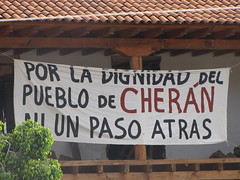
Cherán protest banner
A sign in the Cherán, Michoacán, town plaza strikes a rebellious note. The town rebelled against illegal loggers clear-cutting the local hills with the help of armed criminal groups earlier this year – and ran off the local mayor, too. Michoacán electoral officials want there to be a vote in Cherán, but locals say they won't allow political parties to participate.

The PAN mayor of La Piedad was shot dead while campaigning Nov. 2, casting doubt on the ability to hold general elections across the oft-violent state of Michoacán in 10 days time – and also casting doubt on the ability to hold federal electoral races next year in the pockets of Mexico where organized crime violence has been rife.

Ricardo Guzmán Romero was fatally shot while campaigning for the PAN candidate in the pork-processing town of La Piedad, PAN officials said via Twitter. The circumstances of the assassination remain uncertain, but PAN youth president Jhonathan García, who was witness to the shooting, said via Twitter that the mayor was shot in the abdomen. Press reports say Guzmán was passing out pamphlets when attacked.

Michoacán Gov. Leonel Godoy scheduled a press conference for 9 p.m. local time. Guzmán became the fourth Michoacán mayor to be assassinated since Godoy took office in early 2008, Michoacán news agency Quadratín reported.

Voters in Michoacán go to the polls Nov. 13 in an election Luisa María Calderón, sister of President Felipe Calderón, hopes to win for the PAN. Public opinion polls vary. An Agencia Mendoza Blanco y Asociados survey shows a tight, three-way PAN-PRI-PRD contest, while Gabinete de Comunicación Estratégica gave Calderón 39-36 lead over PRI candidate Fausto Vallejo. PRD candidate Silvano Aureoles Conejo trailed with 25 percent support, setting up a potential embarrassment for the PRD, which had dominated Michoacán politics for the past decade.

The assassination marked the latest difficulty for Michoacán's electoral process, which will renew the governor's office, local congress and 113 municipal governments. The state electoral institute reports the withdrawal of 51 candidates, according to the newspaper El Universal. The PAN-New Alliance coalition, meanwhile, was unable to find candidates in at least 10 municipalities.

Residents of Cherán, where locals ran off illegal loggers, organized crime, the police and the mayor, refuse to allow political parties to run candidates, even though the electoral institute insists on there being a vote.

Violence, of course, predates the election in Michoacán, where La Familia Michoacana and a splinter group, the quasi-religious Knights Templar, are disputing the state. Michoacán native Felipe Calderón sent troops to Michoacán shortly after taking office – the first such deployment of his administration.

20 September 2011

Presidential front-runner declares his intentions

IMG_4690
Former State of Mexico governor Enrique Peña Nieto speaks Sept. 14 to residents of a flooded out neighbourhood in Cuautitlán after distributing pre-paid cards for replacing damaged furniture and appliances. His term as governor ended the next day and he now is pursuing the PRI presidential nomination.

To no one's surprise, former State of Mexico governor Enrique Peña Nieto acknowledged his plans to run for the Institutional Revolutionary Party (PRI) presidential nomination. Even less surprising, he did so while appearing on Televisa, the media empire long-accused of providing him with plenty of favourable coverage – and exposing him frequently to a nationwide audience in a country where most people get their news via television broadcasts – during his six-year gubernatorial administration.

Derisively branded "Gel Boy" (pronounced, "hell-boy," in Spanish) by detractors for the copious amounts of gel in his hairstyle, Peña Nieto enters the contest with a massive lead among over any of the probable presidential candidates as the governing National Action Party (PAN) appears spent after 11 years in power and President Felipe Calderón lacks a popular heir-apparent. The left-leaning Democratic Revolution Party (PRD), meanwhile, has been plagued by infighting since nearly capturing power in 2006 and its nomination process is another civil war waiting to happen.

The 45-year-old Peña Nieto puts a young face on an old-school PRI, which has recovered from losing the presidency in 2000 and being decimated in 2006 (after vicious infighting) and has gone on to dominate politics on the local level – and become a party of powerful state governors, who preside over jurisdictions with little transparency and weak autonomous institutions.

He hails from a political clan known as "Grupo Atlacomulco," which has wielded power in the State of Mexico for decades and grew rich from the largess of generous government concessions. Its most famous patriarch, former State of Mexico governor and Mexico City regent, Carlos Hank Gónzalez, coined the infamous Mexican political maxim, "A politician who is poor, is a poor politician." Peña Nieto appears to have the backing of the church hierarchy, too – something unthinkable a generation ago for a PRI politician.

Peña Nieto will likely face PRI Senate leader Manlio Fabio Beltrones in the nomination battle – and emerge the victor: The State of Mexico carries enormous weight in PRI matters. Additionally, his reputation has been burnished by having presided over an administration savvy in public relations and which focused heavily on the completion of public works projects. He also survived fiascoes unscathed, such as the botched Paulette investigation in 2010 – in which a four-year-old girl was found dead in her own bed nine days after investigators supposedly had searched her room – or his fumbling for answers during a television interview when explaining the circumstances of his first wife's death.

His current wife, soap opera star Angelica Rivera, draws no shortage of favourable coverage, too – and their union was made possible after the Archdiocese of Mexico City annulled her first marriage because it took place on a beach in Acapulco. Even his teenage daughter was named one of the 10 hottest girls in Mexico by Quién, a society magazine.

The former governor has outlined no specific plans for a PRI administration, although the behaviour of the PRI delegation in the lower house of Congress – which he heavily influences – might offer hints at what to expect. The PRI delegation has thwarted attempts at labour reform, failed to pass money laundering and national security laws, steadfastly opposed the reelection of politicians and has fought every year during the budget process to devolve ever more money to opaque state governments,
 
Even details of his accomplishments seem vague – such as the claim made in his final informe (state of the state address) that the homicide rate dropped by half in the State of Mexico during his administration and doubled in the rest of the country. This all at a time when at least four cartels have battled for territory in the suburbs of Mexico City and the neighbouring Federal District has remained relatively free of organized crime nonsense.

During recent reporting trips to the State of Mexico, people have carried on enthusiastically in interviews about how Peña Nieto has kept his word and improved life in the state. When asked to provide examples, the conversation usually turns to some distant project, which quite possible included federal funding, or highways charging tolls far beyond what an ordinary motorist might be able to afford.

When posed with questions about security, everyone says it has worsened – especially for anyone riding the over-priced public transit network in the State of Mexico, which has been a target for armed thugs in recent years. But, again, they seem willing to give Peña Nieto the benefit of the doubt, proving that voters overwhelmingly view security as a federal matter and seldom will hold a local mayor or governor responsible. Some interviewees even figured the arrival of a priísta in Los Pinos would somehow bring the crime problem under control – just like during the "golden age" of PRI rule that so many in Mexico now have fond memories of recalling (when narcos were kept in check) and hope to see come to pass once again.

The presidential election goes down July 1, 2012, leaving time for the frontrunner to be reeled in – just like Calderón did with Andrés Manuel López Obrador in 2006. But how that might happen remains a mystery, especially when many voters appear apathetic about the political process (witness the low turnout in the July 2011 State of Mexico gubernatorial election,) young voters with more bad memories about the PAN in power than the PRI are actually opting for the PRI, and so many people, like one participant leaving comments on the Reforma website, gush enthusiastically, "Finally a primary candidate with a project and real proposals. Enrique Peña Nieto, President of Mexico!!"

28 August 2011

Padre Pistolas

IMG_4415
Father Jesús Alfredo Gallegos Lara is better know as Padre Pistolas, a Michoacán priest famed throughout the region for packing heat and singing ranchera and mariachi music. He also has become famous for promoting public works projects - all to the dismay of his superior, the Archbishop of Morelia. The archbishop once suspended Father Gallegos, but politicians from all sides - who regularly seek out his endorsement, including PAN gubernatorial candidate Luisa Calderón, the president's sister - have urged Padre Pistolas to run for public office, knowing his popularity, moral authority and pull with the local population surpasses that of anyone else in church.

I visited with Padre Pistolas recently - hoping, course, he wouldn't pull out his Colt 45 and, say, "Vaya con Dios, muchacho!" He's folkloric, but also very dedicated to his work - and has done more to improve life in the rundown pueblos he serves than any other public figure. The story ran in The Globe and Mail (click the title of this post to read it.)

29 January 2011

'Acapulco is both heaven and hell'

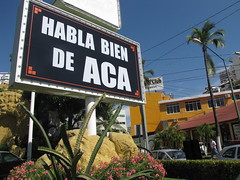
Habla bien de Aca
A campaign launched by Acapulco night club owners encourages people to speak well of Acapulco. It comes as the granddaddy of Mexican tourist destinations suffers through a wave of organized crime bloodshed that has involved beheadings and mass abductions. Tourist officials say the violence takes place far away from tourist areas and doesn't impact visitors. They complain, too, that violence in other parts of Guerrero often is erroneously reported as somehow involving or being near Acapulco. I went to Acapulco recently to report on the situation for USA TODAY; read my dispatch by clicking on the headline for this blog post.

16 November 2010

Bulletproofing goes big time

IMG_3500
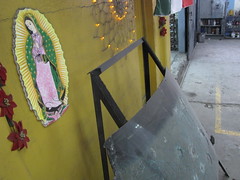
A shot-up windshield from a Honda Accord sits under a shrine to Our Lady of Guadalupe in the garage of Protecto Glass International in Mexico City. The firm is one of the oldest armouring companies in Mexico and has experienced a boom in demand for bulletproof vehicles as perceptions of insecurity increase in Mexico.

The Mexican bulletproofing business has exploded with the crackdown on organized crime, moving from an industry protecting politicians, executives and the über wealthy to one armoring increasingly more modest vehicles for ever less important government functionaries, small business owners and professionals wanting to ward off carjackings and kidnapping attempts.

One industry group values the Mexican bulletproofing business at US $80 million, but that figure might be low since many armoring companies are not registered with the Public Security Secretariat, U.S. firms are capitalizing on the demand from Mexico and the bad guys - according to some - have their own people protecting vehicles.

Brazil still leads the hemisphere in armoring, says Esteban Hernández of Auto Safe in Mexico City. Mexico leads in the demand for Level 5 armoring, however - a level protecting against attacks with assault weapons and grenades. Hernández, ironically, came from Colombia in the mid 1990s to promote bulletproofing. Nowadays, he says of the armoring companies in his home country, "They're on the brink of collapse."

Read the full story in the Nov. 15 edition of USA Today.

14 September 2010

Chicharito

IMG_3133
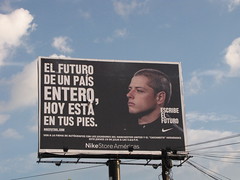
A billboard in Guadalajara features local soccer star Javier "Chicharito" Hernández and the warning, "The future of a whole country, today is at your feet." The admonishment reflects the pressure on Hernández, who now plays for Manchester United.

Mexican soccer phenom Javier Hernández - better known by the handle, "Chicharito," or Little Pea - made his debut Sept. 14 in the Champions League as his club Manchester United took on Rangers. The debut, like everything he does with Manchester United, received major press attention back in Mexico, where the 22-year-old striker is fast becoming a living legend - especially in his native Guadalajara.

Chicharito faces enormous expections in Mexico, where international soccer success has been elusive and players have generally preferred to earn solid livings in a domistic league flush with cash from the nation's broadcasting duopoly instead of challenging themselves in tougher European leagues.

The lad appears ready. He comes from a solid, middle-class family, never indulges in vices such as smoking and drinking, according to his granddad, and never gets caught up in any scandals - unlike, say, aging striker and current Mexican soccer demigod Cuauhtémoc Blanco, who showed up for World Cup camp overweight and out of shape. He also speaks excellent English and was pursuing a university degree at UNIVA in suburban Guadalajara as he rocketed to soccer stardom last year with Chivas, the legendary Mexican franchise that doesn't field foreign-born players. His family has even moved to England with him.

I tracked down Chicharito's graddad - a former Mexican international and Chivas player - in late July, when Manchester United passed through Guadalajara, for story that ran in The Sun. Read it here, or click on the title.