
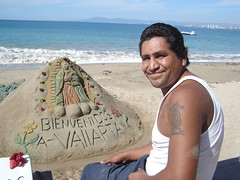
An estimated eight million Mexicans will descend on the Basílica de Guadalupe in the capital this week and fete Our Lady of Guadalupe, the country's most revered religious icon. This gentleman in Puerto Vallarta honored the Guadalupe with a sandcastle by the Malecón
I spent the wee hours of Wednesday morning at the basilica. Here's what ran the following day in The News.
Pilgrims descend on the capital to celebrate the Virgin of Guadalupe
David Agren
The News
Esteban Cruz tumbled into the deep end of a swimming pool six years ago while horsing around with a cousin. Unable to swim, he quickly sunk to the bottom. Desperate and "drowning" he begged the Virgin of Guadalupe for intervention. A lifeguard pulled him from the pool moments later, sparing him a watery death.
Cruz has made a pilgrimage every December since to the Basílica de Guadalupe, where he gives thanks for what he considers a miracle. This year, he pedaled his red mountain bike from Valle de Chalco Solidaridad, a sprawling municipality on the southeastern outskirts of the capital, to the basilica in the northern part of Mexico City, leaving at 9 p.m. and arriving just in time for Midnight mañanitas.
"I thought I was going to die," Cruz recalled while sitting on the curb in front of the basilica during the wee hours of Wednesday morning.
"Thankfully, the virgin intervened."
Cruz was just one of an estimated eight million Mexicans flocking to the basilica over the past week as the country feted its patron saint, a dark-skinned virgin that they believe appeared in front of an indigenous farmer named Juan Diego on Dec. 12, 1531. And 476 years later, the cult of the Virgin of Guadalupe still captivates tens of millions of devotees in the world's second most populous Catholic country.
The virgin also draws adherents from immigrant communities in the United States and Latin America. The Basílica de Guadalupe attracts 20 million visitors a year, ranging from gaggles of clowns decked out in face paint and baggy pants to world leaders – Nicaraguan President Daniel Ortega paid a visit over the summer, fulfilling a campaign promise to visit the shrine if he retook power in the Central American
country.
Her influence on Mexican society is still strong. Author and social commentator Carlos Fuentes even called President Felipe Calderón's win in last year's election, "A triumph of the Virgin of Guadalupe."
STRONG IN SPITE OF CATHOLIC WEAKNESS
In spite of a long-term decline in the percentage of the population that identifies itself as Catholic, the virgin's popularity shows few signs of waning.
"In reality, it never has diminished, but actually grown," said Conrado Ulloa Cárdenas, a philosophy professor at the University of Guadalajara.
"The devotion [is still] growing against all our predictions to the contrary."
Devotion to the virgin persists most strongly in Mexico City and the states surrounding the capital, especially among the working classes and the poor, according to Ulloa Cárdenas.
He added that wealthier Mexicans still believe in the virgin but are less inclined to publicly show their devotion.
MASSES FOR THE MASSES
Many of those arriving at the basilica arrived on foot, walking for days in many cases. Others rode bicycles or took the Metro. Entire families toting backpacks, blankets and bagged lunches spilled out of the Metro stops surrounding the basilica in the hours leading up to Midnight on Tuesday.
As the clock struck 12 a.m., fireworks exploded, trumpets from the assembled mariachi bands blared and the assembled masses began singing traditional mañanitas, or birthday songs to the virgin.
Many of the out-out-state pilgrims would later camp out on the streets and sidewalks surrounding the basilica – and even between the pumps at a Pemex station.
Midnight also ushered in a day of 15 masses. The lineup included a solemn mass featuring mariachi groups, a 2 a.m. service for construction workers and concheros, or traditional Aztec dancers, and a mass for cyclists coming in from two municipalities in Puebla.
Some visiting the Basilica started repaying mandas, or fulfilling promises made to the virgin in exchange for intervention.
María Luisa Guerrero and four family members poured 100 cups of coffee for pilgrims caught in the crushing line to enter the basilica, starting at midnight.
"It's something small, but it's the act that counts," she said.
"It's what I could afford to do."
MASS MARKETING
Guerrero prayed to the virgin after her daughter was hospitalized with severe intestinal problems during the spring. She promised that she would serve coffee to the pilgrims streaming past her home every Dec. 12 if her daughter was cured.
"I always had a lot of faith," Guerrero said, adding that her daughter made a full recovery.
Guerrero, who lives mere blocks from the basilica, has always believed in the virgin, but never participated in the Dec. 12 festivities until recently. She said the numbers were as large as ever, but the local government and church officials had created a more controlled atmosphere.
A force of more than 2,200 police officials – some in riot gear – patrolled the area along with support workers from the local borough and inspectors from the federal consumer protection agency Profeco on the lookout for price gouging.
The numbers could grow even larger said borough of Gustavo A. Madero spokesman Ruben Chavarría as the Archdiocese of Mexico City builds a new plaza near the basilica containing shops, a museum and crypts.
Vendors in the area viewed the new project with suspicion, however.
"The government and the church is kicking us out of here," said Jazmín Hernández, a vendor whose family has been selling religious items at the basilica for four generations.
"The church sees a business opportunity and wants to capture all of it," she added.
Her family is devoted to the virgin, but Hernández's merchandise selection now features statues of the Santa Muerte, or Saint Death, a skeletal figure popular with the downtrodden and kidnapping gangs. She expressed misgivings about the church, but not the virgin.
Others were less questioning, including Cruz, the Chalco resident, who planned on leaving the Basilica at 4:30 a.m.. That would provide him with enough time to pedal home and still arrive at work on time. Although he acknowledged his fatigue and carried a heavy portrait of the virgin on his back, he was undaunted by his journey and the full day of manual labor at a marble cutting business awaiting him back in Chalco.
"If you don't have faith, the [pilgrimage] can be pretty uncomfortable," he said.
11 December 2007


03 December 2007
The Real Deal (My account of the Lucha Libre)
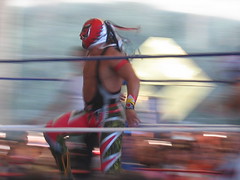
I penned a rather large account of the Lucha Libre, Mexico's campy, but increasingly popular, version of professional wrestling: http://www.theglobeandmail.com/servlet/story/RTGAM.20071130.lucha01/BNStory/specialTravel/home
The Lucha libre is good fun and worth taking in during a trip to Mexico. Shows are staged regularly around the country, although the epicenter is the Arena Mexico in Mexico City's Colonia Doctores.
30 November 2007
Viva The News
The News, Mexico's English-language daily, on sale at the Jardin in San Miguel de Allende, Guanajuato.

17 November 2007
'Bridge between politics, culture' faces uncertain future
David Agren
The News
The National Autonomous University of Mexico, or UNAM, selected a new rector last Tuesday. But given the media coverage of the secretive selection process, one could be forgiven for thinking the country had elected a new president.
Or as some observers perhaps more aptly put it, named a new Pope.
José Narro Robles, former dean of the UNAM medical school, officially takes over as the university’s rector on Nov. 20.
Unofficially, he assumes a much larger role in Mexico’s cultural and political life as the leader of the country’s pre-eminent institution of higher education, which has been described by outgoing rector Juan Ramón de la Fuente as the “grand social project of the Mexican nation.”
“Rectors have always had an important role, like that of a [cabinet] minister without legal recognition, someone [whose position] had enormous weight,” said UNAM professor Imanol Ordorika, who studies higher education institutions and co-authored a book on UNAM’s internal politics.
“The rector has an enormous influence in the national political scene.”
That influence stems from the stature and size of UNAM, which educates nearly 300,000 students per year, carries out roughly half of the nation’s scientific research and has produced graduates who went on to become presidents to Nobel Prize winners to billionaire businessmen – former president Carlos Salinas de Gortari, writer Octavio Paz and impresario Carlos Slim Helú, to name three.
Its sprawling Ciudad Universitaria campus in southern Mexico City recently attained status as a UNESCO World Heritage Site. And the school’s professional soccer team, Pumas, has a long history of success and a large and loyal following.
UNAM also defines and dominates much of the nation’s intellectual scene and is affiliated with La Jornada, a left-leaning daily newspaper. As UNAM sociology professor Roger Bartra Muria put it, “[UNAM] is the principle bridge between politics and culture.”
Outsiders agree about UNAM's role. The university is a “very important, very influential institution,” said Carlos Briseno Torres, rector of the University of Guadalajara, the nation's second largest public university.
The school has always held a proud place as a public institution providing generations of Mexicans from all social classes with a secular and free education.
But UNAM’s sway has diminished somewhat with the advent of private universities. Private schools now educate approximately 40 percent of the nation’s university students, a 400 percent jump over the past three decades, according to Ordorika, who added that the federal government hasn’t invested in expanding access to public higher education over that time.
Although widely regarded for its profession programs, some UNAM humanities and social sciences graduates entering the job market report having their credentials belittled by private sector employers.
Thus, one of Narro’s biggest challenges will be maintaining the national university’s stature as Mexico’s educational and political landscape continues to shift. And already, the new rector has pledged during his candidacy to uphold the tenets of secularism and free access, which perhaps give the national university its greatest fame.
“The big challenge is to put [UNAM] in tune with the needs of Mexico and the challenges of the future,” the new rector said on Thursday.
Many UNAM professors have already expressed approval for Narro’s approach.
“For the population that doesn’t have easy access to education, the university resolves that problem,” said Rafael López González, an UNAM professor and coauthor of a book on the university’s political history.
“It’s a fundamental institution for higher education in Mexico.”
UNAM students only make a voluntary payment of 20 cents towards the cost of their studies. According to political science student Lucía Alvarado, “When you pay, you get a stamped receipt that costs more than the actual fee.”
Alvarado opted for studying at UNAM instead of an expensive private university costing 7,000 pesos per month, explaining, “UNAM is a better school in terms of research, freedom of thinking and the humanities.”
She also liked UNAM’s approach of admitting students from diverse socio-economic backgrounds.
"There are all types of people ... including the children of important political figures studying here," she said.
"We're all equal friends here ... in the [private schools], there are so many cliques."
Many of Alvarado’s classmates lacked her educational options, though.
Adrián Paredes, also a political science student, said he enrolled in UNAM for “the quality of its programs,” but more importantly, “It’s accessible.”
He noted, however, that the lack of resources generated by a tuition fee creates challenges for UNAM. The school only accepts about one-third of all applicants on an annual basis. It also urgently needs to upgrade aging classrooms and fading athletic facilities, Paredes added.
University administrators proposed a tuition fee in 1999 as a means of funding infrastructure improvements, but the plan sparked a backlash that shut down the school for nine months.
Outgoing rector De la Fuente assumed UNAM’s top job in the midst of the student strike. But during his eight-year tenure the school regained some of the stature it lost during the shutdown. It climbed into the ranks of the top 100 universities in the world on a prestigious survey of higher education institutions and undertook ambitious research projects, including developing the most powerful supercomputer in Latin America.
In spite of the fact he's inheriting a top university, Narro will face challenges as the new rector. Already, he has faced criticism, albeit indirectly.
Some faculty members, observers and protesting students – who burned down the doors to the rectory building on Thursday night – objected to the perpetuation of a management style they described as secretive and not fitting with the country becoming more open and democratic. They also took exception with the 15-member UNAM Board of Regents’ less-than-transparent method of choosing De la Fuente’s successor.
Ordorika compared the selection process to that of the Vatican.
“It’s like a conclave of cardinals, where the cardinals – in this case, 15 cardinals – meet behind closed doors and decide who is going to be rector,” he said.
Narro’s ascent into the rector’s office was greeted on Wednesday with newspaper headlines and commentaries inferring that De la Fuente was instrumental in naming his successor – a charge the outgoing rector and board members deny. But Ordorika noted that 13 of the 15 current board members were appointed during De la Fuente’s tenure by the UNAM University Council.
Additionally, “The proposals made by the rector are always approved,” Ordorika explained.
The list of eight aspirants vying for the rector’s position also drew scorn from some UNAM faculty members, who were hoping for candidates who would usher in a new era of leadership, untainted by previous political connections.
Bartra, the UNAM sociologist, said, “Many of the candidates are actually old PRIistas.”
He noted that all but one of the candidates either had deep roots in the Institutional Revolutionary Party, or PRI, or have recently switched to the governing National Action Party, or PAN.
Only candidate Rosaura Ruiz Gutiérrez, who rose through the ranks of the faculty unions and student movements, lacked such a background. (Narro previously headed the IMSS during the administration of former president Ernesto Zedillo.)
Still, with a PAN president in Los Pinos, Bartra sees opportunity for UNAM and Narro.
Previous PRI presidents would often meddle in the rector selection process and by proxy, the UNAM agenda, according to Bartra.
But with the PAN – a party whose senior officials mostly attended private universities – now occupying presidency, he ironically saw an opportunity for UNAM to part with the remnants of the old PRI system.
“I believe this is a good thing,” he said.
“It implies more autonomy. A real autonomy.”
And with increased autonomy for the university – which President Felipe Calderón has promised to respect – Bartra expressed cautious optimism about the future of UNAM.
“It seems that now UNAM is in a new stage that hasn’t ever been explored,” he said.
“It’s something fascinating to witness.”
The News
The National Autonomous University of Mexico, or UNAM, selected a new rector last Tuesday. But given the media coverage of the secretive selection process, one could be forgiven for thinking the country had elected a new president.
Or as some observers perhaps more aptly put it, named a new Pope.
José Narro Robles, former dean of the UNAM medical school, officially takes over as the university’s rector on Nov. 20.
Unofficially, he assumes a much larger role in Mexico’s cultural and political life as the leader of the country’s pre-eminent institution of higher education, which has been described by outgoing rector Juan Ramón de la Fuente as the “grand social project of the Mexican nation.”
“Rectors have always had an important role, like that of a [cabinet] minister without legal recognition, someone [whose position] had enormous weight,” said UNAM professor Imanol Ordorika, who studies higher education institutions and co-authored a book on UNAM’s internal politics.
“The rector has an enormous influence in the national political scene.”
That influence stems from the stature and size of UNAM, which educates nearly 300,000 students per year, carries out roughly half of the nation’s scientific research and has produced graduates who went on to become presidents to Nobel Prize winners to billionaire businessmen – former president Carlos Salinas de Gortari, writer Octavio Paz and impresario Carlos Slim Helú, to name three.
Its sprawling Ciudad Universitaria campus in southern Mexico City recently attained status as a UNESCO World Heritage Site. And the school’s professional soccer team, Pumas, has a long history of success and a large and loyal following.
UNAM also defines and dominates much of the nation’s intellectual scene and is affiliated with La Jornada, a left-leaning daily newspaper. As UNAM sociology professor Roger Bartra Muria put it, “[UNAM] is the principle bridge between politics and culture.”
Outsiders agree about UNAM's role. The university is a “very important, very influential institution,” said Carlos Briseno Torres, rector of the University of Guadalajara, the nation's second largest public university.
The school has always held a proud place as a public institution providing generations of Mexicans from all social classes with a secular and free education.
But UNAM’s sway has diminished somewhat with the advent of private universities. Private schools now educate approximately 40 percent of the nation’s university students, a 400 percent jump over the past three decades, according to Ordorika, who added that the federal government hasn’t invested in expanding access to public higher education over that time.
Although widely regarded for its profession programs, some UNAM humanities and social sciences graduates entering the job market report having their credentials belittled by private sector employers.
Thus, one of Narro’s biggest challenges will be maintaining the national university’s stature as Mexico’s educational and political landscape continues to shift. And already, the new rector has pledged during his candidacy to uphold the tenets of secularism and free access, which perhaps give the national university its greatest fame.
“The big challenge is to put [UNAM] in tune with the needs of Mexico and the challenges of the future,” the new rector said on Thursday.
Many UNAM professors have already expressed approval for Narro’s approach.
“For the population that doesn’t have easy access to education, the university resolves that problem,” said Rafael López González, an UNAM professor and coauthor of a book on the university’s political history.
“It’s a fundamental institution for higher education in Mexico.”
UNAM students only make a voluntary payment of 20 cents towards the cost of their studies. According to political science student Lucía Alvarado, “When you pay, you get a stamped receipt that costs more than the actual fee.”
Alvarado opted for studying at UNAM instead of an expensive private university costing 7,000 pesos per month, explaining, “UNAM is a better school in terms of research, freedom of thinking and the humanities.”
She also liked UNAM’s approach of admitting students from diverse socio-economic backgrounds.
"There are all types of people ... including the children of important political figures studying here," she said.
"We're all equal friends here ... in the [private schools], there are so many cliques."
Many of Alvarado’s classmates lacked her educational options, though.
Adrián Paredes, also a political science student, said he enrolled in UNAM for “the quality of its programs,” but more importantly, “It’s accessible.”
He noted, however, that the lack of resources generated by a tuition fee creates challenges for UNAM. The school only accepts about one-third of all applicants on an annual basis. It also urgently needs to upgrade aging classrooms and fading athletic facilities, Paredes added.
University administrators proposed a tuition fee in 1999 as a means of funding infrastructure improvements, but the plan sparked a backlash that shut down the school for nine months.
Outgoing rector De la Fuente assumed UNAM’s top job in the midst of the student strike. But during his eight-year tenure the school regained some of the stature it lost during the shutdown. It climbed into the ranks of the top 100 universities in the world on a prestigious survey of higher education institutions and undertook ambitious research projects, including developing the most powerful supercomputer in Latin America.
In spite of the fact he's inheriting a top university, Narro will face challenges as the new rector. Already, he has faced criticism, albeit indirectly.
Some faculty members, observers and protesting students – who burned down the doors to the rectory building on Thursday night – objected to the perpetuation of a management style they described as secretive and not fitting with the country becoming more open and democratic. They also took exception with the 15-member UNAM Board of Regents’ less-than-transparent method of choosing De la Fuente’s successor.
Ordorika compared the selection process to that of the Vatican.
“It’s like a conclave of cardinals, where the cardinals – in this case, 15 cardinals – meet behind closed doors and decide who is going to be rector,” he said.
Narro’s ascent into the rector’s office was greeted on Wednesday with newspaper headlines and commentaries inferring that De la Fuente was instrumental in naming his successor – a charge the outgoing rector and board members deny. But Ordorika noted that 13 of the 15 current board members were appointed during De la Fuente’s tenure by the UNAM University Council.
Additionally, “The proposals made by the rector are always approved,” Ordorika explained.
The list of eight aspirants vying for the rector’s position also drew scorn from some UNAM faculty members, who were hoping for candidates who would usher in a new era of leadership, untainted by previous political connections.
Bartra, the UNAM sociologist, said, “Many of the candidates are actually old PRIistas.”
He noted that all but one of the candidates either had deep roots in the Institutional Revolutionary Party, or PRI, or have recently switched to the governing National Action Party, or PAN.
Only candidate Rosaura Ruiz Gutiérrez, who rose through the ranks of the faculty unions and student movements, lacked such a background. (Narro previously headed the IMSS during the administration of former president Ernesto Zedillo.)
Still, with a PAN president in Los Pinos, Bartra sees opportunity for UNAM and Narro.
Previous PRI presidents would often meddle in the rector selection process and by proxy, the UNAM agenda, according to Bartra.
But with the PAN – a party whose senior officials mostly attended private universities – now occupying presidency, he ironically saw an opportunity for UNAM to part with the remnants of the old PRI system.
“I believe this is a good thing,” he said.
“It implies more autonomy. A real autonomy.”
And with increased autonomy for the university – which President Felipe Calderón has promised to respect – Bartra expressed cautious optimism about the future of UNAM.
“It seems that now UNAM is in a new stage that hasn’t ever been explored,” he said.
“It’s something fascinating to witness.”
14 November 2007
Small farmers use courts, not machetes, to block dam project
By David Agren
The News
It’s a public works project of the grandest scale.
La Parota, a massive hydroelectric development 28 kilometers northeast of Acapulco, is projected to produce at least 765 megawatts of power, enough to light up the entire state of Guerrero for an entire year.
Its curtain is to tower 162 meters over the Papagayo River and its reservoir will flood more than 17,000 hectares, an area 10 times the size of the Bay of Acapulco.
The dam is also supposed to create 10,000 construction jobs, ensure a steady supply of drinking water for rapidly growing Acapulco and increase economic development in a marginalized region populated by subsistence farmers.
For the Federal Electricity Commission (CFE), La Parota is a crown jewel in a string of high-profile projects meant to produce clean energy and help power the ambitious economic growth plans envisaged by the federal government.
There’s just one problem: The dam is expected to displace hundreds of small farms, many of which are organized as ejidos, the communal properties distributed to landless campesinos following the Mexican Revolution. And the farmers, or ejiditarios, don’t want to leave.
In the past dozen years, machete-wielding ejiditarios have derailed several high-profile development projects, including a $300-million golf course development in Tepotzlán, Morelos and a new airport for Mexico City in Atenco, State of Mexico.
But in the case of La Parota, a group of residents from the village of Cacahuatepec have opted for law books rather than machetes.
And in a story evoking the tale of David versus Goliath, the farmers took CFE to court and won an injunction in September against the dam, successfully arguing that the Environment Secretariat (Semarnat) and the National Water Commission (CNA) improperly granted permits for the project.
On Nov. 7, however, federal Judge Livia Lizbeth Larumbe Radilla reversed her decision, ruling that the laws permitting the dam’s construction would not directly deprive the complainants’ access to their land and water.
The villagers and their lawyers plan to appeal.
“We’re now in the second round of the game,” said Xavier Martínez, an environment lawyer with the civil rights firm that argued the landholders’ case.
Still, he called the judge’s original decision to halt construction “unprecedented,” and said the dam was not being impeded by the courts, “but a social movement.”
The CFE is not likely to walk away from the $800-million dam project - despite the legal roadblocks. Its crews have not yet returned to the La Parota site, according to Martínez.
Even so, say experts, the precedent set by the villagers of Cacahuatepec could complicate future large-scale infrastructure projects that require relocating established communities.
“Previously, the state would throw all of its weight behind the construction of these types of projects and nothing could be done about it,” said Arturo Pueblita Fernández, a law professor at Universidad Iberoamericana in Mexico City.
“Now there’s more openness and an attempt to avoid social conflicts. Therefore, it could be the case that construction on this project might never happen.”
The ongoing legal complications surrounding La Parota – and conceivably at other locations in the future – could complicate the economic growth objectives of President Felipe Calderón, who in September won congressional approval for a fiscal reform overhaul that was designed, in large part, to help overhaul the country’s sagging infrastructure.
Three decades in the works
The CFE first proposed building La Parota in 1976 on the Papagayo River, which empties into the Pacific Ocean southeast of Acapulco on the Costa Chica, a thinly populated and underdeveloped region known for its Afro-Mexican inhabitants.
The rugged hills of Guerrero, home to some of the nation’s poorest communities, have spawned numerous armed uprisings against the federal government. Its populace includes the People’s Revolutionary Army, or EPR, a long-standing Marxist guerilla group that has made recent headlines with a series of attacks on Pemex gas pipelines. According to lawyers working in the region, it is instinctive for Guerrero’s marginalized populations to fight back when encroached upon by outsiders.
The La Parota project, however, received little attention until CFE construction crews arrived unannounced in 2003. Then, a local movement to fight the dam was formed almost immediately.
Mario Patrón, a lawyer with the Guerrero-based Centro Derechos Humanos de la Montaña Tlachinollan, worked with some of the residents fighting the dam. He said the locals’ determination to stay put grew even stronger as they learned of the impact of previous public works projects, including hydroelectric developments in Nayarit and the Mexico City-Acapulco highway, which displaced thousands after opening in 1989.
“At La Parota, an opposition movement was generated because … they’ve known that hydroelectric projects don’t bring development for those that get relocated,” Patrón explained.
“The campesinos said that they didn’t want to be kicked off their land and leave for [Acapulco] where they would be working in some bad-paying menial job.”
Despite a clause in the Constitution requiring compensation for land expropriations, the CFE has never made “a firm offer” to any of the impacted landholders, he added.
CFE spokesman Gerardo Cubos declined to comment on La Parota, citing the ongoing legal actions.
However, in comments published by the Mexico City daily El Universal shortly after construction was halted in September, CFE manager Gerardo Cruz Velázquez acknowledged to a business audience in Acapulco that the CFE fell short in pitching La Parota-area residents on the virtues of relocating.
He also accused international rights groups protesting against La Parota of being naïve to the situation in Guerrero and the dam’s potential benefits.
“It doesn’t interest them that people [here] eat nothing more than a tortilla with chilies once a day and they have to carry water jugs on their heads from the river to their homes,” Cruz Velázquez said.
International attention
Two United Nations representatives visited the impacted area in early September and expressed dissatisfaction with the CFE’s attention to transparency and human rights.
A recent Amnesty International study also expressed concerns. According to its August 2007 report, intimidation has been rife in the area and three people have been killed. In one of the killings, an opponent of the dam, Eduardo Maya Manrique, was dragged from his home by three unidentified men and stoned to death in January 2006, according to the report. No one has been charged in the matter.
The report also questioned the true number of people the dam would impact.
According to the CFE, approximately 3,000 people would have to be relocated, but Patrón put the figure at closer to 75,000, explaining that the CFE failed to account for residents indirectly impacted by the dam and its reservoir.
Even properties not submerged could be negatively impacted, he added. Two settlements, for example, would become islands. In other places, ground water would become scarce. The Papagayo River would also be permanently impacted.
The CFE’s website provides little information about the dam, its potential impact and prospects for future completion, although it boasted of other large ongoing and recently completed projects on the Santiago River in the western state of Nayarit.
Regardless of whether La Parota is ever completed, the ongoing judicial action in Guerrero is likely to have a significant impact on future public works projects undertaken by the federal government, said Martínez, the environmental lawyer involved in the farmers’ case.
“They just can't keep on building projects like the way they were,” he said.
SIDEBAR: When machetes beat back development
The News
Atenco, 2002:
In July 2002, local farmers in San Salvador Atenco, backed by left-wing, anarchist and anti-globalization groups, fought with police for three days over a government plan to build a $2.3-billion airport in their town.
The airport would have taken over approximately 10,000 acres of land in 13 villages in the municipality outside Mexico City. In exchange, the farmers were to be paid $3,000 per acre as compensation, but the locals rejected the offer and took to the streets with machetes in hand.
Dozens of people were injured in the ensuing clashes. Nineteen public officials were taken hostage and later exchanged for imprisoned farmers in an act that critics said rewarded violence.
The government later raised its compensation offer to an amount reportedly seven-times the initial bid, but the farmers rejected it.
Finally, two weeks into the showdown, Transportation Secretary Pedro Cerisola announced the government was abandoning plans to build the airport in Atenco.
Tepoztlán, Morelos, 1995:
Golf Course Inflames Mexico Town
The News, with files from The New York Times News Service
A coalition of campesinos, small-business owners and environmentalists in this town south of Mexico City reacted violently in August 1995 after the municipal government approved a golf course development and industrial park in an ecologically sensitive area.
After 12 days of unrest – during which time the protesters beat back riot police with rocks and barbed wire, seized hostages and occupied city hall – the mayor backed down and promptly resigned.
Some Tepoztlán residents had accused Mayor Alejandro Morales Barragan of rubber-stamping the development project behind their backs.
Opposition to the projects drew together an unusual alliance of affluent people, who wanted to preserve the town's character, and villagers suspicious of the promises of foreign corporations.
Tepoztlán has become a favorite weekend retreat of Mexico City's wealthy elite. But many of its 13,000 residents still cling to the village's peasant traditions.
Development backers balked at suggestions their plans would have ruined the town, explaining that the project would have created more than 9,000 construction-related jobs and nearly 3,000 permanent service jobs. The land, they added, was indeed located inside of a national park, but was privately-owned. Environmental impact studies had also been completed.
The News
It’s a public works project of the grandest scale.
La Parota, a massive hydroelectric development 28 kilometers northeast of Acapulco, is projected to produce at least 765 megawatts of power, enough to light up the entire state of Guerrero for an entire year.
Its curtain is to tower 162 meters over the Papagayo River and its reservoir will flood more than 17,000 hectares, an area 10 times the size of the Bay of Acapulco.
The dam is also supposed to create 10,000 construction jobs, ensure a steady supply of drinking water for rapidly growing Acapulco and increase economic development in a marginalized region populated by subsistence farmers.
For the Federal Electricity Commission (CFE), La Parota is a crown jewel in a string of high-profile projects meant to produce clean energy and help power the ambitious economic growth plans envisaged by the federal government.
There’s just one problem: The dam is expected to displace hundreds of small farms, many of which are organized as ejidos, the communal properties distributed to landless campesinos following the Mexican Revolution. And the farmers, or ejiditarios, don’t want to leave.
In the past dozen years, machete-wielding ejiditarios have derailed several high-profile development projects, including a $300-million golf course development in Tepotzlán, Morelos and a new airport for Mexico City in Atenco, State of Mexico.
But in the case of La Parota, a group of residents from the village of Cacahuatepec have opted for law books rather than machetes.
And in a story evoking the tale of David versus Goliath, the farmers took CFE to court and won an injunction in September against the dam, successfully arguing that the Environment Secretariat (Semarnat) and the National Water Commission (CNA) improperly granted permits for the project.
On Nov. 7, however, federal Judge Livia Lizbeth Larumbe Radilla reversed her decision, ruling that the laws permitting the dam’s construction would not directly deprive the complainants’ access to their land and water.
The villagers and their lawyers plan to appeal.
“We’re now in the second round of the game,” said Xavier Martínez, an environment lawyer with the civil rights firm that argued the landholders’ case.
Still, he called the judge’s original decision to halt construction “unprecedented,” and said the dam was not being impeded by the courts, “but a social movement.”
The CFE is not likely to walk away from the $800-million dam project - despite the legal roadblocks. Its crews have not yet returned to the La Parota site, according to Martínez.
Even so, say experts, the precedent set by the villagers of Cacahuatepec could complicate future large-scale infrastructure projects that require relocating established communities.
“Previously, the state would throw all of its weight behind the construction of these types of projects and nothing could be done about it,” said Arturo Pueblita Fernández, a law professor at Universidad Iberoamericana in Mexico City.
“Now there’s more openness and an attempt to avoid social conflicts. Therefore, it could be the case that construction on this project might never happen.”
The ongoing legal complications surrounding La Parota – and conceivably at other locations in the future – could complicate the economic growth objectives of President Felipe Calderón, who in September won congressional approval for a fiscal reform overhaul that was designed, in large part, to help overhaul the country’s sagging infrastructure.
Three decades in the works
The CFE first proposed building La Parota in 1976 on the Papagayo River, which empties into the Pacific Ocean southeast of Acapulco on the Costa Chica, a thinly populated and underdeveloped region known for its Afro-Mexican inhabitants.
The rugged hills of Guerrero, home to some of the nation’s poorest communities, have spawned numerous armed uprisings against the federal government. Its populace includes the People’s Revolutionary Army, or EPR, a long-standing Marxist guerilla group that has made recent headlines with a series of attacks on Pemex gas pipelines. According to lawyers working in the region, it is instinctive for Guerrero’s marginalized populations to fight back when encroached upon by outsiders.
The La Parota project, however, received little attention until CFE construction crews arrived unannounced in 2003. Then, a local movement to fight the dam was formed almost immediately.
Mario Patrón, a lawyer with the Guerrero-based Centro Derechos Humanos de la Montaña Tlachinollan, worked with some of the residents fighting the dam. He said the locals’ determination to stay put grew even stronger as they learned of the impact of previous public works projects, including hydroelectric developments in Nayarit and the Mexico City-Acapulco highway, which displaced thousands after opening in 1989.
“At La Parota, an opposition movement was generated because … they’ve known that hydroelectric projects don’t bring development for those that get relocated,” Patrón explained.
“The campesinos said that they didn’t want to be kicked off their land and leave for [Acapulco] where they would be working in some bad-paying menial job.”
Despite a clause in the Constitution requiring compensation for land expropriations, the CFE has never made “a firm offer” to any of the impacted landholders, he added.
CFE spokesman Gerardo Cubos declined to comment on La Parota, citing the ongoing legal actions.
However, in comments published by the Mexico City daily El Universal shortly after construction was halted in September, CFE manager Gerardo Cruz Velázquez acknowledged to a business audience in Acapulco that the CFE fell short in pitching La Parota-area residents on the virtues of relocating.
He also accused international rights groups protesting against La Parota of being naïve to the situation in Guerrero and the dam’s potential benefits.
“It doesn’t interest them that people [here] eat nothing more than a tortilla with chilies once a day and they have to carry water jugs on their heads from the river to their homes,” Cruz Velázquez said.
International attention
Two United Nations representatives visited the impacted area in early September and expressed dissatisfaction with the CFE’s attention to transparency and human rights.
A recent Amnesty International study also expressed concerns. According to its August 2007 report, intimidation has been rife in the area and three people have been killed. In one of the killings, an opponent of the dam, Eduardo Maya Manrique, was dragged from his home by three unidentified men and stoned to death in January 2006, according to the report. No one has been charged in the matter.
The report also questioned the true number of people the dam would impact.
According to the CFE, approximately 3,000 people would have to be relocated, but Patrón put the figure at closer to 75,000, explaining that the CFE failed to account for residents indirectly impacted by the dam and its reservoir.
Even properties not submerged could be negatively impacted, he added. Two settlements, for example, would become islands. In other places, ground water would become scarce. The Papagayo River would also be permanently impacted.
The CFE’s website provides little information about the dam, its potential impact and prospects for future completion, although it boasted of other large ongoing and recently completed projects on the Santiago River in the western state of Nayarit.
Regardless of whether La Parota is ever completed, the ongoing judicial action in Guerrero is likely to have a significant impact on future public works projects undertaken by the federal government, said Martínez, the environmental lawyer involved in the farmers’ case.
“They just can't keep on building projects like the way they were,” he said.
SIDEBAR: When machetes beat back development
The News
Atenco, 2002:
In July 2002, local farmers in San Salvador Atenco, backed by left-wing, anarchist and anti-globalization groups, fought with police for three days over a government plan to build a $2.3-billion airport in their town.
The airport would have taken over approximately 10,000 acres of land in 13 villages in the municipality outside Mexico City. In exchange, the farmers were to be paid $3,000 per acre as compensation, but the locals rejected the offer and took to the streets with machetes in hand.
Dozens of people were injured in the ensuing clashes. Nineteen public officials were taken hostage and later exchanged for imprisoned farmers in an act that critics said rewarded violence.
The government later raised its compensation offer to an amount reportedly seven-times the initial bid, but the farmers rejected it.
Finally, two weeks into the showdown, Transportation Secretary Pedro Cerisola announced the government was abandoning plans to build the airport in Atenco.
Tepoztlán, Morelos, 1995:
Golf Course Inflames Mexico Town
The News, with files from The New York Times News Service
A coalition of campesinos, small-business owners and environmentalists in this town south of Mexico City reacted violently in August 1995 after the municipal government approved a golf course development and industrial park in an ecologically sensitive area.
After 12 days of unrest – during which time the protesters beat back riot police with rocks and barbed wire, seized hostages and occupied city hall – the mayor backed down and promptly resigned.
Some Tepoztlán residents had accused Mayor Alejandro Morales Barragan of rubber-stamping the development project behind their backs.
Opposition to the projects drew together an unusual alliance of affluent people, who wanted to preserve the town's character, and villagers suspicious of the promises of foreign corporations.
Tepoztlán has become a favorite weekend retreat of Mexico City's wealthy elite. But many of its 13,000 residents still cling to the village's peasant traditions.
Development backers balked at suggestions their plans would have ruined the town, explaining that the project would have created more than 9,000 construction-related jobs and nearly 3,000 permanent service jobs. The land, they added, was indeed located inside of a national park, but was privately-owned. Environmental impact studies had also been completed.
28 October 2007
Mexico City museum honors Bolshevik revolutionary
David Agren
Special to the Express-News
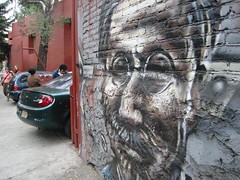
MEXICO CITY — Sixty-seven years ago in Mexico City, a Stalinist assassin plunged a pickax into Leon Trotsky's skull. The Bolshevik revolutionary died in exile from the Soviet Union.
During the latter part of his three-year stay in Mexico, Trotsky lived with his wife, grandson and a team of security guards in a small compound surrounded by high walls in Coyoacán, a bourgeoisie neighborhood in the southern part of the Federal District.
Nowadays, Esteban Volkov Bronstein, Trotsky's grandson, helps run a museum in the former abode, which attracts an eclectic mix of curious tourists — usually in the area to visit the nearby Casa Azul, artist Frida Kahlo's longtime residence — and idealistic lefties, who pay their respects on the anniversary of the attack by laying flowers at the hammer and sickle-adorned mausoleum in the garden.
Alberto Fonseca, a philosophy professor at the Autonomous University of Mexico City, has visited the Trotsky Museum on Aug. 20 — the day Trotsky was assassinated — for 12 consecutive years, delivering a speech that highlights the aspirations of modern-day revolutionaries such as Hugo Chavez, Evo Morales and Fidel Castro, to a small group of communists sporting Marx and Lenin pins, and leading an off-key rendition of the Internationale, the communist anthem.
Although Trotsky lacks the present-day stature of Ernesto "Che" Guevara — who Fonseca described as a "sexier" icon — the Ukrainian-born revolutionary has enjoyed a modest surge in popularity in recent years.
More than 24,000 visitors passed through his museum in 2004, taking in its tranquil garden, shaded by tall trees and dotted with cacti; modest study stocked with revolutionary tomes; three guard towers; and the chicken coops and rabbit cages, which housed the animals Trotsky lovingly tended to. The reappearance of the infamous murder weapon in 2005 captured worldwide headlines. (A secret police commander apparently lifted it from the evidence room and his daughter wanted to sell it. The museum, however, refused to pay.)
The hit 2002 movie "Frida" portrayed moments from Trotsky's Mexican sojourn, including his supposed affair with the film's namesake — an event Volkov doubts. He explained that the guards, who accompanied his grandfather around the clock, said it couldn't have occurred without their knowledge.
"I never found out until I read it in a book," he said.
He conceded, though, "(Kahlo) had a great capacity for seducing men.
"She was a little spiteful towards Diego (Rivera) because he often deceived her."
In his day, Trotsky, famous for his trademark round-rim glasses, disheveled hair and goatee, dominated one of the feuding streams of international communism. A disillusioned George Orwell wrote "Animal Farm," a stinging rebuke of revolution run amok, after barely escaping a purge by Stalinist thugs during the Spanish Civil War.
Like Snowball, the well-intentioned pig from Orwell's novel, chased off the Manor Farm by a ruthless rival, Trotsky went into exile after losing a power struggle with Soviet tyrant Joseph Stalin, bouncing around Europe for nearly a decade, constantly staying one step ahead of ever-present assassins.
Mexican President Lazaro Cárdenas granted Trotsky asylum in the 1930s at the urging of Diego Rivera and members of the Mexican Communist Party. Upon his arrival, Trotsky found a country full of revolutionary fervor. During Cárdenas' six-year reign, he nationalized the Mexican oil industry, openly supported the Republican side in the Spanish Civil War and redistributed millions of hectares of hacienda land. Trotsky initially lived with Rivera and Kahlo in the Casa Azul until ideological differences with Rivera — and not an affair with Kahlo — forced the revolutionary to move.
Volkov arrived in Mexico in 1939, having lost virtually his entire family. His father disappeared in a Soviet gulag. His mother committed suicide in 1933. A sibling was left behind in the Soviet Union. Because of his frequent moves, Volkov pretty much lost his ability to speak Russian.
He lived with his grandfather for a little more than a year, surviving a "well-planned" machine gun attack on the Coyoacán house led by famed muralist David Siqueiros, a Stalinist. Volkov survived by hiding under his bed. Some of the bullet holes still riddle the museum.
But Ramon Mercader, a Stalinist agent, infiltrated Trotsky's inner circle. He carried out the dirty deed as Trotsky reviewed documents supposedly penned by the attacker.
Volkov stayed in Mexico after the attack, living in Coyoacán and working as a chemical engineer, but he never became politically active. In his retirement, he's kept his grandfather's legacy alive through the museum. But decades after the assassination, some bitterness remains.
"In mere seconds, (the assassin) liquidated one of the best minds of the Marxist revolutionaries."
From the San Antonio Express-News
26 October 2007
The nation’s ‘legitimate president’ soldiers on in spite of facts
By David Agren
The News
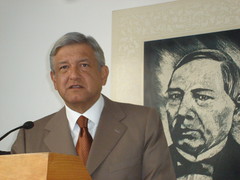
TEPEACA, Pue. – Pedro de la Cruz García, a 72-year-old farmer from this rural community 40 kilometers east of Puebla city woke early on a recent Sunday morning, pulled on a bright yellow shirt, gray pants and a pair of well-worn sandals and started walking. Using a cane for assistance, he managed to make the kilometer-long trek to the town square in time for the start of a rally organized by 2006 presidential runner-up Andrés Manuel López Obrador of the left-leaning PRD.
Like many of the approximately 200 other supporters gathered in the square, de la Cruz calls López Obrador the “legitimate president of Mexico” and considers last year’s election – which his candidate lost to Felipe Calderón of the conservative PAN by less than a percentage point – to have been rigged.
López Obrador also believed the results were rigged, and following the election, he filed a petition asking the Federal Electoral Tribunal (TRIFE) for a vote-by-vote recount. The TRIFE denied the request two months later, but that hardly deterred the candidate popularly known as AMLO. Instead, the former Mexico City mayor vowed to defy the ruling and promised to make the nation ungovernable. He declared himself the legitimate president, formed a parallel cabinet and returned to rallying support from his die-hard constituency, drawn primarily from the poor and working classes.
A year after the Court’s ruling, the “legitimate president” tag still rings true for people like those at the Tepeaca rally. Few were willing to consider Calderón as their rightful leader, and others would only mention his name as part of an insult. One attendee, Ernesto Rodríguez, held a sign reading, “Felipe Calderón is the bastard son of [Vicente] Fox.”
The view at the rally is less commonly held across Mexico as a majority of the population has moved on from the contentious July 2, 2006 election and considers Calderón the true victor. In a poll published by Grupo Reforma on the one-year anniversary of the election, 36 percent of respondents still viewed the results as tainted, but 31 percent of López Obrador voters said they wouldn’t opt for him again. (López Obrador has long taken issue with Grupo Reforma’s polling methods and editorial policy.)
Even in the republic’s poorest and most remote municipalities, which López Obrador tours tirelessly, turnout for his events appears to be diminishing. In Tepeaca, several observers estimated the crowd size at roughly 20 percent of the total that came out for a pre-election appearance.
Despite emerging from a tight election with a precarious sense of legitimacy, Calderón’s approval rating now hovers in the 65-percent range – due in part to an aggressive stance against drug cartels. Furthermore, with backing from the PRI, Mexico’s third party, Calderón achieved passage of a pension reform bill during the spring and a comprehensive fiscal reform package last month. López Obrador urged his party to never negotiate with president, but some PRD legislators sat down with Calderón and his secretaries before eventually voting against fiscal reform. When AMLO called on PRD lawmakers to disrupt the voting, the plan fizzled. A poll by Ulises Beltrán y Asociados showed that 70 percent of respondents disagreed with AMLO’s tactics.
López Obrador’s strategy of organizing an alternative government and eschewing contact with Calderón baffles some political observers, who say that he could be more effective leading a responsible opposition instead of waiting for the economy to collapse or for the president to stumble.
“He’s hoping that Felipe Calderón will fall on his face and that the (downtrodden) will carry him on their shoulders to victory,” says George Grayson, a government professor at the College of William & Mary in Virginia and the author of a biography of López Obrador.
A ‘Cordial Relashionship’
While Calderón solidifies his grip on the presidency, López Obrador’s persistence presents challenges for members of his PRD, which made impressive gains in the last congressional elections and holds second-place status in Congress.
“It’s a love-hate relationship,” Grayson said. “He still has a lot of supporters in the PRD.”
Mexico City Mayor Marcelo Ebrard, has pledged support for López Obrador, but all five PRD governors have kept their distance and even have met with Calderón. None of the governors attended a July 1 López Obrador rally in Mexico City’s Zócalo. Only Ebrard appeared with the “legitimate president.”
There are other signs suggesting López Obrador may be losing influence within the PRD. For example, indications are his candidate for party president, Alejandro Encinas, will not win the party election. And PRD leaders in Oaxaca are calling for him to be stripped of party privileges since he campaigned for non-PRD candidates in local elections there.
Mexico City-based political analyst Dan Lund, however, disagrees with the idea that the PRD is fracturing over López Obrador.
“You’d have to be silly to view him as a liability because the PRD would have disappeared had it not been for him,” Lund said. “Everyone views him as political capital.”
Even so, Jorge Agustín Ortiz, a López Obrado coordinator, acknowledged some separation between AMLO and the PRD.
“Andrés Manuel has a cordial relationship with the PRD, but he has his own movement,” Ortiz said.
The movement, called the Convención Nacional Democrática, or National Democratic Convention, organizes López Obrador followers at the grass-roots level. It claims 1.5 million members and signs up new ones at every rally.
Lund says López Obrador’s goal is to build a pacifist social movement – something rare in a country with a history of authoritarianism and violence. Other political commentators suggest a different motive. In a recent column in the Milenio newspaper, analyst Román Revueltas speculated that López Obrador might be planning a break with the PRD in order start a new party.
It’s all being built with little fanfare, though. López Obrador’s presence in the media spotlight has diminished. As mayor of Mexico City and later a leading presidential candidate, he frequently made the front pages. His daily predawn press conferences provided timely fresh content for the capital’s electronic media outlets. Nowadays, López Obrador appears on a weekly television program Tuesday mornings at 1 a.m. on TV Azteca. His rallies receive scant coverage.
MIXED REVIEWS
Unlike the constitutional president, López Obrador travels light without much security. He arrived at the event in Tepeaca in a white SUV with no hubcaps and then casually waded through a throng of supporters toward the stage.
During his speech, he mentioned his travails from 2006, but mostly focused on populist issues like rising food and gasoline prices and lavish presidential pensions.
The message resonated with de la Cruz, the elderly farmer who walked a kilometer with a cane to hear it. Afterward, he signed up for the Convención Nacional Democrática.
When López Obrador was mayor of Mexico City, he says, “Things worked, he supported the disabled [and] he was giving money to seniors. Who’s given me even five cents? Nobody.”
After 40 minutes with the crowd in Tepeaca, López Obrador climbed back into his SUV and headed off for another six rallies scheduled for that day. He plans to eventually speak in each of the nation’s 2,438 municipalities, where his message of social justice and benefits for the poor is likely to attract at least some followers of the “legitimate president.”
Many though, have fallen away, including Mexico City taxi driver Dario Espinosa.
"I used to support him, but not any longer," Espinosa says, explaining that he disagreed with López Obrador's six-week blockade of central Mexico City last summer.
"I think he's through."
Subscribe to:
Posts (Atom)
