06 May 2008

On leftist party's birthday, two factions, visions, cakes

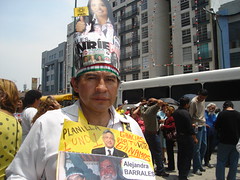
Rafael Acosta "Juanito"
Rafael "Juanito" Acosta shows support for the pro-AMLO factions of the PRD.

On leftist party's birthday, two factions, visions, cakes

David Agren
The News

The two candidates contesting the still-undecided Democratic Revolution Party internal vote, Alejandro Encinas and Jesús Ortega, marked the PRD's 19th anniversary by speaking of unity – an elusive objective during the party's oft-contentious leadership campaign and post-election fallout.

"We have problems, but that's not going to overshadow the anniversary of the PRD," Ortega told The News while celebrating at the Revolution Monument.

But the pair made their pronouncements at separate birthday bashes mere blocks from each other in central Mexico City, where card-carrying PRD members – and others simply accepting free junkets to the national capital – spoke ill of their opponents and even disparaged the rival celebrations.

"All of the traitors are over there," said Encinas supporter Rafael Acosta, pointing toward Ortega's celebrations.

Acosta, a self-described "social fighter," objected to the willingness of the Ortega wing of the PRD – known as "Los Chuchos" – to broker deals with the federal government, which many in the party consider illegitimate due to allegations of fraud in the 2006 presidential election.

"They're a bunch of sellouts … and trying to steal the [PRD] election," he added.

Differences over strategy threaten to split the PRD less than two decades after Cuauhtémoc Cárdenas founded the party, which has long been beset by infighting among its disparate currents.

And neither Encinas nor Ortega has been willing to entertain the possibility of stepping aside, even though the election, held March 16, has been plagued by allegations of vote tampering, improper campaigning and favoritism on the part of senior PRD officials.

The pair couldn't even agree on an interim leader as Encinas rejected the appointment of Guadalupe Acosta to the post by the PRD national council over the weekend.

Encinas, who was named the winner by a PRD committee last Tuesday – despite only 84 percent of the votes being counted – held a relatively modest party in the Colonia Juárez complete with birthday cake, yellow balloons and free T-shirts.

Rosalba Carmelita Cruz, who said she was previously offered giveaways of food and household items from the Ortega campaign, objected to the Chuchos' birthday bash.

"They're throwing a bigger party to attract more followers," she said.

"There's more of a party, more food, more giveaways."

Ortega feted the PRD anniversary at the Revolution Monument with bands, clowns and a demonstration by the masked men of the Lucha Libre. He also called for the Left to become more "modern" and "critical."

But many of the attendees, including Nezahualcóyotl resident Faustino López Benitez, appeared more interested in freebies and complimentary taco dinners than left-wing political discourse.

He confessed to boarding a bus earlier in the day at the urging of an organizer known as "the drunk" and after "a friend told me that it was the [PRD] anniversary."

When asked about Ortega and later Encinas, López Benitez responded both times "I have no idea who that is," while waiting for a plate of pastor tacos.

The lack of passionate support at the Ortega event allowed interlopers like Eligio Manuel Hernández to sell an estimated 100 straw hats with the slogan "¡Viva AMLO!" a reference to party stalwart Andrés Manuel López Obrador, who backed Encinas and raised the ire of Ortega by signing campaign propaganda deemed illegal by PRD election officials.

"Ortega's been brought in by [President Felipe] Calderón to trip up Encinas," Hernández alleged.
The elderly weaver also insisted that party members "get along fine" and would emerge united. But he wasn't sure how.

09 April 2008

CNDH backs Huichol exiles

Huichol leader

David Agren
The News

The National Human Rights Commission, or CNDH, demanded the Jalisco government better protect indigenous Huicholes, who have been expelled from their communities for not following traditional religious practices.

The CNDH also admonished the state attorney general’s office for failing to take action on legal complaints of religious intolerance filed by Dagoberto Cirilo Sánchez, a Guadalajara missionary, on behalf of the expelled residents. The first complaints were lodged in 2003.

“This national organization has no proof that shows the government of Jalisco has taken actions that would restore the victims’ properties or help them purchase other lands,” the CNDH said in a press release issued on April 7.

The CNDH press release added that Huicholes residing in the municipality of Mezquitic in northern Jalisco state were banished by an elders’ council after joining the Seventh Day Adventist church.

Nearly 300 Huicholes departed Mezquitic in August 2005, when they reported having their houses burned down and lives threatened. Many of the converts stopped participating in rituals that involved drinking tejuino – a fermented corn beverage – and consuming peyote, a hallucinogenic plant harvested in San Luis Potosí state by Huicholes fulfilling community obligations.

The expelled Huicholes are now living in Nayarit state near the Agua Milpa dam. The CNDH described their living conditions as “deplorable” due to a lack of basic services and an inability to participate in a local fishery, which an ejido, or communal farm, has the right to exploit.

The Huichol, who are famed for their artwork and colorful clothing, are known to be reclusive and live in the dry sierra of Jalisco, Nayarit and Zacatecas states. Many of their communities are not accessible by roads.

07 April 2008

Journalist's Case Shines Light on Impunity, Institutional Corruption in Mexico


Published in World Politics Review

David Agren | 08 Apr 2008

MEXICO CITY -- Muckraking journalist Lydia Cacho initially thought hit men working for narcotics trafficking gangs were going to kill her when she was apprehended outside of her Cancún office in December 2005. But the unidentified gunmen were actually police officers, who immediately transported her more than 900 miles to a prison cell in Puebla city, where she was jailed on defamation charges.

The cops allegedly taunted and assaulted her during the overnight trip, threatening her life and sticking a gun in her mouth. Their two-car convoy stopped while passing the Campeche Sound, Cacho says, and one of the gunmen asked: "Can you swim?"

Cacho would spend half a day in jail, during which time she was subjected to more mistreatment and learned of plans to have her raped from a sympathetic prison employee, who had the journalist moved to the infirmary.

She later discovered that Puebla state Gov. Mario Marín, acting at the behest of an influential businessman who was mentioned in a book she had recently written, ordered her apprehension. Friends in the state urged her to run and to steer clear of Marín. They advised: "Don't mess with him."

But Cacho, who gained fame as a crusading activist for women's and children's rights and for her exposés of pedophile rings in Cancún, refused to back down. And more than two years after her apprehension and imprisonment, her case still provokes outrage in Mexico. It reminds a jaded population of the rampant impunity, institutional weakness and unseemly political alliances that are still openly operating in the country -- even after the old one-party system was voted out of power on the federal level.

It has also cast an unfavorable spotlight on some of the country's most prominent institutions, including the National Human Rights Commission, the presidency and the Supreme Court, which ruled in late November that Cacho's rights had not been "egregiously violated."

"It's good against evil," Cacho said of her case during a January interview in Mexico City, where she was working with lawyers on presenting her case in several international courts.

"It's the clearest human rights case that we have ever had in Mexico. It's so clear that the human rights of children were violated and the human rights of the journalist that wrote about it were violated -- not only by organized crime, but by the political system."

The case also has vaulted Cacho, a striking 44-year-old famed for her flowing black hair and casual attire of jeans and low-cut shirts, into national prominence -- a role she expressed some discomfort with.

"Fame is overstated," she said.

"People tend to think that because I look how I look, I'm a soap opera star and they tend to treat me like star, which is just ridiculous."

Her appearance masks a tough-as-nails disposition and sharp intellect. Cacho, who speaks four languages and was educated at the Sorbonne, has long worked as an investigative reporter in Cancún, where she runs a shelter for abused women and children. She also survived being raped in a bus station washroom in 1999 -- an attack she was told could have been revenge for her work and which left her with broken bones.

Her most recent travails stemmed from her 2005 book "The Demons of Eden," an exposé of Cancún pedophile rings and the influential figures she alleges have allowed them to operate. The book named Kamel Nacif, a Puebla businessman known as the "denim king," as a protector of Jean Succar Kuri, an accused pedophile, who was recently extradited back to Mexico after being detained in the United States. (Succar Kuri has not been convicted and maintains his innocence. Nacif has never denied knowing Succar Kuri.)

Nacif objected to being named in Cacho's book. Cacho would later learn that Nacif pressured Marín, who represents the Institutional Revolutionary Party, or PRI, to file charges for defamation -- which was then a criminal offense in Mexico, even if the information was true. (Defamation was recently decriminalized due to Cacho's case.)

Next Page: 'A beautiful bottle of cognac' . . .


The entire affair might have blown over, but a telephone recording of a conversation between Nacif and the governor was leaked on Valentine's Day 2006. Cacho suspects the recording was made by Nacif's wife. The profanity-laced recording featured the men scheming to punish Cacho. Nacif also promised Marín, "a beautiful bottle of cognac," for railroading the journalist.

Calls were made for Marín's head, but all elected Mexican politicians enjoy immunity from prosecution. The federal government can strip politicians of their immunity, but President Felipe Calderón, who narrowly won power in the 2006 federal election, depends on Marín's PRI for passing his legislative agenda. The PRI, which stumbled in the last federal election, but maintains substantial strength on the state level, refuses to allow a governor to fall.

The National Human Rights Commission later intervened, but details of Cacho's case were leaked to government officials in Puebla. A computer containing her case files was found in a trash can in the state.

Her case finally went to the Supreme Court, which launched an investigation.

"The investigation is amazing," Cacho recalled.

"It could prove that 23 people were involved in my arrest by the order of the governor and how they chose a certain judge so she could give me time in jail and how they chose the policemen to pick me up in Cancún so they would be able to torture me without any moral problems."

But the court, by a six-to-four decision in late November, opted against recommending action on her file. The two female justices on the high court changed their minds after issuing a preliminary ruling that appeared to favor Cacho. The judges based part of their final ruling on a statute barring taped telephone conversations as evidence in Mexican trials. Court President Guillermo Ortiz Mayagoitia later said the ruling did not absolve Marín of responsibility.

Cacho rejected the explanation, saying the court president's own investigation largely ignored Marín and that six of the judges made a "political decision." Additionally, Nacif acknowledged that his voice was on the inadmissible taped telephone conversation. Marín also admitted being a party to the conversation, but said the tape had been edited.

Protesters responded to the ruling by pelting the Supreme Court building with eggs and smashing bottles of cognac on the front steps.

Veteran political observer and pollster Dan Lund described the decision and general lack of action on Cacho's case as "the quintessence of impunity and the failure of the institutions to work . . . the executive branch, the ministry of justice and the Supreme Court.

"Lydia Cacho is still in a situation of threat -- both formal and informal -- and Marín, the governor, is enjoying all the perks of power," added Lund, president of the Mund Group, a Mexico City market research firm.

Marín's party overwhelmingly won the Nov. 11, 2007, municipal and legislative elections in Puebla, which were rife with allegations of vote buying and violence. Nacif's company recently landed a large contract with a state government in Southeastern Mexico, according to Cacho, who travels with security guards and frequently changes cellular phone numbers due to unexplained service disruptions during foreign calls.

It was also revealed last month that the U.N. High Commissioner for Human Rights, Louise Arbour, had advised Cacho to leave the country because the journalist's safety and rights could not be guaranteed in Mexico. Cacho said she would stay put, although she's preparing to present her case in several international courts and recently released a new book.

The international attention would reflect badly on Mexico, according to Lund, but it could prod the government of an image-conscious country into action on human rights and institutional reforms, which have been happening only gradually over the past 20 years.

"You get a feeling in the society that things are changing, or could change or have changed, and then something like this happens," Lund said.

"It feels like nothing has changed."

David Agren, a Canadian journalist based in Mexico City, has covered Mexico since 2005 for a number of publications.

30 March 2008

Another left-wing party engulfed in turmoil


David Agren
The News

The Democratic Revolution Party, or PRD, staged a contentious and yet-undecided internal election on March 16 that threatens to fracture the left-wing party.

Mexico’s other left-wing party, the Social Democratic Alternative, or Alternativa, also faces a similar fate on Sunday, when it selects a new slate of national leaders.

Even worse for Alternativa is the distinct possibility that the three-year-old party could disappear entirely after the 2009 midterm elections if its official status is rescinded by the Federal Electoral Institute, or IFE.

“How it [breaks up] is problematic because it’s not big enough to split successfully [since] neither side could actually survive,” said Jeffrey Weldon, a political science professor at ITAM.

The outcome could also see Alternativa lose its best-known figure, Patricia Mercado, a prominent women’s rights crusader whose maverick 2006 presidential campaign garnered attention by highlighting controversial social issues like drug legalization, gay rights and access to abortion.

Mercado’s campaign won the Alternativa five seats in the Chamber of Deputies and enough votes to remain registered with the IFE. But her success – becoming Alternativa's public face – and agenda-driven approach to party-building sparked disquiet in the party's senior ranks.

Luciano Pascoe, the Alternativa's IFE representative described Mercado as “gold” for the party, but accused her of claiming too much credit for past successes.

“We invested every penny this party had in her image,” he said.

“She's gold because she has a team behind her.”

Mercado is vying for the Alternativa presidency against incumbent Alberto Begné, a former IFE official. Mercado accuses Begné of selling out the party’s original social democratic agenda by forging alliances with political rivals that guarantee money and legislative seats rather than pushing her social agenda forward.

Her supporters also accuse Begné of employing thug tactics at local-level conventions – six of which have resulted in complaints to the electoral tribunal, or Trife, that were dismissed on Friday.

Mercado told The News that “hired goons” from the National Polytechnic Institute were unleashed on her supporters at Alternativa’s Mexico City convention on March 16.

She also accused party leadership of swelling her opponents’ ranks with PRD supporters.

Pascoe denied Mercado's allegations. He also defended the Alternativa's party-building strategies and said Mercado was running her side of the party like a “caudilla,” or strong woman.

“We can't afford to build a party that's focused on one person,” he said, describing that strategy as the principal weakness of Mexican political parties.

A DIFFERENT KIND OF PARTY

The party was founded in 2005 with the idea of providing a “modern left” that would promote individual rights and break from the tendencies of some PRD and PRI leaders to form patronage alliances, said Alternativa Deputy Aida Marina Arvizu Rivas.

But it got off to an awkward start as a coalition of social activists pushing for minority rights, intellectuals who were previously affiliated with the Institutional Revolutionary Party, or PRI, and several campesino groups.

Tensions surfaced almost immediately as the campesino wing advanced the presidential nomination of Víctor González Torres, a discount drug baron famous for womanizing.

González Torres, a self-described populist better known as Dr. Simi, promised to bring a war chest to the Alternativa campaign, but the IFE quashed his bid by ruling in favor of Mercado. The campesino wing later crawled back to the PRI in the waning days of the campaign.

“It was oil and water. A bunch of city intellectuals that dress well and speak fancy and a bunch of rowdy [campesinos],” said Federico Estévez, also a political science professor at ITAM. “Of course they split apart.”

Mercado went on to lead a shoestring campaign that caught fire after she performed strongly in the first presidential debate. She gained further notoriety by attending a rally promoting marijuana legalization in Mexico City’s hip Condesa neighborhood.

In the end, Alternativa wound up with slightly less than 3 percent of the presidential ballots – enough to deny López Obrador the presidency.

MONEY TROUBLE

The result also allowed the Alternativa to exist as a registered political party that receives public funding from the IFE – 130 million pesos in 2008.

But spending irregularities from 2006 resulted in a 15 million-peso fine last year, forcing the party to depend on a 60-million-peso line of credit that is still being repaid, according to the El Universal newspaper.

Mercado said the party was being run as a “franchise” – a factor driving the current leadership to forge alliances with larger parties that can guarantee continued funding for the Alternativa.

Estévez attributed much of the Alternativa’s discord to money rather than ideological and strategic differences.

He also noted that Mercado has a history of being involved with upstart political parties in search of public financing and she mortgaged her house during an unsuccessful candidacy in 2000.

Estévez predicted the ongoing Alternativa row – and the turmoil engulfing the PRD – would persist due to the high stakes involved.

“National party leaders have enormous power in this country, legal power as well as financial support, so it’s worth fighting practically to the death,” he said.

28 March 2008

Oil boom delivers wealth, pressures to Campeche town

Oil worker

David Agren
The News

Ciudad del Carmen, Camp. – Rudecindo Cantarell was fishing in a rich shrimping zone known as Las Delicias in the early 1970s, when he noticed thick crude floating past his boat. He initially attributed the slicks to leaks spilling from ships passing through the area. But the oil continued reappearing.

The veteran fisherman eventually notified officials with Petróleos Mexicanos, or Pemex, in Coatzacoalcos, Veracruz of his discovery on two occasions, but the state-owned oil concern showed little interest. Cantarell would later go to the Pemex headquarters in Mexico City with news of oil bubbling up to the surface of the Campeche Sound.

Pemex eventually dispatched technicians to Las Delicias, and, within three years, the company constructed its first offshore platform in an area that would eventually produce more than 2 million barrels of crude on a daily basis.

Cantarell had discovered the world's second-largest oil field, which now bears his name, but because the Constitution grants the state ownership rights to all natural resources, he had no legal claim to it. He died penniless in 1998.

"If he had been an American, he would have been a millionaire," said Dr. Daniel Cantarell, a local historian in Ciudad del Carmen, Campeche, and a distant relative of the fisherman.

But Rudecindo Cantarell's inadvertent find unleashed an economic boom in Ciudad de Carmen, now a port city of 155,000 inhabitants on a slender island surrounded by mangroves just off the Campeche coastline.

The discovery of oil transformed the modestly prosperous fishing outpost into a boomtown. Warehouses and industrial facilities now occupy the main docks once used by some of the more than 4,000 fishing boats that previously hauled in jumbo shrimp – the region's principal product prior to the discovery of oil. Helicopters departing for the drilling platforms some 80 kilometers offshore are a common sight. Two modern bridges – which were built after a ferry accident – now link the island with the mainland.

Crude pumped from Cantarell has been a boon for the federal government, which today supports 40 percent of its annual budget with oil revenues. But it also has produced a windfall for local contractors, whose services range from supplying offshore oil rigs with everything from milk to tortillas to furnishing Pemex with sophisticated equipment for extracting oil from deep below the ocean floor.

Pemex employees and contract workers in Ciudad del Carmen – many of whom hail from other parts of Mexico – have cashed in with relatively generous benefits and salaries. The employees and contractors use their earnings to purchase homes in modern subdivisions and large pickups and sport utility vehicles, which they drive down newly paved streets. Municipal officials estimate the oil industry now accounts for 80 percent of the regional economy.

But many locals missed out on the newfound prosperity. They watched Pemex and an army of contractors displace the local fishing industry and then found themselves largely passed over for positions with the petroleum monopoly.

In addition, the influx of outsiders – comprised of wealthy oil workers and impoverished job-seekers arriving from other states – placed enormous strains on a municipality that previously lacked paved roads, adequate drainage and a secure source of drinking water. Meanwhile, those flush with cash began crowding locals out of the rental market and paying inflated prices for basics like food and transportation.

"If a rental property used to cost 800 pesos, after Pemex arrived, it cost 5,000 pesos," said Dr. Cantarell, who recalled oil workers pitching tents in the town square during the early days of the boom due to a lack of accommodations.

"Pemex never prepared the town to receive so many people."

PERPETUAL BOOM TOWN
Since its founding in 1716, when the Spanish finally evicted marauding pirates from the area, Ciudad del Carmen has lived through a series of serendipitous economic bonanzas. Past booms ranged from the harvesting of dyewood to exporting chewing gum to catching jumbo shrimp.

"They say that this place has been blessed, that the Virgin of Carmen looks out for us," said Dr. Cantarell, who has authored 19 books on Campeche history. "As one activity would disappear another would almost immediately take its place."

But oil was different from the other booms – and many of its riches have failed to trickle down to the native population.

"We're not rich, but we have a mentality of wealth here because nothing was ever lacking until Pemex arrived," said Marco Antonio Rodríguez, president of Marea Azul, a local environmental advocacy group.

Resentment toward Pemex and the oil industry still runs high in the area, according to some local observers.

"There are frictions here because so many people born in Ciudad del Carmen aren't hired by the industry," said Jorge Luis Sansores, communications director at the Universidad Autónoma del Carmen.

Those people include Bernardo Pantoja, a fisherman-turned taxi driver, who, along with his three brothers, abandoned shrimping in the early 1990s after Pemex forbade them access to the waters surrounding its oil platforms and their catches dried up.

"There used to be a lot of shrimp and it was really profitable," Pantoja said, holding his hands six inches apart to show the size of the jumbo shrimp he used pull from the areas now occupied by drilling platforms.

"But Pemex entered the area and screwed everything up," he said. "They installed the first wells and shut down everything."

Pemex prohibits fishing in a large area surrounding its drilling platforms – and navy patrols ward off potential interlopers. The company expanded its exclusion zone after the Sept. 11, 2001 terrorist attacks.

Its drilling activities and a spate of oil spills are blamed for wiping out the prime breeding grounds for jumbo shrimp, but Dr. Cantarell said poor management and over-exploitation by fishermen from outside of the region also played a role. The Agriculture Secretariat reported that the shrimp catch in the Campeche Sound declined from 2,938 tons in 2000 to just 843 tons in 2006. Catches in the 1970s averaged more than 20,000 tons. The Environmental Secretariat recently listed the beaches around Ciudad del Carmen as some of the most polluted in Mexico, although much of the contamination is from untreated sewage rather the oils spills, which are generally carried by currents toward Tabasco and Veracruz.

MISTRUST OF TRUST FUNDS
The federal government and Pemex established two trust funds as compensation for the displaced fishermen, who were expected to use the 15-million-peso annual payments to establish other economic activities. Some of the fishermen are now trying to establish fish farms, while a group of ribereños – fishermen that stick close to shore and mostly catch robalo, shrimp and oysters – established an ice house and a bottled water business.

Some ribereños still engage in fishing, but they say their catches are modest.

"There are some good days, but our haul often doesn't even cover the cost of buying fuel," said Jorge Alonso Jiménez, 30, as he clutched a tall can of beer after a morning of fishing for robalo.
Jiménez pointed to corruption and irregularities with the trust funds as a prime source of the problem.

"Pemex gives a lot of money so that you stay out of its exclusion zone," he commented, adding that much of the money appears unaccounted for and that many non-fishermen are listed on the padron, or beneficiaries' list.

Jiménez said he receives only about 1,000 pesos per year from one of the funds.

"If Pemex sends 10 pesos, we might get one peso," he explained, adding: "I'd rather be an oil worker."

No one from either of the trust funds was available for comment.

PREFERENTIAL HIRING
There are two principal labor organizations in Ciudad del Carmen's oil industry. Section 42 of the national oil worker's union represents those Pemex employees manning the company's offshore drilling platforms, while Section 47 is responsible for administrative and support workers.

Lázaro Gómez, a Ciudad del Carmen native, works 12-hour shifts on a drilling platform for two weeks at a time. He landed his job through a connection: his sister was a nurse in a hospital for Pemex employees, where, he said, "Pretty much everyone is working with a family member."

His job includes generous health and retirement benefits and a Christmas bonus worth 57 days' pay. According to Pemex salary figures dated Aug. 1, 2006, entry-level support employees working in marine maintenance earn 8,042 pesos per month while an engineer's assistant makes 14,389 pesos. All employees receive monthly allowances for food, housing and fuel totaling another 8,354 pesos along with 35 days' paid vacation, attendance and performance bonuses and scholarships for their children.

Gómez did not disclose his salary, but several contractors said that Pemex employees generally work fewer hours and receive a better overall compensation package that those in the private sector.

According to Gómez, most Pemex workers in Ciudad del Carmen had previous connections with one of the union bosses, who often dictate hiring, influence working conditions and sell positions.

He estimated that 75 percent of his coworkers come from outside the local area.

A Pemex spokesman, who was unauthorized to speak on the record, attributed the hiring of outsiders to a lack of qualified local candidates, but added that the situation was gradually changing. Officials from Section 42 declined comment for this story.

José Francisco Chi Dominguez, a spokesman for the municipal government, said Pemex hires a few locals for unskilled positions and that some of the multinational contractors hire graduates from the local university.

But he cited "union influence" for the presence of so many out-of-state workers.

"The union has more deeper roots in states like Tamaulipas and Veracruz so they bring in people from those places," he said.

Chi Dominguez acknowledged the lingering dissatisfaction over Pemex's hiring practices and impact on the fishery, but he said the oil giant plows money back into the municipality through several programs meant for improving the local waterworks, paving roads and funding public works projects like police precincts and health clinics.

AN END TO THE BOOM
Ciudad del Carmen's petroleum boom could ironically end before the local population starts occupying key positions in the industry. Production in the Cantarell oil field has already started declining, prompting concern for many in the local government.

"As [the oil field] gradually declines, the city could go back to what it was in the early 70s," Chi Dominguez said.

Dr. Cantarell, the historian, spoke of past precedents for what was happening in Ciudad de Carmen.

"The oil here is going to run out. That's obvious," he said.

"And people are once again standing around asking, 'What comes next?'"

14 March 2008

Mexican left on verge of splitting

DSC03332

David Agren
The News

Members of the Democratic Revolution Party select a new national president on Sunday, concluding an oft-contentious internal election.

And while the national race officially features five candidates, representing disparate factions in the center-left party, the vote is shaping up as more of a referendum on competing visions for the center-left party instead of a traditional leadership contest.

Voters will decide if the 19-year-old PRD should mature and become more institutional or whether it should continue in a perpetual anti-establishment role.

Analysts say that differences over strategy could jeopardize the future of the party, which is the second-leading force on the federal level.

“It’s very possible that after the internal elections the party will split into a current composed of [PRD moderates] and a current for those following [former presidential candidate Andrés Manuel] López Obrador,” said Aldo Muñoz, political science professor at Universidad Iberoamericana.

“The losers will almost certainly form a new party.”Both of the leading candidates – Alejandro Encinas and Jesús Ortega – often speak of unifying the PRD and downplay talk of abandoning the party. But their methods and proposals for vaulting the PRD into power and unifying the Mexican left differ radically.

Encinas, an economist by training and former American football player, represents a combative current known as the United Left, which refuses to recognize the legitimacy of President Felipe Calderón and eschews brokering deals with rival political parties.

The former Mexico City mayor kicked off his campaign by blasting the pragmatic actions of party moderates, whom he described as “nothing more than conservatives, only more desperate.”

He most notably objected to the PRD courting former members of the right-leaning National Action Party, or PAN, as potential candidates in Yucatán and Guanajuato, warning the party risked losing its identity as a left-wing party.Encinas also picked up the backing of López Obrador, an anti-establishment figure, who once commented, “To hell with their institutions,” after the nation’s electoral tribunal rejected his allegations of fraud after the 2006 election. López Obrador presently heads an alternative government that is separate from the PRD.

Jesús Ortega, Encinas’ main rival, also views the 2006 election as rigged, but many in his New Left current of the PRD – also known as Los Chuchos – have shown a willingness to work with the federal government and want the party to participate more in the country’s political institutions. They also have expressed some interest in reforming the government-controlled energy sector – a proposal that López Obrador has been tirelessly campaigning against.

Ortega recently warned that the PRD risked being viewed as “immature and violent” if it continued fomenting protests and failed to fully participate in the nation’s political life.

“Los Chuchos doesn't think the [PRD] can win power unless it cooperates more with the government,” Muñoz explained.

But members cooperating with the government and participating in legislative bargaining – most notably Ruth Zavaleta, PRD speaker of the Chamber of Deputies – have drawn intense fire from some quarters of the PRD.

Zavaleta, a member of the New Left, said she wants the PRD to “mature” and become more “institutional” – and stop excluding itself during key legislative debates.

“The PRD should become an institution … and mature within the existing structures,” she told The News.

“It should be a party based in rules, in statutes [and] in principles.”

But becoming more institutional might prove difficult given the party’s origins as a coalition of diverse groups pursuing their own agendas that initially were seeking to topple to long-governing Institutional Revolutionary Party, or PRI.

DIVERSE ORIGINS

The PRD was founded in 1989 by Cuauhtémoc Cárdenas – a former PRI governor of Michoacán and the son of a revered former president – just one year after nearly winning the presidency.

He had bolted from the PRI earlier in the decade due to ideological differences and after being passed over for the party’s presidential nomination in favor of future President Carlos Salinas.

Cárdenas formed the National Democratic Front, which quickly attracted an unlikely assortment of groups the PRI’s old corporatist structure was unable to co-opt.

The coalition ranged from social activists working on behalf of earthquake victims in the capital to guerrillas that were previously hunted by the military in the hills of Guerrero state to small left-wing political parties with socialist and communist ideologies. It also gained support from former PRI members – like López Obrador – who were dissatisfied with the party’s shift to pro-market policies and the advent of technocrats like Salinas.

“The PRD is very pluralistic. It ranges from former guerrillas to people that used to be involved heavily with the PRI,” Zavaleta explained.

Zavaleta jumped into the political arena at the age of 21 after the 1985 Mexico City earthquake destroyed her home in the Centro Historico. She was moved to a temporary camp for displaced residents near the airport, where she began agitating for better services like garbage collection and drainage and pressing the local government for credit to rebuilt damages homes.

But she and her colleagues began drifting into local politics by capturing low-level positions – like jefe de la manzana, or block captain – and eventually found themselves organizing in boroughs on the eastern side of Mexico City for the National Democratic Front.

“We started to be a different kind of struggle: The struggle for democracy in the country,” Zavaleta recalled.

“All of the groups ... decided to back Cuauhtémoc Cárdenas so he could win power and depose the old [PRI] regime.”

The movement almost succeeded in 1988 as Cárdenas, an uncharismatic figure known for his stern facial expressions, staged a popular presidential campaign.

But a mysterious computer crash in the Interior Secretariat wiped out the early voting results favoring the National Democratic Front.

Cárdenas would never recapture the same magic – although he became Mexico City’s first elected mayor in 1997 – as he ran unsuccessfully for the Presidency in 1994 and 2000, placing third in both races.

Support for the party subsequently diminished with his poor electoral performances.

Zavaleta cited the perpetual caciquismo, or dependence on a strong figurehead like Cárdenas, as one of the PRD’s main weaknesses.

“[The party] can’t be sustained in caciquismo,” she said.

“As soon as the cacique disappears, the party then divides.”

Cárdenas’ fading from the national scene created the conditions for another leader to emerge: López Obrador, who as Mexico City mayor championed social programs like stipends for seniors and single mothers and big public works projects, which included restoring the Centro Historico and constructing a second level on the Periferico expressway.

López Obrador and Cárdenas have been estranged in recent years.

The PRD nearly captured the presidency in 2006, when López Obrador fell short by less than one percentage point in an election he branded “fraudulent.” But the PRD, riding López Obrador’s coattails, won a record number of congressional seats in 2006 and supplanted the PRI as the second-leading party in Congress.

The results reaffirmed López Obrador as the face of the party – even though his tactics of belittling Calderón as the “spurious president” and chiding members for working with other political groups irritated many in the PRD. But even López Obrador’s critics recognized the benefits of having an influential front man.

“The problem we have is that Andrés Manuel needs to continue being a strong leader and we need to strengthen our [movement] and his leadership,” Camilo Valenzuela, one of the five aspirants for the PRD presidency, told The News.

“But [he] also needs a strong party,” Valenzuela added.

The candidate also expressed concern that López Obrador was positioning himself as the unofficial PRD president by endorsing Encinas, who succeeded López Obrador as Mexico City mayor in 2005.

Columnist Sergio Sarmiento noted the same thing in a recent Grupo Reforma column.

“There’s not much difference between what López Obrador is doing and what President Felipe Calderón did by placing a close confidant at the head of the [National Action Party],” he wrote.

Many analysts give Encinas an advantage in the race due to López Obrador’s support, even though Ortega’s PRD faction controls the majority of the party’s state and national leadership positions.

“The grassroots came because of López Obrador so I still expect the grassroots to follow López Obrador whatever the organizations do in the states,” said Federico Estévez, political science professor at ITAM.

Jeffrey Weldon, a political science professor at ITAM, also predicted an Encinas victory due to fears that López Obrador’s backers might break away from the PRD.

“This threat of defections is going to actually weigh pretty heavily on a lot of people,” he said.

“They all know that without López Obrador the party is going to be a lot weaker."

27 February 2008

Contentious judicial reform provision dropped

Contentious judicial reform provision dropped

David Agren
The News

The Chamber of Deputies on Tuesday discarded a controversial provision from its wide-ranging judicial reform package that would have allowed for police searches of private homes without the officers first obtaining a warrant.

Members of all eight parties approved dropping the measure, which had been bitterly opposed by the Democratic Revolution Party, or PRD, the Convergence Party and the Labor Party over concerns the provision would provide a pretext for persecuting social and political groups and foment corruption by unscrupulous police officials.

The legislation, which the Chamber of Deputies had been expected to approve on Tuesday, now goes back to the Senate, where debate on judicial reform will begin on Thursday.

Judicial reform would overhaul the nation's oft-maligned criminal justice system by introducing oral trials, providing speedier access to the courts and bringing improved transparency to a process that's largely carried out on paper and behind closed doors.

But the reforms provoked disquiet among opposition political parties, social movements and human rights groups due to the provisions allowing for police searches without a warrant.

The groups also objected to provisions for fighting organized crime, which included proposals that would permit authorities to detain suspects for up to 80 days without charges being laid and better facilitate the extradition of suspects to foreign countries.

National Human Rights Commission President José Luis Soberanes said over the weekend that the judicial reform package "constituted a step backwards for individual rights."

Ruth Zavaleta, Speaker of the Chamber of Deputies, told The News that "80 percent" of the reforms were excellent, but added that the parts allowing for police searches could be used by ruling politicians seeking revenge against their ousted rivals.

The Chamber of Deputies originally approved the judicial reform package in December, but the Senate modified the legislation by taking out a provision allowing investigators to search financial records without first obtaining legal permission and removing four words from the clause permitting police searches. The Senate is expected to pass judicial reform promptly and sources in the Chamber of Deputies said the package would pass before the current legislative session ends in late April.