02 November 2011

PAN mayor shot dead

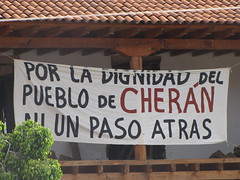
Cherán protest banner
A sign in the Cherán, Michoacán, town plaza strikes a rebellious note. The town rebelled against illegal loggers clear-cutting the local hills with the help of armed criminal groups earlier this year – and ran off the local mayor, too. Michoacán electoral officials want there to be a vote in Cherán, but locals say they won't allow political parties to participate.

The PAN mayor of La Piedad was shot dead while campaigning Nov. 2, casting doubt on the ability to hold general elections across the oft-violent state of Michoacán in 10 days time – and also casting doubt on the ability to hold federal electoral races next year in the pockets of Mexico where organized crime violence has been rife.

Ricardo Guzmán Romero was fatally shot while campaigning for the PAN candidate in the pork-processing town of La Piedad, PAN officials said via Twitter. The circumstances of the assassination remain uncertain, but PAN youth president Jhonathan García, who was witness to the shooting, said via Twitter that the mayor was shot in the abdomen. Press reports say Guzmán was passing out pamphlets when attacked.

Michoacán Gov. Leonel Godoy scheduled a press conference for 9 p.m. local time. Guzmán became the fourth Michoacán mayor to be assassinated since Godoy took office in early 2008, Michoacán news agency Quadratín reported.

Voters in Michoacán go to the polls Nov. 13 in an election Luisa María Calderón, sister of President Felipe Calderón, hopes to win for the PAN. Public opinion polls vary. An Agencia Mendoza Blanco y Asociados survey shows a tight, three-way PAN-PRI-PRD contest, while Gabinete de Comunicación Estratégica gave Calderón 39-36 lead over PRI candidate Fausto Vallejo. PRD candidate Silvano Aureoles Conejo trailed with 25 percent support, setting up a potential embarrassment for the PRD, which had dominated Michoacán politics for the past decade.

The assassination marked the latest difficulty for Michoacán's electoral process, which will renew the governor's office, local congress and 113 municipal governments. The state electoral institute reports the withdrawal of 51 candidates, according to the newspaper El Universal. The PAN-New Alliance coalition, meanwhile, was unable to find candidates in at least 10 municipalities.

Residents of Cherán, where locals ran off illegal loggers, organized crime, the police and the mayor, refuse to allow political parties to run candidates, even though the electoral institute insists on there being a vote.

Violence, of course, predates the election in Michoacán, where La Familia Michoacana and a splinter group, the quasi-religious Knights Templar, are disputing the state. Michoacán native Felipe Calderón sent troops to Michoacán shortly after taking office – the first such deployment of his administration.

20 September 2011

Presidential front-runner declares his intentions

IMG_4690
Former State of Mexico governor Enrique Peña Nieto speaks Sept. 14 to residents of a flooded out neighbourhood in Cuautitlán after distributing pre-paid cards for replacing damaged furniture and appliances. His term as governor ended the next day and he now is pursuing the PRI presidential nomination.

To no one's surprise, former State of Mexico governor Enrique Peña Nieto acknowledged his plans to run for the Institutional Revolutionary Party (PRI) presidential nomination. Even less surprising, he did so while appearing on Televisa, the media empire long-accused of providing him with plenty of favourable coverage – and exposing him frequently to a nationwide audience in a country where most people get their news via television broadcasts – during his six-year gubernatorial administration.

Derisively branded "Gel Boy" (pronounced, "hell-boy," in Spanish) by detractors for the copious amounts of gel in his hairstyle, Peña Nieto enters the contest with a massive lead among over any of the probable presidential candidates as the governing National Action Party (PAN) appears spent after 11 years in power and President Felipe Calderón lacks a popular heir-apparent. The left-leaning Democratic Revolution Party (PRD), meanwhile, has been plagued by infighting since nearly capturing power in 2006 and its nomination process is another civil war waiting to happen.

The 45-year-old Peña Nieto puts a young face on an old-school PRI, which has recovered from losing the presidency in 2000 and being decimated in 2006 (after vicious infighting) and has gone on to dominate politics on the local level – and become a party of powerful state governors, who preside over jurisdictions with little transparency and weak autonomous institutions.

He hails from a political clan known as "Grupo Atlacomulco," which has wielded power in the State of Mexico for decades and grew rich from the largess of generous government concessions. Its most famous patriarch, former State of Mexico governor and Mexico City regent, Carlos Hank Gónzalez, coined the infamous Mexican political maxim, "A politician who is poor, is a poor politician." Peña Nieto appears to have the backing of the church hierarchy, too – something unthinkable a generation ago for a PRI politician.

Peña Nieto will likely face PRI Senate leader Manlio Fabio Beltrones in the nomination battle – and emerge the victor: The State of Mexico carries enormous weight in PRI matters. Additionally, his reputation has been burnished by having presided over an administration savvy in public relations and which focused heavily on the completion of public works projects. He also survived fiascoes unscathed, such as the botched Paulette investigation in 2010 – in which a four-year-old girl was found dead in her own bed nine days after investigators supposedly had searched her room – or his fumbling for answers during a television interview when explaining the circumstances of his first wife's death.

His current wife, soap opera star Angelica Rivera, draws no shortage of favourable coverage, too – and their union was made possible after the Archdiocese of Mexico City annulled her first marriage because it took place on a beach in Acapulco. Even his teenage daughter was named one of the 10 hottest girls in Mexico by Quién, a society magazine.

The former governor has outlined no specific plans for a PRI administration, although the behaviour of the PRI delegation in the lower house of Congress – which he heavily influences – might offer hints at what to expect. The PRI delegation has thwarted attempts at labour reform, failed to pass money laundering and national security laws, steadfastly opposed the reelection of politicians and has fought every year during the budget process to devolve ever more money to opaque state governments,
 
Even details of his accomplishments seem vague – such as the claim made in his final informe (state of the state address) that the homicide rate dropped by half in the State of Mexico during his administration and doubled in the rest of the country. This all at a time when at least four cartels have battled for territory in the suburbs of Mexico City and the neighbouring Federal District has remained relatively free of organized crime nonsense.

During recent reporting trips to the State of Mexico, people have carried on enthusiastically in interviews about how Peña Nieto has kept his word and improved life in the state. When asked to provide examples, the conversation usually turns to some distant project, which quite possible included federal funding, or highways charging tolls far beyond what an ordinary motorist might be able to afford.

When posed with questions about security, everyone says it has worsened – especially for anyone riding the over-priced public transit network in the State of Mexico, which has been a target for armed thugs in recent years. But, again, they seem willing to give Peña Nieto the benefit of the doubt, proving that voters overwhelmingly view security as a federal matter and seldom will hold a local mayor or governor responsible. Some interviewees even figured the arrival of a priísta in Los Pinos would somehow bring the crime problem under control – just like during the "golden age" of PRI rule that so many in Mexico now have fond memories of recalling (when narcos were kept in check) and hope to see come to pass once again.

The presidential election goes down July 1, 2012, leaving time for the frontrunner to be reeled in – just like Calderón did with Andrés Manuel López Obrador in 2006. But how that might happen remains a mystery, especially when many voters appear apathetic about the political process (witness the low turnout in the July 2011 State of Mexico gubernatorial election,) young voters with more bad memories about the PAN in power than the PRI are actually opting for the PRI, and so many people, like one participant leaving comments on the Reforma website, gush enthusiastically, "Finally a primary candidate with a project and real proposals. Enrique Peña Nieto, President of Mexico!!"

28 August 2011

Padre Pistolas

IMG_4415
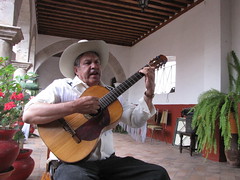
Father Jesús Alfredo Gallegos Lara is better know as Padre Pistolas, a Michoacán priest famed throughout the region for packing heat and singing ranchera and mariachi music. He also has become famous for promoting public works projects - all to the dismay of his superior, the Archbishop of Morelia. The archbishop once suspended Father Gallegos, but politicians from all sides - who regularly seek out his endorsement, including PAN gubernatorial candidate Luisa Calderón, the president's sister - have urged Padre Pistolas to run for public office, knowing his popularity, moral authority and pull with the local population surpasses that of anyone else in church.

I visited with Padre Pistolas recently - hoping, course, he wouldn't pull out his Colt 45 and, say, "Vaya con Dios, muchacho!" He's folkloric, but also very dedicated to his work - and has done more to improve life in the rundown pueblos he serves than any other public figure. The story ran in The Globe and Mail (click the title of this post to read it.)

29 January 2011

'Acapulco is both heaven and hell'

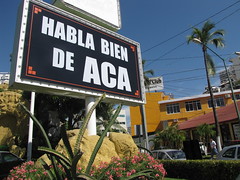
Habla bien de Aca
A campaign launched by Acapulco night club owners encourages people to speak well of Acapulco. It comes as the granddaddy of Mexican tourist destinations suffers through a wave of organized crime bloodshed that has involved beheadings and mass abductions. Tourist officials say the violence takes place far away from tourist areas and doesn't impact visitors. They complain, too, that violence in other parts of Guerrero often is erroneously reported as somehow involving or being near Acapulco. I went to Acapulco recently to report on the situation for USA TODAY; read my dispatch by clicking on the headline for this blog post.

16 November 2010

Bulletproofing goes big time

IMG_3500
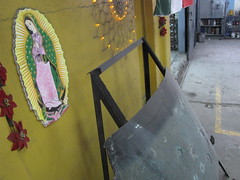
A shot-up windshield from a Honda Accord sits under a shrine to Our Lady of Guadalupe in the garage of Protecto Glass International in Mexico City. The firm is one of the oldest armouring companies in Mexico and has experienced a boom in demand for bulletproof vehicles as perceptions of insecurity increase in Mexico.

The Mexican bulletproofing business has exploded with the crackdown on organized crime, moving from an industry protecting politicians, executives and the über wealthy to one armoring increasingly more modest vehicles for ever less important government functionaries, small business owners and professionals wanting to ward off carjackings and kidnapping attempts.

One industry group values the Mexican bulletproofing business at US $80 million, but that figure might be low since many armoring companies are not registered with the Public Security Secretariat, U.S. firms are capitalizing on the demand from Mexico and the bad guys - according to some - have their own people protecting vehicles.

Brazil still leads the hemisphere in armoring, says Esteban Hernández of Auto Safe in Mexico City. Mexico leads in the demand for Level 5 armoring, however - a level protecting against attacks with assault weapons and grenades. Hernández, ironically, came from Colombia in the mid 1990s to promote bulletproofing. Nowadays, he says of the armoring companies in his home country, "They're on the brink of collapse."

Read the full story in the Nov. 15 edition of USA Today.

14 September 2010

Chicharito

IMG_3133
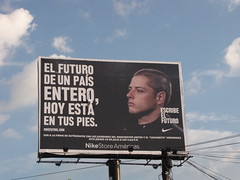
A billboard in Guadalajara features local soccer star Javier "Chicharito" Hernández and the warning, "The future of a whole country, today is at your feet." The admonishment reflects the pressure on Hernández, who now plays for Manchester United.

Mexican soccer phenom Javier Hernández - better known by the handle, "Chicharito," or Little Pea - made his debut Sept. 14 in the Champions League as his club Manchester United took on Rangers. The debut, like everything he does with Manchester United, received major press attention back in Mexico, where the 22-year-old striker is fast becoming a living legend - especially in his native Guadalajara.

Chicharito faces enormous expections in Mexico, where international soccer success has been elusive and players have generally preferred to earn solid livings in a domistic league flush with cash from the nation's broadcasting duopoly instead of challenging themselves in tougher European leagues.

The lad appears ready. He comes from a solid, middle-class family, never indulges in vices such as smoking and drinking, according to his granddad, and never gets caught up in any scandals - unlike, say, aging striker and current Mexican soccer demigod Cuauhtémoc Blanco, who showed up for World Cup camp overweight and out of shape. He also speaks excellent English and was pursuing a university degree at UNIVA in suburban Guadalajara as he rocketed to soccer stardom last year with Chivas, the legendary Mexican franchise that doesn't field foreign-born players. His family has even moved to England with him.

I tracked down Chicharito's graddad - a former Mexican international and Chivas player - in late July, when Manchester United passed through Guadalajara, for story that ran in The Sun. Read it here, or click on the title.

13 September 2010

Yet another Jefe Diego letter surfaces

Yet another letter purportedly authored by the kidnappers of former presidential candidate Diego Fernández de Cevallos surfaced Sept. 13, more than three months after the political insider and legal bigwig better known as "Jefe Diego" disappeared from his ranch in the state of Querétaro.

A photo, showing a blindfolded Fernández de Cevallos holding a copy of the magazine Proceso with him and former president Carlos Salinas posing in a photo, also surfaced with the letter, which, in a mocking tone, alleges that Jefe Diego has been abandoned by his friends and family and leaves uncertain who exactly is responsible for his apprehension.

"Thanks to the personal and public trajectory of 'Jefe Diego' many things continue to be said and perhaps all the lines of investigation fit since his family has abandoned him and his own friends don't care about his fate," the letter read.

The letter was signed by the, “Misteriosos Desaparecedores,” made mention of various theories that Jefe Diego might have been grabbed by everyone ranging from narcos to rebels to "defrauded individuals." And its surfacing promised to deepen the mystery of his disappearance and foment even more conspiracies on how a figure closely linked to the most senior officials in the country's internal security apparatus could suddenly vanish without a trace and how investigators would so willingly remove themselves almost immediately from the case at the behest of his family.

It was no secret that the cigar chomping Fernández de Cevallos cut a controversial path through Mexican political and legal circles. He became notorious for his moonlighting as an attorney for some of the country's most powerful companies suing the federal government to win injunction in tax cases while he served as a National Action Party (PAN) senator.

He also clashed with President Felipe Calderón, who, in 2008, buried the hatchet with the Diego faction of the PAN by appointing a Fernández de Cevallos protegé, Fernando Gómez-Mont, as interior minister and later a former legal associate, Arturo Chávez Chávez, as attorney general. (Gómez-Mont left cabinet after objecting to the PAN-Democratic Revolution Party alliances formed in five states for the July 4 elections.)