31 January 2006

Rugby taking off in Mexico

IMG_0043

BY DAVID AGREN/THE HERALD MEXICO
El Universal
January 31, 2006


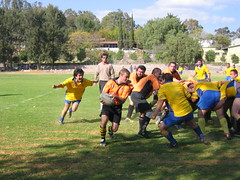
Shortly after founding the Guadalajara Rhinos Rugby Club, coach Eduardo Fernández used to organize weekly practices at an ill-equipped pitch in suburban Guadalajara only to have no one show up. Last Saturday, in a giant step forward for his squad and the sport´s stature in western Mexico, the Rhinos, scrummed down against the University of Celaya, Guanajuato, for the Mexican Rugby Federation´s top prize, the Raúl Monroy Cup, a mere three seasons after the Guadalajara team was formed.

"The work of the last three years is reflected in today´s final," Fernández said prior to kickoff. "Each season we´ve been improving."

Although not especially popular in Mexico, rugby is gradually inching towards a more prominent spot on the country´s sporting landscape. An estimated 650 players participate in the sport nationwide. Mexico joined the International Rugby Board in 2004 and sent a national team - known as the Serpientes - to a prestigious seven-aside tournament in Los Angeles for the first time last winter, placing 14th in the 16-team event and defeating the West Indies squad.

Outside of Mexico City, five new teams now compete in the Mexican Rugby Federation´s 12-team circuit, which stretches from Cordoba, Veracruz, in the east to Guadalajara in the west. For the first time in decades, a team from outside of Mexico City won the league championship, when Celaya captured last year´s title.


"One good thing that´s been happening in Mexican rugby is the growth we´ve had outside of Mexico City," explained Fernández, a quixotic figure who´s founded two clubs.


Fernández played for 16 seasons with the University of Guanajuato before founding cross-town rival Dragones five years ago. Upon moving to Guadalajara, he partnered with John Tobin, an Irish expatriate, to start the Rhinos.


The pair quickly found Enrique Estrada, who grew up playing rugby at the Greengates school in suburban Mexico City, to manage the club´s off-field matters, which besides renting pitches, rounding up sponsors and procuring a stand-by ambulance for each game, includes organizing the "tercer tiempo," a post-match social event, where the battered and bruised players put aside on-field differences and enjoy some good-natured camaraderie over tacos and beers.


Despite the recent growth, Mexican rugby lacks strong organization and funds for promotion. Players usually pay for all expenses, including the cost of renting fields, which are usually better suited to other sports and often missing uprights and locker rooms. Expatriates occupy up to half the roster spots on some squads as Mexico still develops relatively few players.


For some teams, just attracting enough players to each game presents an enormous challenge. Guadalajara advanced to the cup final after a Mexico City squad defaulted. The Rhinos used to field a sizable contingent of exchange students each season, leaving the team constantly scrambling to find new members .


But with a growing number of foreign players putting down roots in Guadalajara and increased Mexican participation in the sport, Estrada envisions the Rhinos becoming a contender in the near future; the club swept this season´s games against the two Guanajuato squads and qualified for last weekend´s cup final against Celaya. For the last road trip to Guanajuato, 19 players made the three-hour journey, a record turnout.

A RUGBY TOWN

Rugby has enjoyed more popularity in Guanajuato than any other city outside of the capital. The University of Guanajuato has fielded a rugby squad for more than 25 years. For most of that time it was the lone non-Mexico City team, a pioneer status the club´s longtime members embrace - even though on-field glory has been scant; the squad has only won one national championship.


"It´s been a source of pride for us," coach José Jesús Álvarez said of his club´s longevity. "We´ve been fortunate to have people who participate year after year."


Still, despite the club´s history, attracting players takes effort for Álvarez and his crew.


"It´s not that easy," he said. "Many people come out, but when they begin to see the discipline, the contact, everything involved, they don´t stay."


The university, however, produced enough players over the years that a new squad, the Guanajuato Dragones, was formed. Beyond the Bajio, University of Guanajuato alumni - like Eduardo Fernández - occupy spots on many Mexican club rosters, which Álvarez said made it difficult for his squad to build a winning tradition.


"They finish up here and then they leave for other teams," Álvarez said, explaining that students constitute almost the entire University of Guanajuato roster.


In contrast, the University of Celaya regularly fields a squad laden with experienced foreigners, who work in the eastern-Guanajuato city and nearby Querétaro, home to a number of multinational companies.


For last weekend´s title game, played on a wind-swept pitch in a Tlajomulco, Jalisco, industrial park, the Celaya players arrived on a comfortable charter bus and took the field wearing crisp white uniforms, emblazoned with sponsors´ logos, looking every bit the championship team.


Celaya trounced the Rhinos 81-17 in the Raúl Monroy Cup final, which capped a short tournament-style season. Guadalajara kept the game close in the first half, but the larger and more experienced Celaya players overpowered the Rhinos in the second half, effortlessly running up the score.


Celaya captain Gustavo Hernández, however, complimented the Guadalajara team.


"It´s only a question of one or two years before they reach the top level," he said.

19 January 2006

Even-tempered Canadian expats aren't arguing over January 23 election


Story by: David Agren

The 2004 U.S. election stirred political passions on Mexico's Chapala Riviera (Lakeside). Friendships reportedly dissolved over political differences and members of opposing parties would avoid each other in public. Open politicking led to a politically charged atmosphere at some Lakeside events – most notably at a speech given by Tony Garza, the U.S. ambassador to Mexico. The former Texas railroad commissioner drew jeers after delivering a partisan address.

In comparison, the competitive Canadian election, which takes place on January 23, has intrigued many in Lakeside's Canadian community, but featured little acrimony.

"We came down here to get away from it all," said Erik Benedictson, a Chapala resident, originally from Lake Cowichan, British Columbia. "We're still keenly interested," he added, explaining he regularly watches coverage via Star Choice satellite. "We just don't rant or rave about it."

The Canadian election pits the embattled governing Liberals against the Conservative Party (Tories), left-leaning New Democratic Party (NDP) and openly-separatist Bloc Quebecois. Recent polls put the Tories in front by a double-digit margin, although the Liberals launched a series of deeply-negative attack ads last Tuesday.

Recurring scandals have diminished Liberal fortunes – especially in Quebec – and the party has so far run an uninspiring campaign. "You could never have predicted the Liberals would run such a bad campaign," said Adam Daifallah, co-author of the recently published book, "Rescuing Canada's Right: Blueprint for a Conservative Revolution."

"They're making gaffes everyday. … It's a total reversal [of the 2004 race]."

According to Rob Parker, vice president of the Canadian Club and a former federal politician, who served as a Conservative member of parliament for nine months in the late 1970s, "There's been a great deal of interest" in the election race and many partisans reside at Lakeside. But most Canadian expatriates aren't arguing over the upcoming vote.

Parker, who lives in Ajijic, said all of Canada's main parties are well-represented at Lakeside, although, due to demographics, some of the smaller parties probably had few adherents.

"I haven't run into any Marxist-Leninists or Communists [down here]," he quipped, referring to two thinly-supported Canadian parties, which have never had a member elected to Parliament.

"There are certainly strong feelings among the supporters of each of the three major parties."

No Canadian political party has campaigned in Lakeside this year. Unlike the big two U.S. political parties, the Canadian parties have no foreign offshoots to drum up support or sign up voters. During the last U.S. election, heavyweight campaigners, including George P. Bush, the president's nephew, and Diana Kerry, Democratic candidate John Kerry's sister, courted expatriate voters in Mexico.

Adam Daifallah said contrasting political cultures explain many of the differences.

"Politics in the United States is a sport and it's professional," he explained.

"In Canada we don't have that same phenomenon. It's still very much a pastime. It's not the same obsession."

Parker attributed the lack of politicking in Lakeside to the fact Canadians have less of a history of voting from abroad – unlike their American neighbors. Also, Canada seldom holds elections in the winter – a time when the Canadian population at Lakeside swells.

To make participating in the election easier – for supporters of all parties – the Canadian Consulate in Guadalajara, Elections Canada and the Canadian Club worked out a unique voting-abroad scheme.

Approximately 150 Canadian expatriates living at Lakeside cast ballots between January 5 – 7, voting at an informal poll run by the Canadian Club.

Erik Benedictson voted during the three-day event, saying afterwards, "The Canadian Club made it easy."

He explained that the club helped with obtaining ballots, publicized the vote and provided a full list of the candidates names in each of the ridings for the special write-in ballots. (Canadian voters only elect a local member of parliament and do not directly choose the prime minister.)

Rob Parker said the marked ballots would be shipped to Canada on January 12, arriving well in advance of the January 23 deadline. A source at the Canadian Embassy in Mexico City said that as of last Thursday, 914 Canadians had registered for voting. The embassy also facilitated shipping ballots back to Canadian through its diplomatic bags.

The current race could result in another minority Parliament, meaning Canadians could face another election within the next two years, something Parker promised to be ready for.

"We've had some practice," he said with a chuckle.

From the Guadalajara Colony Reporter

Mexico’s vanilla farmers ponder uncertain future


 Story by : David Agren

Cornelio Olmos de la Cruz figured he had found a lucrative cash crop when he planted vanilla on his small farm near Gutierrez Zamora, Veracruz several years ago. With the world price hovering around 200 dollars per kilogram, the investment looked profitable. A local vanilla processor encouraged him – along with his neighbors – to grow more of the popular flavoring agent. But by the time his vines matured, the bottom had fallen out of the international vanilla market, leaving him with an unprofitable crop, a mountain of debt and a once-eager buyer unwilling to pay him a worthwhile price.

"Vanilla was the biggest scam," he lamented bitterly after arguing with a buyer.

"Two years ago, we were told to plant vanilla."

The Papantla, Veracruz area bills itself as the zone that "perfumes the world" and for its small vanilla farmers, the region's prized crop reeked of cash for the past five years. A spike in the world price, beginning in the late 1990s, made vanilla so valuable, thieves would pilfer the money-colored pods as the winter harvest neared. With prices peaking at 500 dollars a kilogram, hundreds of landowners like Olmos planted vanilla vines expecting a sweet harvest. The pay out, however, never materialized.

"Vanilla used to be extremely profitable," said Pedro Larios, the owner of Casa Larios, a Papantla-based vanilla processor.

"A lot of people planted vanilla in 2003 and 2004 when the price was high. They're angry now."

"With this price … (the farmers) are going to get rid of their vanilla and start harvesting other things," commented Salvador Gonzalez, a farmer, who has 2,000 vines on a plot near Gutierrez Zamora.

"It's just not profitable."

Four years ago, Gonzalez received more than 500 pesos for a kilogram of raw vanilla. Nowadays his crop fetches between 40 and 50 pesos per kilogram.

The Mexican producers' troubles started far away from Veracruz state, which hugs the Gulf of Mexico to the east and the rugged Sierra Madre mountains to the west, on the other side of the globe. Madagascar, the world's largest producer, recently began flooding the market again with vanilla after enduring five years of weather-related calamities.

In a normal year, Madagascar produces 60 percent of the global supply. A cyclone in 2000 wiped out approximately one-third of the island's vanilla crop. Unusually cool weather in 2002 also dampened its production. The resulting shortage, coupled with strong international demand, sent prices soaring.

Madagascar's production has now returned to its previous high levels, arriving at the same time as Mexico's spate of newly-planted vanilla vines matured.

In addition to the current glut in the world market, the demand for costly natural vanilla, which flavors everything from desserts to cola, weakened over the past five years as vanilla users substituted inexpensive artificial extracts for the real thing.

According to Craig Nielsen, CEO of Nielsen-Massey Vanillas, a vanilla processor based in Waukegan, Illinois, worldwide demand for natural vanilla has decreased by "35 to 40 percent" over the past five years. He estimated the world market has a surplus of 500 tons, meaning prices should remain relatively stable for the next two to three years.

Pedro Larios, however, also blamed a small group of international vanilla buyers, who he said wield immense power over the producers.

"We depend on … the (foreign buyers)," he explained.

"Previously, when there was a harvest, someone with a lot of money would come and buy it all."

In an effort to find new markets, Larios, whose second-generation enterprise primarily cures and then sells vanilla to large international buyers, recently struck a small deal with a Japanese perfume manufacturer, which allows him to receive a better price by cutting out intermediaries.

Although vanilla is native to Mexico, the country now accounts for approximately one percent of the world's production. Most of Mexico's vanilla grows in northern Veracruz, a region just south of the Tropic of Cancer that receives adequate rainfall, experiences few weather extremes and has good soil drainage. The Totanac Indians dubbed vanilla, the only orchid that produces an edible fruit, xanath and used it to flavor atole (a corn-dough beverage). The Aztecs would add it to chocolate. Legend has it Aztec emperor Moctezuma offered chocolate flavored with vanilla to Hernan Cortes. The Spanish later brought vanilla back to Europe, where it became enormously popular.

Besides Veracruz, farmers in Puebla, San Luis Potosi, Hidalgo and Oaxaca also cultivate vanilla. Little of their harvest is processed in Mexico, where natural vanilla consumption is low.

"We now consume vanilla, but not very much," Larios said, adding that virtually every vanilla product sold in Papantla's markets is artificial.

Mexico produced all of the world's vanilla until the French devised a method in the 1800s for pollinating vanilla flowers by hand, allowing the crop to be grown in far-flung places like Madagascar, Indonesia and the South Pacific. India and Uganda have also emerged as strong vanilla-growing countries over the past few decades.

With the advent of foreign competition, the majority of Veracruz farmers abandoned vanilla cultivation. A petroleum boom lured many into the oil industry. Mexico virtually ceded the vanilla market to foreign producers.

"Madagascar began producing 1,500 tons [annually] and started selling it … everywhere, allowing them to pass us in the world market," explained Larios, a chemical engineer by training, who previously worked for Pemex.

"Us, we became oil workers."

Veracruz farmers only rediscovered vanilla over the past 20 years, but an unpredictable world market has left many disillusioned with their choice. Additionally, vanilla requires an immense amount of labor during the harvest and pollination seasons, which is found more cheaply in other parts of the world.

"(In Madagascar), manual labor is cheaper and they harvest so much," said Crispin Perez Garcia, president of the National Vanilla Producers' Board, as he watched workers at Casa Larios' Papantla facility prepare freshly harvested pods for the long and at times labor-intensive curing process.

At Casa Larios, rows of vanilla pods baked under the hot sun covering almost all of the expansive front patio. The pods, which resemble fat green beans upon arrival, are first boiled for 30 seconds. The pods are then spread out on the patio, staying in the sun until the internal temperature reaches 55 degrees. Later, the pods sweat in a large wooden box, which releases the aromatic oils. The drying and sweating process is repeated 25 times, at which point the shriveled pods have blackened and give off an intense aroma that's anything but plain. Larios explained that it takes five kilograms of raw vanilla to make one kilogram of cured vanilla.

Mexican vanilla producers like Perez insist they grow the world's best vanilla. According to a laboratory analysis provided by Casa Larios, Mexican vanilla strikes the right flavor and aroma balance. Vanilla from Madagascar has an intense flavor, but provides less of an aroma. Indonesian vanilla lacks some of the same flavor, but provides a powerful aroma. Madagascar's vanilla, however, has proven popular – even though Perez insisted, "It's not the same quality. It's a different type of vanilla."

Craig Nielsen differed, saying, although it has more "spicy notes," Mexican vanilla is somewhat similar to Madagascar's. Many of his clients buy Mexican vanilla for its cachet of being a Latin American product, although in some cases, the spiciness adds something special to their recipes.

Little of that matters much to Cornelio Olmos de la Torre, though, whose experimentation in large-scale vanilla farming has left him pondering his future. The former soldier and 30-year veteran farmer, now plans to rip up most his vanilla vines and might raise sheep instead.

"What else do you do?" he asked.

From the Guadalajara Colony Reporter

16 January 2006

Shrimp island lacks "Pueblo Magico" feel

Mexcaltitan

Story by : David Agren

According to legend, the Aztecs once inhabited Mexcaltitan, a small island in Nayarit surrounded by mangroves. They supposedly decamped Mexcaltitan in 1091 for unknown reasons, wandering for more than two centuries until they founded Tenochtitlan in 1325, on two islands in Lake Texcoco; the present site of Mexico City. The Aztecs founded a grand city, the seat of the warrior-tribe's empire, which dominated Mexico until conquistador Hernan Cortes plundered it in 1521.

Modern day Mexcaltitan, which means 'the place of the temple of the moon' in the Nahuatl language, is somewhat less glorious in comparison. Nowadays, shrimp fishermen populate the rustic island, which for the most part lacks paved roads, motor-vehicle traffic and telephone lines. Tall curbs keep the houses and businesses dry during the rainy season, when the San Pedro River floods the island and canoes navigate what passes for Mexcaltitan's main drag, which is aptly named Venecia (Venice). Small lanchas (passenger boats) ferry residents, supplies and more recently tourists to and from the mainland.

Based on the island's history and unique geography, the Mexican Tourism Secretariat dubbed Mexcaltitan a Pueblo Magico (Magic Town), hoping to draw an army of tourists into the remote corner of Nayarit, 108 kilometers northwest of Tepic.

Any journey to Mexcaltitan first passes through Santiago Ixcuintla, a pleasant burg on a coastal plain in the middle of a tobacco-growing region. The lanchas to Mexcaltitan depart from a nondescript point 30 minutes out of town, traveling to the island whenever a combi full of passengers or supplies arrive.

Upon landing in Mexcaltitan, the island's big industry, shrimp fishing, quickly becomes apparent. Shrimp, drying in the hot sun, cover patches of the sidewalks on virtually every block. Fishermen mend nets in front of their homes. Restaurants boast impressive shrimp dishes, ranging from shrimp cocktail to shrimp pate, on their menus. Vendors hawk tamales de camarones (shrimp tamales).

The shrimp boats – humble canoes rigged with outboard motors – head out at night, a time when longtime fisherman Carmelo Estrada said, "The shrimp walk on water."

In a good night, he hauls in 50 kilograms of shrimp, which the next morning he cooks in a large pot with water and salt, turning the delicacy from a dull gray to a bright pink-orange color. He then spreads the shrimp on a concrete patio to dry for two days.

The Pueblo Magico program is supposed to diversify the economy, but shrimp fishing still dominates and tourism amenities are still scarce. One hotel, La Ruta Azteca, operates on the island. A guidebook accurately describes it as "the best, worst and only option." For 150 pesos, a guest receives a single bed, lukewarm water and night in a musty room.

Apparently, the Pueblo Magico program brings also public investment with it, but scarcely any of the money seems to have arrived in Mexcaltitan.

"(The government) sends materials, but nothing gets fixed," lamented Reina Perez, a lifelong island resident. According to a recent Mural article, the federal Tourism Secretariat threatened to revoke the island's Pueblo Magico status if improvements weren't made.

Rumored improvements, which have so far not come to fruition, include painting all of the island's houses white with red trim – a color scheme long used on the island, but according to Perez, for political reasons.

"When the [Institutional Revolutionary Party] PRI was in power all of the houses were painted with their colors," explained Perez, a closet National Action Party (PAN) supporter.

"When the PAN won, people changed the colors."

A team of outsiders spruced up the island – and painted many of the houses – prior to former president Carlos Salinas' visit, the only time anyone remembers improvements being made.

Salinas inaugurated the Museo de Origen, the town's one bonafide tourist attraction. The museum recounts Aztec legends and – no surprise – has a display on shrimp fishing. Beyond the museum, a few seafood restaurants, including one on a neighboring island, might pique a tourist's curiosity.

On the downside, the ubiquitous public drinking is difficult to avoid. Men, sitting on curbs, start chugging caguamas (quart-sized bottles of beer) at the crack of dawn. Bottle caps litter the dirt roads.

Lanchas back to the mainland travel infrequently, making Mexcaltitan a potentially difficult spot to leave. Appropriately, the midday lancha arrives at the mainland in time to meet the Corona beer truck. Some supplies simply can't wait.

From the Guadalajara Colony Reporter

02 January 2006

Nayarit coffee growers emerge unscathed from years of crisis


Story by : David Agren

Freddy Martinez Torres and four family members dumped 50-kilogram sacks of freshly-harvested coffee cherries on a buyer's scale in Cafe Cumbre Huicicila, Nayarit, optimistic their crop would fetch a good price. The buyer fiddled with the old scale, weighing the sacks of cherries, before offering 3.50 pesos per kilogram. Although not entirely satisfied with the rate, Martinez accepted it, taking payment on the spot.

"It's not as much as we wanted but it's okay," he said, looking weary from spending a 12-hour day on his 1.5-hectare farm.

"(The buyer) could probably give us more."

The rate compares favorably, though, to the miniscule prices paid earlier this decade, when a crisis ravaged the coffee industry, forcing many farmers off their land. Martinez received as little as one peso per kilogram during those lean years, making this season's rates, which he called "profitable," look pretty good.

Nayarit coffee farmers recently began harvesting their crop in the hills south of Tepic, commencing earlier than last season. Along with enduring record-low prices a few years back, a hurricane flattened many farms in 2003. But unlike other Mexican coffee producing regions, which were hit hard by hurricane Stan, this year's weather proved favorable in Nayarit.

"The region over all looks better," said Charlie Lambert, international sales director for Cafe Cumbre, a large certified-organic producer, which operates near where Martinez farms.

"We're expecting ... an okay year."

Nayarit lacks the notoriety of Chiapas, Oaxaca and Veracruz, Mexico's famed coffee regions. The state, however, is notable for being one of the most northerly coffee-growing zones in the world. It accounts for approximately five percent of the national coffee output.

"The Nayarit coffee market is minimal," Lambert said.

Coffee from Nayarit differs from other Mexican regions; Lambert described it as somewhat sweet and lacking bitterness.

"We have several customers ... that buy it principally to blend with their espresso blends," he explained.

Martinez, his father and three brothers farm 17 hectares, which is divided among them. The family sells 20 tons of raw coffee cherries in an average year. About 15 Huichol Indians help with the picking. Family members maintain the farm through the off-season and grow corn and vegetables for their own consumption.

During the coffee crisis, many of the workers went looking for more profitable employment in Nayarit's tobacco and tomato fields. Some farmers also departed, although the Martinez family managed to scrape by.

"The thing about the Martinez family ... their farm is small enough that within the family they can provide virtually all of the labor [except for the harvesting]," Lambert explained, saying that with the current prices being paid, the family should do well.

Also helping, many of the buyers - previously dubbed "coyotes" - have become more scrupulous in recent years. Farmers, equipped with better methods of communication, now know the prevailing market conditions. Five buyers used to operate in Cafe Cumbre Huicicila, sometimes ripping off the small producers, who had little choice but to unload their highly-perishable harvests. Nowadays, only three make the journey up the winding 18-kilometer dirt road from Compostela, Nayarit.

Although 3.5 pesos per kilogram for raw coffee cherries sounds low, it takes 5.4 kilograms of cherries to make one kilogram of green coffee (which is ready for roasting).

According to Lambert, the small producers lack expensive processing equipment, which would add value to their coffee. The recently picked coffee cherries, which have a deep wine-colored hue, must be fermented within 24 hours of being picked.

Cafe Cumbre commands a premium price for its coffee due to the finca's organic certification. It also processes all of its raw coffee, operating a roasting plant in Zapopan. Farmers like Martinez never use chemicals on their land, but without organic certification, he fails to receive a higher price.

Still, unlike previous years, he has a crop and someone offering a reasonable price for it. It's a better situation than in southern Mexico, where hurricane Stan wiped out much of this year's coffee production.

From the Guadalajara Colony Reporter

23 December 2005

Chinese competition dampens holiday spirit for Jalisco ornament firm


Story by : David Agren

Open cardboard boxes loaded with shimmering ornaments, which are easily visible from the sidewalk, suggest happiness and joy. But the present economic reality for Sorpresas en Artes Navideñas (SeAN), a glass-ornament manufacturer in San Julian, Jalisco, brings little cheer for its manager and his dwindling number of employees. Stiff foreign competition has jeopardized the future of their industry, flooding the Mexican and export markets with poor-quality knockoffs that sell for a fraction of the price.

"The Asian factories have hit us hard," said Guillermo Gonzalez Mata, the plant manager. "We can't compete on price."

SeAN used to ship a trailer-load of ornaments to the United States each month. This year, it failed to fill a single trailer. Asian factories churn out identical merchandise for a fraction of the price. It often shows up in Mexican street markets, but also in supermarkets and department stores. SeAN manufactured 500,000 ornaments for the 2005 Christmas season. Unlike many of its competitors, its employees produced each piece by hand, giving each ornament a unique one-of-a-kind luster.

"There's a lot of conscience involved," Gonzalez said proudly.

The ornament-making process takes 25 minutes from start to finish. Each piece starts out as narrow tube of glass, which is then cut according to the size of the ornament. The pieces are blown into the appropriate shape. The shiny pieces are metalicized while the frosted items are exposed to oxygen gas. After being formed into globes, ovals and teardrops, the pieces are painted. Some pieces like the miniature Santas, bells and toy soldiers, come from moulds. Finally, a small army of detailers hand-paint most of the ornaments.

After outlining the labor-intensive process, Gonzalez observed, "The quality of the Chinese merchandise is poor."

But China has stolen market share away from San Julian's factories, leading to job losses. One factory on the outskirts of the Los Altos-region town closed last year while another produced even fewer ornaments than SeAN did. Three years ago, SeAN employed 100 people, who designed, manufactured, decorated and packaged the ornaments. This year it only hired 22. The town, famous for its dairy industry, increasingly survives on remittances sent home by migrants.

"There's not a single family in San Julian that doesn't have at least one member in the United States," Gonzalez said.

With the export market drying up, SeAN focused more on selling its goods in Mexico.

"We sold more here [this year] because we can't compete with the Chinese," he added.

The factory snagged several private-label contracts, including one from the Transportation and Communications Secretariat (SCT). SeAN decorators hand-paint the government agency's logo on three types of ornaments. The company also boxed sets of premium ornaments, which require attention to detail the Chinese factories can't match. Glass ornaments adorn fewer trees with each passing Christmas, although some Americans prefer the traditional decorations to the now-ubiquitous plastic offerings. Antiques dealers scour Mexican pueblos, looking for the classy, if less-refined, ornaments from factories like SeAN.

Andrea Hernandez, a nine-year veteran employee of the San Julian plant, which is 150 kilometers northeast of Guadalajara, said most of SeAN's retail customers come looking for something original.

"There's a lot of outside competition, but there are still people who like to keep traditions. ... There are people who value our work," she explained. "It's artesania because it's all done by hand."

Susanna Kirchberg, a Guadalajara folk art dealer, said glass ornaments are highly sought after, but in general, "It's a dying art."

Guillermo Gonzalez Mata didn't know what fate awaited his factory – or if it would even operate in the coming years – simply saying, "In our case, it all depends on the owner."

From the Guadalajara Colony Reporter

Zapopan brewery battles beer giants


Story by : David Agren

Jesus Briseño never especially liked the watery mass-market beers sold in most Guadalajara bars. During trips abroad, he discovered craft beers, freshly-made ales, stouts and lagers that were packed with subtle, but interesting flavors and usually drawn from a keg. He later started making his own beer at home before studying to become a brew master in the United States. Nowadays he brews beer for Zapopan-based Cerveceria Minerva in small batches, putting it into kegs so customers can buy it by the pint in local bars and restaurants.

Small breweries like Cerveceria Minerva flourish in Canada and the United States, where a thirst for craft beers has created a sizeable market niche and stolen sales from large conventional producers. In Mexico, however, two large breweries, Grupo Modelo, the maker of Corona, Estrella and Modelo, and Cerveceria Cuauhtemoc Moctezuma, which sells Sol, Indio and Tecate, dominate the market, forming a virtual duopoly, which the companies jealously protect. Furthermore, the country lacks a tradition of premium beer consumption; fewer than five microbreweries operate in the Republic. Most Mexican beers lack a distinctive flavor and are almost always sold in bottles.

'Our slogan is: 'Cerveza Minerva, it's not just a beer, it's culture,' ' Briseño said, adding the company hopes to gradually change the way Mexicans view beer. 'We're trying to establish a culture of drinking premium beers.'

Cerveceria Minerva jumped into the brewing fray somewhat quietly during the summer of 2003. A group of six owners, which included Briseño, opened Tierra de Malta, a brewpub on Avenida Ruben Dario, selling beer made on site.
'It used to sell a lot of beer,' Briseño recalled.

'But that's all that it sold.'

Deciding they were better brewers than restaurateurs, the group sold a stake in Tierra de Malta to Salute, a Mexico City chain, after one year in business, but kept the beer-making equipment in place. They later imported additional beer-making equipment, purchasing the assets of a distressed brewer in Philadelphia for a bargain, and set up a brewery in a Zapopan industrial park. The Salute location still produces some of Cerveceria Minerva's volume.

Although not the most successful of ventures, the restaurant proved a taste for craft beer existed in Guadalajara. Cerveceria Minerva now sells four different beers in approximately 20 Guadalajara-area restaurants and bars along with a few establishments in Mexico City and Queretaro.

It brews two beers year round: Viena, an amber lager and Colonial, a golden pale ale. It also makes a Dunkelweissen, a 'dark wheat beer,' which is exclusively sold at the Red Pub in Guadalajara, and four seasonal varieties. During the fall of 2005, it's offering Luna Llena (Full Moon), a cream stout, which Briseño described as 'like a Guinness, but not dry.'

Cerveceria Minervia uses premium ingredients, importing its hops and barley. Although Mexican malt is available, Briseño said the big two breweries have cornered the market. The Zapopan brewery also purifies its own water.

Sales growth has averaged 15 percent per month since the new brewery opened and Cerveceria Minerva recently unveiled plans for bottling its product. The first six packs should hit store shelves in February.

But convincing establishments to stock a new product isn't easy. Grupo Modelo and Cerveceria Cuauhtemoc Moctezuma forge exclusivity agreements with many bars and restaurants. According to Alejandro Orozco, Cerveceria Minerva's sales director and a co-owner, the beer giants entice establishment owners into signing exclusivity agreements by offering tables and chairs, refrigerators, easy payment terms and sometimes cash.

'Our biggest problem has been exclusivity contracts,' Orozco said.

Alejandro Perez, manager of the Red Bar, pulls pints of Cerveza Minerva at his English-style pub, which also offers a wide selection of imported brews and, of course, Grupo Modelo products. He said Group Modelo representatives offered him a kickback worth 10 percent of the bar's beer sales if he signed an agreement, but he declined, saying most of his customers come looking for imports and microbrews.

Placing Cerveceria Minerva beers in retail outlets could also be difficult. The big two breweries also tie many stores to exclusivity contracts. Some retail chains offer poor payment terms. Femsa, the parent company of Cerveceria Cuauhtemoc Moctezuma and a large Coca-Cola bottler, owns Oxxo, one of Mexico'sdominantminent convenience store chains. Oxxo doesn't generally stock competitors' products.

Further complicating matters for Cerveceria Minerva, the federal Congress – at the urging of Mexico's two big breweries – will impose a new environmental tax on all non-returnable beer containers in the new year. The law doesn't affect soft drink and water bottlers that use similar containers. It could make Grupo Modelo and Cerveceria Cuauhtemoc Moctezuma's products cheaper in comparison to the rash of inexpensive imports and craft beers flooding the Mexican market. The two large breweries already have networks for retrieving and washing bottles. If implemented, Orozco said the tax could drive up Cerveceria Minerva's retail prices by as much as 30 percent.

'It's not just a problem that affects us,' Orozco explained. 'It also affects all other foreign beers.'

Still, tax or no tax, Orozco said plans for bottling Cerveceria Minerva's products will proceed.

'You can keep growing into a new market – or just stay stuck,' he said.

And with any luck, the upstart brewer will survive the tax, the exclusivity contracts and the lack of beer appreciation and just maybe 'become a threat to the big guys.

From the Guadalajara Colony Reporter