25 October 2008

Senate votes for reform

1811200722
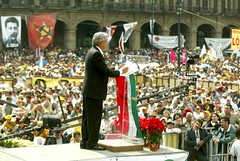
AMLO addresses followers at November 2007 rally.


Senate votes for reform

BY DAVID AGREN
The News

The Senate approved an energy reform package Thursday, six months after President Felipe Calderón unveiled his controversial plan for overhauling the state-run petroleum sector and stemming a precipitous decline in oil production.

Lawmakers from the three main parties voted overwhelmingly in favor of the seven initiatives comprising the package, which now moves to the Chamber of Deputies.

"It's a success that we've had a civilized Senate debate, producing new rules of the game for a better, more modern and more transparent Pemex," said Sen. Manlio Fabio Beltrones, leader of the Institutional Revolutionary Party, or PRI, in the Senate.

The vote was moved from the Senate chamber to a heavily guarded office tower several blocks away in order to avoid protesters loyal to former presidential candidate Andrés Manuel López Obrador, who has long decried the plan as a first step to privatizing the nation's oil industry.

But López Obrador's protests, which included a takeover of Congress earlier this year and regular street demonstrations by his "oil defense brigades," lost some of their steam after members of his same Democratic Revolution Party, or PRD, opted to negotiate the deal with the PRI and Calderón's National Action Party, or PAN.

The initiatives approved Thursday grant Pemex increased budgetary and operational autonomy; allow the state-owned oil giant to partner with private firms for oil exploration and exploitation ventures; make the company's tendering process more flexible and provide incentives to restart dormant drilling activity in mature oil fields.

But the reforms discarded Calderón's proposals for paying performance bonuses to Pemex's private-sector partners and eliminated another for building new refineries with private money. The reforms also failed to touch the influential oil workers union, which holds five seats on the Pemex board.

Despite the changes, Calderón lauded the Senate-approved package.

"Without exaggerating, I can say that it is the most favorable change in the hydrocarbons sector since 1938," he said, referring to the year the petroleum industry was expropriated.

Analysts described the reforms as an improvement over the status quo, but inadequate for solving the managerial issues in Pemex and arresting production declines.

"This reform is important in providing Pemex with increased autonomy, both financially and operationally," said Alejandro Schtulmann, director of research at Empra, a Mexico City risk consultancy.

"But it falls short in solving Pemex's challenges. The union is a huge problem ... it won't do anything to reverse the decline of [the massive Cantarell oil field.]"

The vote followed six months of discord over energy reform, which has provoked legislative shutdowns, more than two months of public hearings, a partisan citizen consultation process and the threat of López Obrador-sponsored brigades flooding the streets.

A small group of senators representing a coalition of left-wing parties known as the FAP voted against the reforms due to the lack of a clause explicitly forbidding future privatization. They also objected to a measure allowing private firms to win contracts for managing entire production areas on behalf of Pemex.

Deputy Javier González Garza, PRD leader in the Chamber of Deputies, said the two measures would be raised during debate in the Chamber, although he added, "I agree with a large part of the reform."

Debate in the Chamber is expected to begin Tuesday.

05 October 2008

Guerrero´s Sunday votes a litmus test for governor

Tlamacazapa

Guerrero´s Sunday votes a litmus test for governor


BY DAVID AGREN
The News

Residents of the southern state of Guerrero head to the polls on Sunday in legislative and municipal elections. But rather than being just your run-of-the-mill local political process, the elections are shaping up as a referendum on Gov. Zeferino Torreblanca´s administration <00AD>- and even one on his Democratic Revolution Party, or PRD, itself.

Torreblanca rode to power in 2005 on a wave of discontent that also swept the Institutional Revolutionary Party, or PRI, out of office after 75 years of oppressive rule in the impoverished state.

The Acapulco retailing magnate ran for PRD on an agenda of change in what is one of the republic´s most marginalized, underdeveloped and conflictive states - a place where 40 percent of the homes have dirt floors, 42 percent of the population is illiterate and the murder rate is double that of the national average, according to federal government statistics.

"The election of Zeferino Torreblanca was historic," said human rights lawyer Mario Patrón, who worked in the La Montaña region of Guerrero until recently.

"After more than 75 years of PRI rule, the civil society took to the streets and voted. There were high expectations," Patrón said.

Guererro residents overwhelming opted for turfing the long-ruling incumbent party - not unlike what had occurred on the federal level five years earlier - in a result that one national broadsheet welcomed as, "Moving toward the end of the outlaw Mexico."

But local observers say that the initial euphoria diminished quickly, as few of the expectations that people had - corruption being reduced, education and social programs being fixed, and oppressive governance being stamped out, for instance - began to materialize.

"They´ve just reproduced the same old practices and the same governing policies," Patrón said. "What we have is power being alternated. There´s been a change of colors, but there has not been a transition."

Ironically - but perhaps unsurprisingly, given the left-wing PRD´s divisions stemming from internal elections both nationally and in Guerrero earlier this year - many of the ballots that could be cast against the PRD are expected to come from disaffected party members, who differ with the governor on policy and party politics.

Some in the PRD predict a humbling at the polls for their party, which is expected to lose seats in the state legislature and could lose numerous municipal races - perhaps most embarrassingly in Acapulco, the state´s largest municipality.

"There´s no possibility of the PRD keeping its majority in the legislature," Alvaro Leyva Reyes, a former campaign coordinator for Torreblanca, told the newspaper El Universal.

TOUGH COMPETITION

Making things even tougher, the PRD is now battling a rejuvenated PRI that has been winning local-level elections nationwide over the past two years, and has shown unity in Guerrero after previously being torn apart by infighting there.

Torreblanca, meanwhile, has drawn the ire of some factions of his party for not adequately financially supporting Andrés Manuel López Obrador´s alternative government, as well as working cooperatively with the PAN administration of President Felipe Calderón.

Torreblanca also has butted heads with the PRD mayor of Acapulco, Félix Salgado Macedonio, according to José Luis Rosales, director of the Rural Development Institute at the Universidad Autónoma de Guerrero.

Salgado has accused Torreblanca of sending that municipality inadequate resources for social programs and urban development projects and described the governor as "PANísta to the core," according to Rosales.

With the PRD stumbling, political observers predict a strong showing from the PRI, which sent its big guns to campaign in Guerrero.

Party president Beatriz Paredes and State of Mexico Gov. Enrique Peña Nieto both made appearances. In Acapulco last Sunday, Paredes described the PRI as united and agents of change.

Patrón, the human rights lawyer, expressed skepticism over the PRI´s pledges to carry out change, but acknowledged that the party was on the rebound in his state.

"The PRI is in the process of reconstruction, and it´s most likely that it will win various municipal governments [in Guerrero]," he said. "It´s starting to regain ground, but this isn´t a result of PRI policies. It´s a consequence of the image of poor governance by the PRD."

07 September 2008

Guadalajara rector spat highlights power struggle


Photo by Steven H. Miller

Guadalajara rector spat highlights power struggle

BY DAVID AGREN
The News

The University of Guadalajara ousted its rector Aug. 29 over vague allegations of mismanagement, sparking calls for campus demonstrations, a string of appeals and accusations of power-brokering at the nation's second-largest public university.

On Aug. 29, Rector Carlos Briseño was ousted by the university's governing council, a body packed with loyalists of Raúl Padilla, a controversial former student leader and rector who is considered by many to be the most influential figure in the university over the past 25 years.

Within hours, Marco Antonio Cortés, a Padilla ally, began occupying Briseño's office in the school's white marble rectory building.

Briseño, too, had once been a friend of Padilla, but after he began cozying up to the local governing National Action Party, or PAN, and the leading opposition Institutional Revolutionary Party, or PRI, both of whom had long been at odds with Padilla, he quickly fell out of favor.

"Carlos Briseño arrived [in the rector's] office by the decree of Raúl Padilla, but the strongman made a mistake," said El Universal columnist Jorge Zepeda, a former editor of the Guadalajara newspaper Siglo 21.

But Briseño wouldn't roll over and play dead, despite decisions by Jalisco Gov. Emilio González and the Public Education Secretariat not to intervene in the case. Instead, he immediately denounced his firing as illegal and began pleading his case to the citizens of the western state.

He convinced a local court to grant an injunction against the firing, but it was overturned Sept. 4 by a federal judge.

Meanwhile, back on campus, 1,500 sympathetic students and teachers in his support on Sept. 5, some of them chanting: "Out with the Padilla crowd!"


OLD-STYLE LEADERSHIP

Briseño assumed the post of rector in early 2007, and it did not take long before he was losing favor with his former mentor.

In late August, Briseño began suggesting reforms at the Centro Cultural Universitario, which oversees a group of successful businesses and projects including hotels, language schools, a burgeoning film festival and the prestigious International Book Fair - the second-largest event of its kind in the world.

Many of the projects had been founded by Padilla, and he had remained as the head of the center after stepping down from the rectory in 1995 at the end of a six-year term.

When asked in an Aug. 28 radio interview why the center and Padilla's leadership of it were being scrutinized, Briseño responded: "Absolute power corrupts.

"I don't have any proof, but we're investigating . we're going to audit each one of the university's businesses," he said.

The General University Council sacked Briseño a day later, citing budgetary mismanagement and insubordination.

For some observers, the firing showed how the university, despite its reputation as an institution on the vanguard of higher education, at the same time remains wedded to an old-style authoritarian leadership.

"At this university, both the past and present are very much alive," said Sergio Aguayo, a professor at the Colegio de México and a Jalisco native.

"There are parts that are excellent, but very large parts are extraordinarily backward in their political culture."


`A BENIGN STRONGMAN'

Zepeda, a University of Guadalajara graduate, called Padilla, "a benign strongman," whose use of power has been both "favorable and unfavorable."

Under Padilla's guidance, both as rector and behind-the-scenes playmaker, the school undertook modernization initiatives that included decentralizing power to regional centers beyond Guadalajara, and organizing successful cultural events.

"In many ways, it's been more at the [cultural forefront] of any other university of the country, including UNAM," Zapeda said.

But the U. de G. - as the school is known locally - has also been viewed suspiciously due to a lack of transparency in its finances. And the school's not-so-secret affiliation with the local Democratic Revolution Party, or PRD, which is headed by Padilla, also raised local hackles.

Briseño brought differing political allegiances to the Padilla inner circle. He was openly friendly to the PRI and numerous PRI functionaries, including Gov. Mario Marín of Puebla, Nayarit Gov. Ney González and party president Beatriz Paredes, attended his annual state of the university address in April 2008.

Local newspapers called the annual state of the university address "A coming-out party" for Jalisco's most prominent PRIísta.

Then, when he began forging better relations with the local PAN administration, which had previously denounced the U. de G. for a lack of transparency, he really fell out of favor.

"He had a series of political commitments, with political forces, that were inconvenient for the university . [including] the old national PRI," Zepeda said. "Briseño suddenly represented the possibility of breaking [the U. de G.] open, but for the worst reasons.

"Everyone views it as a jackpot."

30 August 2008

Average citizens suffer horrors of kidnapping, too

BY DAVID AGREN
The News

Pedro Fletes, a Mexico City teacher and father of six, was pulled from his 1994 Ford Escort by five kidnappers as he passed through the Colonia Roma on a winter morning seven years ago.

His abductors brought him to a "safe house," blindfolded him and kept him confined to a closet for nearly two months. A chain was attached to his leg every night.

Feletes subsisted on a diet of tea and pastries, but was also extended a surprising number of courtesies, including packs of Raleigh cigarettes, his preferred brand.

"If I had been an addict, they would have found me drugs," Fletes said, explaining that his captors treated him like "merchandise" that required care and attention. "The most important thing for them was taking care of me."

Yet in the high-stakes crime of kidnapping, the same captors who brought him his favorite cigarettes might just as easily have cut off an appendage, or even killed him, had the deal for his ransom gone wrong.

Instead, his ordeal ended with him being dumped - penniless and wearing the same clothes he had on when he was grabbed 59 days earlier - at an unfamiliar street corner in a working-class neighborhood near the airport. His family had paid the ransom, the sum of which he declined to disclose, except to say that it was a mere fraction of the millions of dollars demanded by kidnappers involved in high-profile abductions.

Fletes' kidnappers nabbed him for purely economic reasons - even though his salary from his job at a private high school pays him only a middle-class salary. But his abduction came during the early years of a trend in Mexico's lucrative kidnapping industry that has seen the middle and working classes become targets as well as the rich.

"In the '90s and early 2000s, a lot of these kidnappings were done by professionals, groups that were very sophisticated," said Ana María Salazar, a Mexico City political analyst and security expert. "They would plan ahead: who they would kidnap and how much money they were going to get.

"Now people are basically getting kidnapped if they have a nice car or they're wearing a watch, or for some reason there's a perception that they have cash available," she said.

Security experts and the leaders of public security advocacy groups say that the problem for the middle and working classes has only become worse since Fletes was apprehended in 2001. Kidnapping is now so widespread that even impoverished rural villages are feeling its impact.

"There are kidnappings for just 5,000 pesos," said Joaquín Quintana, leader of the anti-crime civic group Convivencia sin Violencia, of the situation in rural areas.

"There are kidnappings where they take a family's child . and ask for a cow and two pigs."

MEDIA ATTENTION

Kidnappings are up 9.1 percent this year in Mexico, averaging 65 per month nationwide, according to the Attorney General's Office. Citizens' groups, however, say that most crimes go unreported, and the real kidnapping rate is likely more than 500 per month.

It's a crime that affects people of all socioeconomic groups. Yet the trend of middle- and working-class kidnappings has been given scant attention by the national media, which this month has focused heavily on the plights of two wealthy families, whose children fell into the hands of kidnapping gangs.

Fernando Martí, whose father Alejandro Martí founded a sporting goods retail empire, was found dead in the truck of an abandoned car July 31. His parents had reportedly paid a $5 million ransom, but it failed to save their 14-year-old son.

The mother of Silvia Vargas made an emotional plea for her daughter's return last week along with offering a reward and posting a billboard to flush out information on the kidnapped 19-year-old, whose father previously ran the National Sports Commission.

The plights of both teenagers made the front-page headlines.

"What happens is that when it's someone from the upper class, and it's a well-known person, it appears in the press," Quintana said.

In the Martí case, the extensive press coverage fomented immense public outrage. A massive march against kidnapping is now planned for Saturday evening in downtown Mexico City.

The coverage also prompted political action - and public displays of support from the country's most prominent politicians. President Felipe Calderón attended the funeral Mass for the 14-year-old kidnapping victim. The president, all 31 governors and the mayor of Mexico City also convened a security summit last week, where the leaders agreed to a 74-point action plan after receiving a public tongue-lashing from Alejandro Martí.

In an apparent reference to the Martí case, Attorney General Eduardo Medina Mora acknowledged that "perhaps it takes emblematic events to make us realize that the government is far from living up to its obligations."

But some have suggested that class interests are what drive the government's and public's concern for kidnapping. Back in 2004, then-Mexico City Mayor Andrés Manuel López Obrador, a self-styled champion of the poor and working classes, branded the backers of an anti-kidnapping protest as "spoiled rich kids."

`AN INCREDIBLE BUSINESS'

Security experts say the kidnapping industry began taking off in the mid-1990s, a time when the peso collapsed and authoritarian one-party rule came to an end on the national and Mexico City levels. Asked to explain kidnappings of working-class people, experts cite reasons ranging from lax law enforcement and deteriorating economic conditions to efforts by the rich to make themselves more difficult to apprehend by purchasing bulletproof vehicles and hiring private security.

Perhaps most important of all, the kidnapping of the middle and lower classes, especially in volume, can be a highly lucrative activity.

"There are gangs that do a lot of small-time kidnapping, because these types of kidnappings are a good business," Quintana said.

"There are no complaints filed, nobody goes after anybody. It's an incredible business."

A flood of new entrants changed the industry by carrying out both express kidnappings, in which the victims are forced to simply empty their bank accounts, and virtual kidnappings that trick victims via the telephone into thinking that their loved ones have been apprehended.

Traditional kidnappings are also becoming less sophisticated as victims are increasingly being mutilated and killed, according to Quintana.

"What we're seeing now, unlike before, is that there are no longer any ethics," he said.

"Before, if they were professionals, they would kidnap [the victim] and treat them like merchandise - take care of them, feed them well, return them in good condition. What's happening now is that you pay for the rescue and [the victim] is murdered."

Fletes, who now runs a support organization for the families of kidnapping victims, expressed gratitude that his kidnappers were of the professional variety.

But the reason he was ever targeted in the first place still mystifies him.

"I'm not a rich man," he said.

25 August 2008

The untouchables

Even with energy reform on political agenda, few dare address a core issue: Pemex's union

BY DAVID AGREN
The News

Omar Toledo Aburto normally mans one of the offshore rigs pumping crude from the Campeche Sound. But these days, he's in charge of a protest camp outside the Labor Secretariat, where he sleeps in the cab of a pickup truck parked alongside one of the capital's busiest thoroughfares.

But his current discomfort has nothing on the possible consequences of confronting the powerful oil workers union, which represents more than 90,000 Pemex employees nationwide, and is run by a group that "rules through terrorism," as Toledo Aburto puts it. "If you don't agree with their rules, you'll automatically be fired," he said.

Or, worse, subjected to death threats and harassment.

Mere hours after the 24-year-veteran petroleum worker set up camp in Mexico City on July 28, his wife and children were threatened by "union toughs," he said. But even though he expressed concern for his family's safety, he remains defiant.

"I'm not scared," he said, pointing to a property line marking the limits of the guarded federal land that he's currently occupying.

With the nation's political parties immersed in debates over proposed reforms to the nation's oil industry, Toledo and a band of about a dozen current and former Pemex workers are calling for changes in the oil workers union, an organization that wields enormous influence over the state-owned petroleum concern, Pemex, and dominates the political sphere in many oil-producing parts of the country.

But such is the union's clout that neither the governing National Action Party, or PAN, nor the Institutional Revolutionary Party, or PRI, has dared propose altering the union's relationship with Pemex in their energy reform proposals. Interior Secretary Juan Camilo Mouriño recently said that dealing with the union "is a different discussion," while PRI senators approved a measure last week saying that they would only support an energy reform package that omits union changes. "People pay tremendous prices for fooling with the union," said George Baker, a Houston-based energy consultant and expert on the Mexican oil industry.

Only the Democratic Revolution Party, or PRD, which plans to unveil its own energy reform initiative on Monday, has dared to challenge the union, which some analysts say is a foe of the left-wing party.

"For the PRD, the oil workers union is a political enemy," said Aldo Muñoz, a union expert at the Universidad Iberoamericana. "The Pemex union supports the PRI and, if it suits them, PAN candidates against the PRD."

PRD Sen. Carlos Navarrete last week warned that the PRD would recommend stripping power from the union in its energy reform proposal.

"In what part of the world does the union have almost half of the [seats on the] board of directors in the most important company in its country?" Navarrete told the newspaper Excélsior. "It's absolutely anachronistic."

Former PRD presidential candidate López Obrador has gone even further, accusing the government and the oil workers of brokering an unseemly, but mutually beneficial, deal.

"There's an agreement between [oil workers union leader] Carlos Romero Deschamps and [President] Felipe Calderón to keep corruption in the union in exchange for supporting the Calderón reform," he said recently.

Some analysts, meanwhile, question whether tackling the union issue - however worthwhile an objective - is appropriate during the early phases of a politically difficult reform process.

"You're trying to get some initial traction [on reform]," Baker said. "Getting traction on the union question probably isn't at the top of the list."

The union, too, has remained silent on the government's energy reform proposals - which would allow increased private sector participation in the exploration and exploitation of oil reserves - a move that Muñoz said was symbolic of just how "pragmatic" the syndicate is.

"It publicly supports the PAN in terms of energy reform, because its interests are never touched," he said.

THE PATH TO POWER

The origin of the oil union's power goes back decades. It initially gained authority after the 1938 expropriation of the petroleum industry, as then-President Lázaro Cárdenas proposed having the government and workers co-manage Pemex. That arrangement established conditions for the union leader to play an important role on the national stage, while his subordinates dominated the affairs of regional petroleum centers, where they funded public works projects, held sway over municipal governments and often ran local businesses.

Even to this day, section leaders control hiring and firing decisions. Nepotism is said to be rife, and positions are reputedly sold for as much as 50,000 pesos. (Pemex could not be reached for comment on these allegations, but has denied them in the past.)

Union leaders often manage side businesses that provide Pemex with employee transportation services, construction crews and basic supplies, according to the dissidents protesting in Mexico City. The union also holds five of the 11 seats on the Pemex board of directors.

Oil workers are now some of the best-paid employees in the country, as the union has consistently won generous wage and benefits packages that include gasoline subsidies, a series of worker-only hospitals and Christmas bonuses worth nearly two-months' pay.

The wealth and influence of the union leaders and members - "the real sheiks" of the oil industry, as Alan Riding called them in his 1985 book on Mexico, "Distant Neighbors" - are far-reaching, too. Successive governments have yielded to the union's hardball negotiating tactics, which have included the trump card of threatening to shut down the entire petroleum sector - the source of 40 percent of the federal budget.

BATTLING ON

Allegations of thuggery - denied by the company - are also common. Toledo said that at least 80 dissident members have disappeared over the past eight years.

The union dissident is calling for Romero Deschamps to be deposed by the Labor Secretariat, arguing that the date of the last internal election was improperly moved ahead.

"He's interested in nothing more than keeping himself in power," Toledo Aburto said. "This man, in every sense of the word, has hijacked the union."

In spite of the threats, the union protesters plan to stay put - partly out of principle, but also due to the potentially uncomfortable situation that awaits some of them upon returning to their hometowns and workplaces.

"I can't go back," Toldeo Aburto said. "They've already stripped me of my job."

The Untouchables

Oil worker

Even with energy reform on political agenda, few dare address a core issue: Pemex's union

BY DAVID AGREN
The News

Omar Toledo Aburto normally mans one of the offshore rigs pumping crude from the Campeche Sound. But these days, he's in charge of a protest camp outside the Labor Secretariat, where he sleeps in the cab of a pickup truck parked alongside one of the capital's busiest thoroughfares.

But his current discomfort has nothing on the possible consequences of confronting the powerful oil workers union, which represents more than 90,000 Pemex employees nationwide, and is run by a group that "rules through terrorism," as Toledo Aburto puts it. "If you don't agree with their rules, you'll automatically be fired," he said.

Or, worse, subjected to death threats and harassment.

Mere hours after the 24-year-veteran petroleum worker set up camp in Mexico City on July 28, his wife and children were threatened by "union toughs," he said. But even though he expressed concern for his family's safety, he remains defiant.

"I'm not scared," he said, pointing to a property line marking the limits of the guarded federal land that he's currently occupying.

With the nation's political parties immersed in debates over proposed reforms to the nation's oil industry, Toledo and a band of about a dozen current and former Pemex workers are calling for changes in the oil workers union, an organization that wields enormous influence over the state-owned petroleum concern, Pemex, and dominates the political sphere in many oil-producing parts of the country.

But such is the union's clout that neither the governing National Action Party, or PAN, nor the Institutional Revolutionary Party, or PRI, has dared propose altering the union's relationship with Pemex in their energy reform proposals. Interior Secretary Juan Camilo Mouriño recently said that dealing with the union "is a different discussion," while PRI senators approved a measure last week saying that they would only support an energy reform package that omits union changes. "People pay tremendous prices for fooling with the union," said George Baker, a Houston-based energy consultant and expert on the Mexican oil industry.

Only the Democratic Revolution Party, or PRD, which plans to unveil its own energy reform initiative on Monday, has dared to challenge the union, which some analysts say is a foe of the left-wing party.

"For the PRD, the oil workers union is a political enemy," said Aldo Muñoz, a union expert at the Universidad Iberoamericana. "The Pemex union supports the PRI and, if it suits them, PAN candidates against the PRD."

PRD Sen. Carlos Navarrete last week warned that the PRD would recommend stripping power from the union in its energy reform proposal.

"In what part of the world does the union have almost half of the [seats on the] board of directors in the most important company in its country?" Navarrete told the newspaper Excélsior. "It's absolutely anachronistic."

Former PRD presidential candidate López Obrador has gone even further, accusing the government and the oil workers of brokering an unseemly, but mutually beneficial, deal.

"There's an agreement between [oil workers union leader] Carlos Romero Deschamps and [President] Felipe Calderón to keep corruption in the union in exchange for supporting the Calderón reform," he said recently.

Some analysts, meanwhile, question whether tackling the union issue - however worthwhile an objective - is appropriate during the early phases of a politically difficult reform process.

"You're trying to get some initial traction [on reform]," Baker said. "Getting traction on the union question probably isn't at the top of the list."

The union, too, has remained silent on the government's energy reform proposals - which would allow increased private sector participation in the exploration and exploitation of oil reserves - a move that Muñoz said was symbolic of just how "pragmatic" the syndicate is.

"It publicly supports the PAN in terms of energy reform, because its interests are never touched," he said.

THE PATH TO POWER

The origin of the oil union's power goes back decades. It initially gained authority after the 1938 expropriation of the petroleum industry, as then-President Lázaro Cárdenas proposed having the government and workers co-manage Pemex. That arrangement established conditions for the union leader to play an important role on the national stage, while his subordinates dominated the affairs of regional petroleum centers, where they funded public works projects, held sway over municipal governments and often ran local businesses.

Even to this day, section leaders control hiring and firing decisions. Nepotism is said to be rife, and positions are reputedly sold for as much as 50,000 pesos. (Pemex could not be reached for comment on these allegations, but has denied them in the past.)

Union leaders often manage side businesses that provide Pemex with employee transportation services, construction crews and basic supplies, according to the dissidents protesting in Mexico City. The union also holds five of the 11 seats on the Pemex board of directors.

Oil workers are now some of the best-paid employees in the country, as the union has consistently won generous wage and benefits packages that include gasoline subsidies, a series of worker-only hospitals and Christmas bonuses worth nearly two-months' pay.

The wealth and influence of the union leaders and members - "the real sheiks" of the oil industry, as Alan Riding called them in his 1985 book on Mexico, "Distant Neighbors" - are far-reaching, too. Successive governments have yielded to the union's hardball negotiating tactics, which have included the trump card of threatening to shut down the entire petroleum sector - the source of 40 percent of the federal budget.

BATTLING ON

Allegations of thuggery - denied by the company - are also common. Toledo said that at least 80 dissident members have disappeared over the past eight years.

The union dissident is calling for Romero Deschamps to be deposed by the Labor Secretariat, arguing that the date of the last internal election was improperly moved ahead.

"He's interested in nothing more than keeping himself in power," Toledo Aburto said. "This man, in every sense of the word, has hijacked the union."

In spite of the threats, the union protesters plan to stay put - partly out of principle, but also due to the potentially uncomfortable situation that awaits some of them upon returning to their hometowns and workplaces.

"I can't go back," Toldeo Aburto said. "They've already stripped me of my job."

29 July 2008

Citizens consulted on oil

Former mayor votes
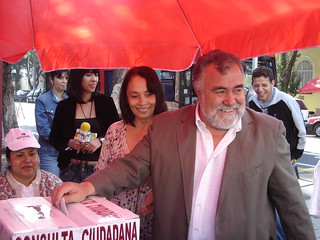
Former Mexico City mayor Alejandro Encinas casts a ballot in a non-binding referendum on energy reform promoted by opponents of the plan.

By DAVID AGREN
The News

Residents in the capital and nine states weighed in Sunday on the future of the country's petroleum sector by casting votes in a non-binding referendum sponsored by a coalition of left-wing political parties.

A Consulta Mitofsky exit poll showed more than 80 percent of respondents voting "No" on the two questions, which asked if private companies should participate in the oil industry and if the lawmakers should approve the energy reform legislation submitted in early April by President Felipe Calderón.

Mexico City Mayor Marcelo Ebrard of the Democratic Revolution Party, or PRD, unveiled the referendum two months ago as a means of derailing Calderón's plan to expand private sector involvement in the country's petroleum sector and grant the state-run oil concern Pemex more autonomy.

The consultation, or "consulta," initially captured significant media and public attention, but the buzz diminished as the capital government began dealing with public dissatisfaction over the handling of a botched nightclub raid and the PRD was forced to annul its internal election due to widespread vote tampering and allegations of dirty tricks. 

Still, organizers anticipated that up to five million people nationwide would participate in the consultations, which are scheduled to be carried out in three stages through Aug. 24.

Voters began trickling into the nearly 4,400 polling stations around the capital at 8 a.m. Brigades of promoters petitioned passersby to participate, but turnout appeared light.

"It's just like the presidential election - the whole thing has already been decided," said parking attendant Roberto Pascual, who abstained from voting.

Polling stations outside of Mexico City reported even lower turnouts.

"People are really apathetic," said Guillermo Aguilar, a government employee manning a Coyoacán polling station. 

"The whole thing has been discredited by the press," he added.

Some press reports said that employees in the local government were pressured into working the consultation, but Aguilar said that he willingly volunteered and only received a T-shirt, ball cap and box lunch in exchange for his services.

Consultation participants were required to show a valid voter identification, but ballots were marked with a black crayon in plain sight of the polling station workers.

City social worker Fernando Najera voted "No" on both questions, saying the Calderón plan was "privatization ... but they just gave it a different name."