07 May 2009

Are rules about flu illegitimate?

0605200901

Most campaigns called off large rallies due to the flu outbreak, but not AMLO, who is receiving IFE scrutiny for this gathering in Tabasco ...

BY DAVID AGREN
The News

Andrés Manuel López Obrador hit the campaign trail on Wednesday, holding rallies that appeared to violate recommendations issued by the Health Secretariat regarding large public gatherings.

The Web site of López Obrador's "legitimate government" reported that 2,000 followers attended an event in Tamulté de las Sabanas, Tabasco, where the left-wing firebrand politicized the flu issue, pressed the flesh and opted not to wear a mask.

"The usurper government has abandoned the people and for that simple reason, these epidemics affect the Mexican population," López Obrador said. President Felipe Calderón, he added, "Alarmed people through the media and spread fear among Mexicans."

By convening campaign events this week in Tabasco and Chiapas and blaming the federal government for the impact of flu outbreak, López Obrador is once again courting controversy with electoral officials, political rivals and even members of his own Democratic Revolution Party, or PRD.

The Health Secretariat has established rules for campaigns: no large gatherings and only small events, to be held between 10 a.m. and 3 p.m. But López Obrador brushed off suggestions from reporters that he was being reckless during a health crisis, telling them, "I only came to pass out pamphlets."

The rules may not technically apply, as López Obrador is not actually running in the July 5 midterm elections that will renew the 500-seat Chamber of Deputies and see municipal and gubernatorial changes. Instead, he plans to hold rallies and broadcast advertisements across the country - except in Mexico City and Tabasco, from which he hails - for candidates from the Labor Party/Convergence party coalition known as Let's Save Mexico.

In the capital and Tabasco, he plans to campaign on behalf of the PRD.

César Yáñez, a spokesman for López Obrador, told The News earlier this week that the current campaign was launched to ensure that the coalition parties win at least 2 percent support, enough to maintain registration with the Federal Electoral Institute, or IFE, and ensure subsidies of more than 1 billion pesos over the next three years.

06 May 2009

Ebrard says he'll work with Calderón on flu

BY DAVID AGREN
The News

Mexico City Mayor Marcelo Ebrard said Tuesday that he would continue working with President Felipe Calderón during the flu outbreak, but cautioned that future cooperation with an administration he considers to have been illegitimately elected would be limited.

On Monday, the left-wing mayor stepped into Los Pinos for the first time since he and Calderón both took office in December 2006, attending a meeting on the flu with the president and the nation's 31 governors. Unlike his counterparts, Ebrard wore a face mask and gloves.

Ebrard - who has faced criticism for putting partisan interests and loyalties to Andrés Manuel López Obrador ahead of the needs of the capital, among other things - defended his trip to Los Pinos.

"What I'm doing is being responsible with respect to my role as head of the Mexico City government," Ebrard told El Universal. "It's clear that in many areas we [already] have been seeking relationships [with Los Pinos]."

Most pundits welcomed the thawing of relations, however. El Universal columnist Ricardo Alemán simply suggested such a diplomatic move should have come sooner. "The Mexico City mayor acted as he should have acted since the beginning of his government: as a statesman," he wrote on Tuesday.

Ebrard previously appeared at a security summit last summer with the president and governors. However, he has largely skipped any joint appearances with President Calderón.

Ebrard has been mentioned as a possible presidential candidate for 2012, but has downplayed those suggestions. His most probable rival for the PRD nomination, López Obrador, told W Radio on Tuesday that "whoever is in the best position" would be the candidate. López Obrador used the radio interview to criticize Calderón for lacking a flu outbreak strategy and "arousing fear."

López Obrador also announced plans to campaign for his preferred candidates this week in Tabasco and Chiapas. Spokesman César Yañez said the events would be low-key - and not involve large crowds, as per Health Secretariat recommendations.

05 May 2009

Politics are seizing on swine flu

Politics are seizing on swine flu

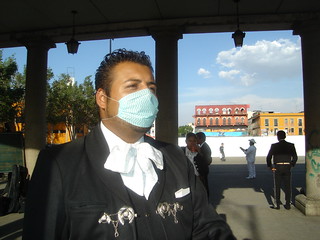
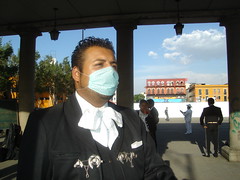
Masked mariachi
BY DAVID AGREN
The News

Nuevo León gubernatorial candidate for the Institutional Revolutionary Party, Rodrigo Medina, and his volunteers fanned out across Monterrey this week armed with bottles of antiseptic hand gel bearing his image and the party colors, thermometers, and face masks for prospective voters. In complete violation of federal health warnings to avoid common salutations such as kisses and handshakes, Medina enthusiastically gripped the hands of the potential supporters receiving the hand gel.

Medina made no apologies for his campaigning and campaign tactics during a time of crisis - even as many national campaigns for the midterm elections postponed inaugural events scheduled for May 3. "We're not going to shy away from this crisis," the 36-year-old candidate told reporters. "If we aim to govern this state, I think that with these acts, it shows a capacity for action and solidarity with the people."

The attempts at leveraging the flu outbreak for electoral purposes in Nuevo León, where polls say the gubernatorial contest is too close to call, highlight a near inevitable politicization of a public health emergency - just two months away from federal midterm elections.

Just as predictable has been the response from rivals. Nuevo León National Action Party candidate Fernando Elizondo suspended his campaign on Tuesday. (Radio and TV ads would continue and volunteers would still distribute fliers and brochures, he said.) He also rebuked Medina for being opportunistic and responsible for putting the health of Nuevo León residents in jeopardy.

"There were massive purchases of face masks, then suddenly [there is] a shortage because [Medina wants] to use them for a campaign," Elizondo told reporters. He preferred to take the high road. "We say that if promoting me were to cause one death, I would prefer to lose," he said.

JULY 5 FEVER
Medina and Elizondo are only peripheral players in a crisis whose handling could be judged at the July 5 polls. Politicians such as President Felipe Calderón and Mexico City Mayor Marcelo Ebrard will likely be judged by the effectiveness of their responses in tackling this public health emergency.

Both stand to gain from the crisis, according to analysts. Calderón seeks to win a majority for his PAN in the Chamber of Deputies on July 5, while Ebrard's Democratic Revolution Party, or PRD, aims to retain its dominance in the capital. Ebrard could also be preparing the foundation for a presidential bid in 2012. (He has yet to confirm speculation that he'll run.) But any missteps in their responses could also be used against them by opportunistic opponents.

Many analysts are already drawing comparisons to the handling of Hurricane Katrina by the administration of former U.S. President George W. Bush as an example of what might happen here. "Did the Democrats capitalize on George Bush's mishandling of Katrina?" asked ITAM political science professor Jeffrey Weldon.

BLAME GAME
Some opposition politicians already have questioned the speed of the federal government response to the flu outbreak along with confusing statistics and shortcomings in its overall communications strategy.

PRI Sen. Pedro Joaquín Coldwell called the government response "necessary for taking care of public health, but rather late." He also said, "It seems like there's been a concealment of information and mistimed actions by the government." Calderón enemy and Democratic Revolution Party Deputy Alejandro Sánchez Camacho, meanwhile, issued a press released that alleged, "[Calderón] has sufficient resources to attend to swine flu, but has little will to confront it." And Labor Party Senate leader Ricardo Monreal, among others, expressed frustration with a lack of clarity in the government's health statistics.

"These are conservative numbers and they seem to be hiding information," the senator from Zacatecas told Reforma this week.

Some political analysts and academics have also found fault in the government's handling of the flu outbreak - and questioned its motives during a time of crisis.

John Ackerman, a professor in the Legal Research Institute at UNAM, questioned the tardiness of the government response to the flu outbreak - the first cases began appearing in mid-March - and the subsequent lack of clarity of its communications. He also questioned the legality of Calderón issuing a health emergency that suspends many civil rights without first seeking congressional approval.

"[The decree] requires the executive to inform Congress about what the real situation is," Ackerman said.

Ackerman also alleged that declaring a health emergency without first going to Congress was another Calderón attempt at the "reconsolidation of the authoritarian president."

Some dispute those arguments, however. "The president has always had the power to declare health emergencies," Weldon said, explaining that such decrees are permitted in most countries and can include such measures as putting sick people into quarantine.

The assumption of more powers by declaring an emergency, he added, brings risks: Calderón will be open to much more criticism - much of it legitimate - from lawmakers and the Mexican City government for any sweeping decisions made during this crisis.

SPINNING THE CRISIS
It remains uncertain how the flu outbreak will alter the political landscape - or when the outbreak itself will end. Ackerman said the spin cycle would determine the winners and losers.

"Is this going to be framed as a natural disaster and the federal government coming in as the savior or is this going to be attributed to institutional failure ... [and] seen as something that could have been prevented?" he asked.

If the latter, he predicted the PRD might launch attacks against the government; the PRI would then ride to the government's rescue, but at a steep price.

"All this strengthens the hand of the PRI and strengthens their ability to negotiate key issues with the government," he said.

Others disagree. George W. Grayson, a Mexico expert at the College of William & Mary in Virginia, thinks Calderón has been perceived as handling the crisis well so far, particularly by Washington - which could give him and the PAN the upper hand going into July 5.

"While [the] PRI was poised to deliver a lethal blow in the mid-year showdown, astute management of the health challenge could reverse the political momentum and strengthen Calderón's hand," Grayson said.

In any special sessions of Congress held before July 5, Grayson said, a good image after the flu crisis could give Calderón leverage over the often-obstructionist PRI.

Political analyst Alejandro Schtulmann, of the Empra risk consultancy, added that attacks by lawmakers on the federal government would be "a high-risk proposition" that could "backfire." The only cover for lawmakers, he said, would be widespread international criticism of the federal government after the outbreak ends, but even that might not be sufficient to harm the president.

"It's unlikely that Calderón would be politically harmed by the crisis because the scapegoat would be the health secretary," Schtulmann said.

04 May 2009

Flu makes normally bustling Mexico City fall quiet

DSC05151

By David Agren, For Canwest News Service

MEXICO CITY — With nothing more than his bare hands, trash collector Felipe Reyes sifts through household waste in the back of a garbage truck, including kitchen scraps and soiled toilet paper, six days a week. He searches for valuables and recyclables, such as cans and bottles, that can be resold. And he hardly ever falls ill, Reyes boasts. But he recently started wearing a mask to avoid catching swine flu, which he considers far more dangerous than anything lurking in the tons of trash his truck hauls off to an overflowing landfill run by the mafia.

“We have more defences against what’s in here than the flu,” he said after removing his mask to puff on a Marlboro cigarette.

“The flu,” he added, “rather scares me.”

Reyes is hardly the only one taking extra precautions in this city of more than 20 million inhabitants, where the flu outbreak has forced authorities to cancel classes, limit restaurants to offering just takeout service, and urge all non-essential businesses to stay closed until May 6. Authorities also called on residents to stay home and forgo decamping the city for traditional Labour Day (or May Day) weekend getaways to Acapulco.

Residents have largely complied, although some in the Mexican capital have taken advantage of the tranquillity and unusually clear skies to ride bicycles, rollerblade, and jog down streets normally clogged by inattentive drivers.

Many prominent institutions and organizations have also complied with orders to avoid convening large public gatherings. Some unions called off their May 1 marches, political parties suspended campaign inaugurations for the summer midterm elections, and the Archdiocese of Mexico City cancelled Sunday Mass across the region. Even cabbies in their ubiquitous Volkswagen taxis were seen wearing masks and latex gloves.

The high rate of compliance with the suggestions from government officials failed to surprise pollster Dan Lund of the Mund Group in Mexico City, who studies Mexican social values.

“This isn’t people obeying the government. It’s that they’re afraid, and what’s being suggested to them makes sense,” he said.

Still, some signs of normalcy were visible. The subway is operating on schedule, grocery and department stores are brimming with merchandise — except for some shortages of masks and hand sanitizer — and garbage is being collected, even on Sundays.

The usual stream of bad news so prevalent before the outbreak also has kept flowing. Prisoners rioted in a Mexico City holding facility, supposedly over a disputed soccer game, punks clashed with cops in the annual May 1 demonstrations, and renegade sections of the teachers’ union protested pension changes and an education reform package that would strip them of the right to sell or bequeath their jobs upon retiring.

Congress also ended its regular legislative period on April 30 by convening sessions marked by lawmakers wearing masks, while voting and staging photo-ops that involved eating pork tacos to prove pork consumption was safe.

“The reputation of politicians is terrible, and now with us being masked, it’s going to get even worse,” quipped lawmaker Gerardo Priego of the governing National Action Party.

On a more serious note, the lawmaker called for authorities to use the outbreak as an opportunity to “decongest” the capital by moving parts of the federal government out of disaster-prone Mexico City, which so dominates national life, trips there are necessary to carry out routine bureaucratic procedures.

But disasters are nothing new for Mexico City, which has been flooded, hit by pandemics, and rocked by earthquakes since its founding in 1325 on a series of lakes in a high-altitude valley.

And the current flu outbreak comes as the country suffers through a wave of violence that has claimed more than 10,000 lives since President Felipe Calderon declared war on narcotics-trafficking cartels in December 2006. The economy has also slumped in recent months, causing the peso to tumble and prices for staples such as food and fuel to soar.

Still, many residents seemed to take the latest outbreak in stride.

“We’re a society that’s used to catastrophes,” said pharmaceutical company employee America Vega, while jogging through a popular tree nursery in the Coyoacan borough.

Others refused to believe the severity of the outbreak, including soft drink and cigarette vendor Maria Bautista Flores, who compared the current panic to the mythical “chupacabras” that terrorized rural Mexico in the mid-1990s through tales of an alien creature snatching goats and sheep.

Cab driver Carlos Gallegos also doubted the severity of the outbreak, saying he only put on a mask to “inspire confidence” in his passengers.

But in Catholic parishes of Mexico City, attendance has dropped by 60 per cent, said the local archdiocese. Church officials also asked the faithful to pray to Our Lady of Guadalupe, the country’s patroness, for intervention. Followers of the Santa Muerte, or Saint Death — a skeletal figure popular in crime-ridden barrios and among those involved in activities such as piracy and kidnapping — also pleaded for intervention and appeared to be complying with government orders to avoid large gatherings.

Alberto Jimenez, who hawks Santa Muerte paraphernalia in a market famed for witchcraft and miracle herbal cures with dubious claims — a 10-herb blend for halting the flu was selling well, according to vendors — said that interest was higher than ever in the death saint, but was still failing to revive his struggling business.

“People have a lot of faith, but they don’t have very much money,” he said.

A lack of money, along with the forced closure of bars and halls used for weddings, has also dented the mariachi business, according to Ney Godinez, who plays a fat base guitar known as the guitarron in a seven-member band.

“This is a pay day and a long weekend. We should be busy,” he said while standing idly in the Plaza Garibaldi, a hub for cantinas-goers and mariachis looking for a gig.

Other destination districts normally bustling with bar and restaurant activity, such as Colonia Condesa, also fell quiet.

A few businesses reported normal sales, however. Convenience-store employees reported normal customer volumes and some larger-than-normal purchases of non-perishable items and bottled water.

Canadian expat entrepreneur Jody Rosen-Spearing, whose Guadalajara-area business sends Mexicans to Canada for education programs, reported having one of his busiest weeks of the year — in spite of the flu outbreak.

“People seem to have confidence that this (outbreak) will end soon,” he said.

Even Felipe Reyes, the trash collector, saw no real effect on his line of work, which involves selling the recyclables and valuables pulled from the garbage.

“The garbage never stops coming,” he said.

29 April 2009

Maximum salary law passes Senate

DAVID AGREN
The News

The Senate approved a bill on Tuesday that forbids any public servant from earning more than the president, who is paid a net salary of 148,015 pesos per month. The Maximum Salary Law was unanimously approved by the upper house of Congress and now goes to President Felipe Calderón for his approval.

Lawmakers said the law would curb salary abuses that result in some municipal and state politicians earning salaries that exceed those of cabinet members and the president. The law, according to Democratic Revolution Party, or PRD, Sen. Pablo Gómez, “Restores the practice of public service that is so discredited in our country.”

Other lawmakers also lauded the measure as a step toward improved transparency and good governance.

“It makes transparent the salaries of public servants, establishes the principle of a labor hierarchy because no low-level [functionary] can earn more than a high-level functionary and, additionally, it establishes the better use of public resources,” said National Action Party, or PAN, Sen. Santiago Creel.

A law for limiting salaries was originally approved by the Senate in 2006, but died in committee after arriving in the Chamber of Deputies. The PRD revived the proposal earlier this year as an austerity measure during tough economic times and firebrand populist Andrés Manuel López Obrador has railed against highly paid public figures during his rallies. But momentum for the law came after the Federal Electoral Institute, or IFE, approved pay rises of nearly 100 percent for its nine-member board. The IFE argued that the pay rise was constitutional, but it was quickly reversed the decision and lawmakers seized on the public-relations misstep as an opportunity to rein in high public salaries.

Still, some public salaries will go untouched by the new law. The law fails to touch the salaries of Supreme Court judges along with members of the electoral tribunal and IFE as the Constitution says that such figures cannot have their salaries reduced while occupying their current positions.

Some PAN members have questioned if reducing salaries will drive talented individuals away from the public sector.

Empty seats, shutdown don't trip up drug bill


BY DAVID AGREN

The News


The Senate met behind closed doors on Tuesday to approve a bill that would permit the possession of small quantities of drugs for personal use but would not force rehabilitation for offending drug users, a key element of the proposal originally presented to the Senate by President Felipe Calderón.

Proponents said the bill would help crack down on small-time drug dealers but avoid treating drug users as criminals. "Fighting organized crime at its lowest level . where drugs are sold retail ... is one thing," said Democratic Revolution Party Senate leader Carlos Navarrete. "Young people, our young people or people of any age in this country, that regrettably have fallen into drug addiction, are another thing."

The "Ley Narcomenudeo," as the bill is known, is similar to a past failed attempt to decriminalize drug possession and its Senate approval comes amid a bloody crackdown on drug cartels. Its passage also comes amid a nationwide debate over the merits of drug legalization.

The new bill would allow possession of up to 5 grams of marijuana, 5 grams of opium, 50 milligrams of heroin, 40 milligrams of methamphetamine and 500 milligrams of cocaine. It would also make police forces at all levels responsible for combating drug dealing and impose sanctions of five to 15 years in prison for those found in possession of drugs with the intention of selling.

The original proposal sent to the Senate by Calderón called for mandatory participation in rehabilitation programs for those found to be in possession of small amounts of drugs. But the PRD on Tuesday claimed credit for successfully lobbying against that proposal. Under the new bill, rehabilitation would be voluntary, except for those caught in possession of drugs at least three times. The bill now heads to the Chamber of Deputies for a vote.

26 April 2009

At church conference, parties find religion

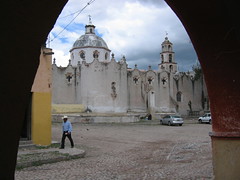
Church in Atotonilco/Iglesia en Atotonilco

At church conference, parties find religion

BY DAVID AGREN
The News

CUAUTITLÁN IZCALLI, State of Mexico - National Action Party president Germán Martínez reminisced about a religious upbringing in Quiroga, Michoacán, while addressing an auditorium of Catholic prelates on Wednesday in this municipality on the northwestern fringes of the Mexico City metropolitan area.

Beatriz Paredes of the Institutional Revolutionary Party followed, speaking similarly about her childhood in the state of Tlaxcala, and of fond memories of the annual patron saint festival in the municipality of Huamantla that fetes La Virgen de la Caridad with predawn pilgrimages and streets carpeted with flowers. Democratic Revolution Party president Jesús Ortega, however, skipped the religious pleasantries and nostalgia and cut straight to politics.

The appearance by the trio of senior political leaders at the annual planning session of the Mexican Bishops' Conference - during which they outlined their platforms and fielded questions on the thorny issues of abortion and religious freedom - was not with without precedent; party officials from the PAN, PRI and PRD had met with senior Catholic prelates prior to the 2006 elections.

But the latest encounter - which also included the presidents of three smaller parties - came as the church has been criticized for wading into the public policy debate with pronouncements, running sharp editorials in church-run publications and lobbying political officials.

Some of the church's hierarchy have even urged Catholics to vote against parties that back policies such as liberalized abortion laws and civil union benefits to same-sex partners.

The encounter - and the recent criticism of the church's so-called meddling - come in spite of strict laws in Mexico that forbid preaching politics from the pulpit, a measure that some church officials want scrapped and say violates their freedom of religion.

"There's a church leadership that is convinced that the church should openly intervene in politics," said Ilán Semo, a political historian at the Universidad Iberoamericana. "[They] have a mentality from the 19th century."

In the mid-19th century, the Reform Laws of Benito Juárez removed the church from the political arena. The Constitution of 1917 reinforced the separation of church and state, along with measures such as prohibitions on the church owning property and priests not being able to wear clerical robes in public.

But reforms approved in 1992 softened many of the anti-clerical restrictions. The softening of the restrictions and the advent of the Catholic-friendly PAN, said Semo, emboldened church officials to opine on public policy and advance a political agenda.

That agenda includes discarding a ban on religious organizations owning radio and television stations and the implementation of religious education in public schools - which are constitutionally mandated to provide schooling that is both secular and free of cost.

The church also wants "freedom of religion" enshrined in the Constitution, which currently only guarantees "Freedom of worship."

Church officials deny allegations that they are attempting to steer parishioners toward preferred candidates or have prelates run for political office, the latter being a violation of cannon law.

They also deny any attempt at blurring the separation of church and state.

"The Catholic Church does not want a confessional state," Archbishop Carlos Aguiar of Tlalnepantla, president of the bishops' conference, said after the meeting with the party presidents on Wednesday.

"The church," he said, "will not be for or against any political party . [and] will promote the importance of the electoral process."

PARTISAN TIES?
The PAN's Martínez on Wednesday enthusiastically backed church participation in promoting democratic values and "fighting absenteeism"

"We're a party that for 70 years has said that there should be freedom, not only of worship, not only of the profession of faith, but rather . a broad and full religious liberty," he told reporters.

Martínez's party has long been accused of being too cozy with the church hierarchy. But church observers say that other parties and political leaders also pursue close church relations.

In Jalisco, for example, the PRI threw its support behind a constitutional ban on abortion after a meeting earlier this year between Cardinal Juan Sandoval of Guadalajara and state party president Javier Guízar.

"Cardinal Sandoval himself often says that PRIístas are the ones that visit him the most," said Víctor Ramos Cortés, a religious studies professor at the University of Guadalajara.

HOT BUTTON
Unsurprisingly, the abortion issue surfaced at the bishops' conference meeting this week.

Only the PAN's Martínez declared his party, "Pro-life;" his PRI and PRD counterparts said that they personally favored the decriminalization of abortion - especially in certain circumstances - but added that blanket positions on the issue would fail to work in their parties due to diverse views on the subject and differing regional sensibilities.

Social Democratic Party, or PSD, president Jorge Díaz Cuervo, whose party is running on a platform that includes the decriminalizing abortion in the states, was less diplomatic.

Díaz Cuervo demanded that the church stay on the sidelines and butt out of people's personal lives. (The PSD platform also calls for legalizing drugs and providing expanded rights for gays and other minority groups.) He cited scripture to make his point.

"As a Catholic, It suits me to pay unto Caesar that which is Caesar's and unto God that which is God's," he said. "As a Mexican, I back the Constitution of 1917 that separates church and state."

His comments were received with a polite, tepid response from the audience. Cardinal Sandoval, for one, did not applaud.

PUBLIC STATEMENT
It remains to been seen what the consequences of the church's interventions into politics will be.

The Interior Secretariat has dismissed several recent complaints over church actions, including one from the PSD regarding a list of "electoral sins" issued by the bishop of Cuernavaca that urged the faithful to vote against any party promoting abortion and gay marriage.

But while government enthusiasm for enforcing laws against church interventions into politics has been minimal, the public has been more enthusiastic in denouncing the blurring of church and state lines.

In Jalisco, a state government donation last year for the construction of a Catholic temple generated such public outrage that the money was returned.

Religious observers say that even though most of the Mexican population is Catholic - and the church ranks as one of the country's most trustworthy institutions - the public draws a line at a certain point when it comes to power.

"People are Catholic ... [but] they don't want priests running the country," Ramos Cortés said.