29 November 2009

Juanito's back - and this time it's for real

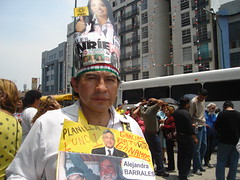
Juanito signage in Iztapalpa
"Juanito" has announced his return to the borough government of Iztapalapa after taking leave Oct. 1 to make way for Clara Brugada, the preferred candidate of Andrés Manuel López Obrador.

The newspaper Reforma summed up the ongoing Juanito saga best with its Sunday headline: The show returns to Iztapalapa.

The show features an emboldened Rafael "Juanito" Acosta, the headband-wearing, Iztapalapa borough chief with a leave of absence, taking back the office that he ceded to a die-hard loyalist of Andrés Manuel López Obrador that had been disqualified from the July 5 election by the federal electoral tribunal (Trife).

Juanito entered the borough offices through a back door over the weekend and defiantly promised that he would only leave if "they drag me out dead," according to the newspaper Milenio.

"They used me. Now I'm using them," he added.

But the show also features scorned López Obrador followers threatening to prevent Juanito from retaking his elected office. The López Obrador faction in the Mexico City Assembly (ALDF) already has promised to find "legal" ways to remove Juanito from his office, while supporters of the acting borough chief Clara Brugada - including the various "frentes" that agitate for housing in impoverished parts of the borough a and reputedly run the pirate taxi business in the capital - have surrounded the borough office in Iztapalalpa.

Brugada convened an estimated 500 supporters on Saturday night, when she alleged that Juanito was mentally unfit to hold public office and that he was provoking "ungovernability" in Iztapalapa.

"We're going to demand through peaceful means that Juanito keep his word. We're not going to allow social disorder in Iztapalapa," she told her supporters.

THE SAGA CONTINUES
The Juanito saga began in June, when the Trife disqualified then-PRD candidate Brugada from the borough chief election due to irregularities at some of the polling stations in the PRD primary elections. Juanito, then-candidate for the PT, was then recruited by López Obrador to run - with López Obrador's backing - and then step aside in favor of Brugada after winning the election. Juanito had second thoughts after the election, but ultimately stepped aside for Brugada.

Juanito's return is provoking headaches for more than just López Obrador, however.

Mayor Marcelo Ebrard deemed the political crisis in the capital's largest borough so urgent that he returned early from a trip and met with Juanito on Sunday morning. The two men had met previously in late September - mere days before Juanito took his oath of office - after which time Juanito decided to take leave and informed the media that he suffered from poor health.

Juanito emerged from the latest meeting undeterred from his plans to retake his office - even though he revealed that Ebrard had offered him the top job in the capital government's sports institute. (Olympic medalist Ana Guevara previously held the job.) He demanded that more security be supplied - he plans on living in the borough office - and said that he would ask President Felipe Calderón for assistance if the Mexico City government failed to comply.

UNCERTAIN MOTIVES
Juanito's motives for ending his 59-day leave of absence remain somewhat uncertain. And although he had said over the past month that he would return to running Iztapalapa, his pronouncements were largely disregarded. He also seemed to be moving beyond politics and capitalizing on his celebrity. Juanito was starring in a play and reportedly had been approached about being a correspondent for a Mexican broadcaster at the World Cup in South Africa. He had been pathetically carting around a statue of himself on a dolly, looking for a place to put it.

It also was no secret that Juanito's relationship with the PT had soured since the election. Juanito had been living in a Colonia Juárez hotel since shortly after the election due to fears for his safety in Iztapalapa, but the PT had stopped the bill last week, according to media reports.

Toward the end of November, Juanito let his scorn be known for Brugada and López Obrador - the latter being a man he passionately supported over the years.

"I asked for leave (Oct. 1) because everyone was against me. Clara Brugada and the López Obrador mafia attacked me with everything and I knew that I wasn't going to be able to govern," he told the newspaper La Razón on Nov. 27.

"I knew that López Obrador, along with Clara Brugada, were going to find a confrontation and blame it on me. I preferred to avoid that and that blood not run."

That scorn extended into Brugada's governance in Iztapalapa and the alleged irregularities in the management of social programs.

Brugada already had raised eyebrows by requesting a 50 percent budget increase for Iztapalapa from the capital government. She also fired some 4,000 employees from the former regime - a frequent occurrence in Mexico when governments are changed.

Juanito called the 4.5 billion pesos that Brugada asked for, "Exaggerated," and alleged, "López Obrador saw Iztapalapa as a jackpot and was going to take from it for his campaign" in 2012.

María Teresa López, Iztapalapa social development director and a Juanito loyalist, told Reforma that since Oct. 1, "(Brugada) has controlled social programs and now we're going to review the management that she was doing of these resources and these beneficiary lists because there's been discretionality."

Juanito may not be so squeaky clean, either.

La Razón columnist Adrián Rueda wrote earlier this month that Ebrard had confronted Juanito back in September with proof that "Rafael Acosta has received a large amount of money from Nueva Viga investors and offers to grant permits to garages interested in dealing stolen auto parts."

UNGOVERNABLE?
How the situation in Iztapalapa unfolds remains to be seen.

The ALDF is expected to address the Iztapalapa situation during its next session on Dec. 1. It's uncertain if the López Obrador faction of the PRD and the PT have sufficient votes to oust Juanito, however. Brugada predicted a lack of governability and "paralisys" due to a suspension in services in Iztapalapa. As proof, Brugada alleged on Sunday that 250,000 homes in Iztapalapa lacked water service - even though the borough government has nothing to do with water service.

For his part, Juanito appears to be going nowhere. He told reporters after meeting with Ebrard: "(The mayor) proposed that I keep Clara in her position and I told him, 'I'm the borough chief and I'm going to stay in Iztapalapa."

28 November 2009

Former Chamber speaker resigns from PRD

Ruth Zavaleta

Ruth Zavaleta, the former speaker of the Chamber of Deputies, who jumped into politics and activism after the 1985 earthquake destroyed her Mexico City home, resigned Friday from the left-wing party she helped to found 20 years ago.

In her resignation letter, Zavelta spoke of the Democratic Revolution Party (PRD) - which was reduced to third-place status in the Chamber after the July 5 midterm elections - as a lost cause. She also mentioned "intolerance" toward the factions that wanted the PRD to move beyond its self-imposed isolation in the legislature and its anti-establishment posturing. Zavaleta instead wanted the PRD to become part of the political establishment and broker deals with rival parties and the federal government - a federal government that loyalists of 2006 PRD presidential candidate Andrés Manuel López Obrador consider to be "illegitimate" and refuse to recognize.

"At this time and since the July 5 election, I don't share the way of doing politics in the PRD," Zavaleta said in her letter.

Zavaleta didn't mention López Obrador by name in her letter, but one long-time enemy of the self-declared "legitimate president," former PRD director of political formation, Fernando Belaunzarán, told the newspaper La Razón that she had tired of the "Stalinist intolerance against her," and, "she was attacked in a hypocritical way."

La Razón columnist Adrián Rueda, meanwhile, suggested on Friday that Zavaleta was disappointed that PRD president Jesús Ortega refused to endorse her aspirations for the 2011 gubernatorial race in her birth state of Guerrero - a move that "accelerated" her resignation.

The decision surprised many, but mostly due to the timing of Zavaleta's departure. The PRD holds a "refoundation" forum Dec. 3 - Dec. 6 that has been organized in response to the party's scandalous 2008 leadership race - that Ortega won by barely 16,000 votes and was settled by the federal electoral tribunal - and could result in disaffected factions and members heading for the exits.

Zavaleta expressed pessimism that the forum would produce results.

"I'm not willing to participate in the supposed discussion on the refounding of the PRD because I don't believe that discussion will be had," she said in her letter.

Her departure reflects the ongoing divisions in the PRD as the New Left, a faction loyal to Ortega that favors dialogue with other parties and the federal government, continues to clash with the factions loyal to López Obrador.

Zavaleta - a former New Left member - favored dialogue with the federal government and reflected that posture during her September 2007 - August 2008 tenure as Chamber speaker.

During her tenure, she said that she had a duty to act in an "institutional manner," which meant dealing with the executive branch of government and allowing debate on legislation that might offend the López Obrador faction - such as energy reform. She became the darling of the PAN and Institutional Revolution Party (PRI), however. Then PAN Chamber leader Hector Larios called her, "A star." But Zavaleta enraged parts of her own PRD, whose members so disliked her that on one occasion they failed to vigorously condemn death threats against her.

López Obrador, meanwhile, leveled misogynistic insults after she met with then interior minister Juan Camilo Mouriño - who López Obrador was trying to scalp for allegations that the Campeche native steered Pemex contracts to family businesses. Then-PRD spokesman Gerardo Noroña Fernández also uttered threats against her after she was seen exchanging pleasantries with First Lady Margarita Zavala at a forum on addictions. (Zavaleta responded to López Obrador by calling him, "A man looking for a fight.")

In some ways, though, Zavaleta was a media creation: She had long been a PRD militant and previously served as borough chief in Venustiano Carranaza, but she held a low political profile prior to her becoming speaker.

Her time as speaker was marked by turbulence; the Chamber approved sweeping reforms to the electoral and criminal justice systems, but was shutdown for 16 days by López Obrador loyalists to prevent the introduction of a bill that would reform the petroleum sector. (The bill was eventually passed in October 2008.) Zavaleta became even less popular among the PRD during the shutdown by presiding over sessions convened in an alternate location that allowed the PAN and PRI to approve legislation that weakened the PRD hammerlock on the Mexico City Assembly.

Her tenure ended with a gala departure, but her career since then has been somewhat quiet. Sources say that she had wanted to replace Javier "El Guero" González Garza as PRD leader in the Chamber, but the internal opposition was too strong. Her aspirations to run as PRD gubernatorial candidate in Guerrero also apparently floundered.

Even though Zavaleta has left the PRD, her fortunes, ironically, may be tied to what transpires in the PRD's refoundation forum next month. Rueda - whose daily column in La Razón is required reading for understanding local politics - wrote Friday that Sen. René Arce, the New Left political boss in Mexico City, has a "political association" registered in the capital that might be converted into a new local party before the 2012 elections.

"They will look to consolidate the new party by negotiating in 2012 with whoever has to gain and seek power in Mexico City," Rueda wrote. That might well be the PRI, which is gaining strength nationally, but is weak in the capital.

Zavaleta has said that she won't join another political party, although the PAN has already come calling with César Nava saying that the doors are open for "distinguished citizen" like her. (Zavaleta is reportedly friends with several senior Panístas, including Zavala and Social Development Secretary, Ernesto Cordero - the latter being a member of President Felipe Calderón's inner circle.) But with her media savvy and a cache of good will from former rivals for her work as speaker, her political future remains bright - and most likely lies with a non-left-wing party.

30 October 2009

Political unrest drags down Honduran economy

Cornhusk doll vendors
Indigenous Chorti Maya in the pueblo of La Pintada near the Copan Ruins sell homemade cornhusk dolls, but sales have dropped since the ousting of President Manuel Zelaya on June 28.

The Honduras political crisis - which appears close to being resolved - deepened the economic misery in one of the hemisphere's poorest countries. Most Hondurans I spoke with during a recent 12-day trip said that their personal economic situations had worsened due to the political crisis and most wanted nothing more for the elected president (Manuel Zelaya) and interim president (Roberto Mitcheletti) to reach some sort of agreement - any agreement.

The pain was very obvious in Copán Ruinas, a tourist town near the Guatemala border that was being bypassed by travellers on the well-worn Central American backpacker trail. Zelaya's ouster along with the subsequent protests and curfew scared off many potential travellers. Some in Copán Ruinas blamed Guatemalan tourism officials for spreading erroneous information about the border being closed in an effort to keep travellers from crossing into Honduras. The tourism minister from the Zelaya's regime - who was recognized by other Central American governments - also told potential travellers: stay away.

Still, even with the political crisis about to end, the economic situation isn't expected to just miraculously bounce back.

Here are the first few lines from my dispatch on the Honduran economy for Catholic News Service:


Political unrest drags down Honduran economy

COPAN RUINAS, Honduras (CNS) -- Oscar Garcia used to sell 100 pounds of tomatoes every day in the municipal market of this colonial town near the Guatemalan border. Since the June 28 ouster of President Manuel Zeyala, Garcia sells just 40 pounds of tomatoes and has to moonlight as a hotel security guard to support his family.

"I'm working day and night and it's barely enough," said Garcia, the father of four. "There are people here starving to death because of the political crisis."

The June 28 coup plunged Honduras into a political crisis, but also deepened long-standing economic problems in one of the hemisphere's poorest countries. Over the past four months, exports have diminished, citizens have reduced their spending and international development aid has been suspended.

Read the
full story here.

19 October 2009

Church revisits role of priests who supported Mexican independence


Photo of José María Morelos mural in Morelia, Michoacán, by Steven H. Miller

By David Agren (Catholic News Service)

MEXICO CITY (CNS) -- Revelers, clutching flags and clad in patriotic colors -- red, white and green -- gathered in town squares across Mexico earlier this year to celebrate the country's independence with fireworks, music and lusty calls of "Viva Mexico."

They also feted a revolutionary hero, Father Miguel Hidalgo Costilla, with re-enactments of the "grito," his 1810 call for independence from Spanish rule.

The celebrations this year kicked off the countdown to the bicentennial of Mexican independence along with the countdown to the centennial of the Mexican Revolution, which erupted in 1910 against the dictatorial rule of President Porfirio Diaz.

But the celebrations ushered in controversy for Catholic officials, who have been attempting to clarify the church's role in the historical event that was ignited by Father Hidalgo's fiery sermon but staunchly opposed by the church hierarchy of the day.

Various dioceses have published editorials and pronouncements on the independence movement. The Mexican bishops' conference, meanwhile, has established a commission for both the bicentennial and centennial. The bishops also sponsored a September conference on the church's role in the independence movement, which pitted the indigenous and mestizo populations, along with "criollos" -- Mexicans of Spanish origin, but born in the New World -- against the reigning Spanish-born elite known as "peninsulares."

The peninsulares, according to historians, were supported by the Catholic hierarchy of the day, although an especially terse editorial by Cardinal Juan Sandoval Iniguez of Guadalajara sought to dispel views that Catholics were entirely against the independence movement.

"Mexico always has suffered from a false official history that presents people and events in black and white, when, in everything, there are nuances," Cardinal Sandoval said Sept. 20 in an editorial published by Semanario, an Archdiocese of Guadalajara publication.

"Enemies of the church have wanted ... to obscure the merit of more than 400 priests that took up arms at that time to fight for independence," he wrote.

The various statements have been especially forceful regarding Father Hidalgo, a national icon, whose face adorns bank notes and whose name is given to roadways across the country.

The excommunications of Father Hidalgo and Father Jose Maria Morelos, a fellow independence leader, have provoked controversy for nearly two centuries and have been a source of friction between the church and the nation's political and intellectual elites.

The most recent controversy over Father Hidalgo was provoked by the Mexico City Archdiocese's response to a request from a congressional commission responsible for organizing bicentennial activities. The commission had asked for the intervention of Cardinal Norberto Rivera Carrera of Mexico City in petitioning the Vatican for the removal of the independence heroes' excommunications. The archdiocese issued a public response Aug. 28 on its Web site that said such a request was impossible because neither man had been properly excommunicated.

The excommunications were invalid, according to archdiocesan archivist Father Gustavo Watson and other church officials, because it was carried out by Manuel Abad Queipo, bishop-designate of Michoacan, who lacked the authority to do so and whose title of bishop was never confirmed by the Vatican.

Additionally, church records show that Father Hidalgo confessed in a Chihuahua convent before dying, was given the sacraments by Franciscan brothers and was buried in a church cemetery. Father Morelos also confessed prior to his 1815 execution, Father Watson said.

"They died inside the Catholic Church and died as priests," Father Watson said. "Therefore, there's no reason to ask that the excommunication be lifted."

Despite the statements and release of new evidence, attempts to change minds could prove difficult. Mexican textbooks teach that the two priests were excommunicated for their activities, although Public Education Secretary Alonso Lujambio told reporters in September that possible revisions would "be studied."

Some historians, meanwhile, accuse the church of trying to revise history and rehabilitate its image in the prelude to the bicentennial.

Political historian Ilan Semo of the Jesuit-run Universidad Iberoamericano in Mexico City concurred that Fathers Hidalgo and Morelos did not die excommunicated, but said church officials were being selective in their historical interpretations.

"The church opposed the independence movement," Semo said. "There were isolated priests in support ... but the hierarchy was against it."

Church officials, however, have called for wiping the slate clean and moving forward.

"Let us not be prisoners of the past," said Archbishop Alberto Suarez Inda of Morelia, president of the bishops' conference's commission on the centennial and bicentennial, told participants at a September forum, "The Church and Independence."

"Let us learn from the path of forgiveness and the purification of memories (so that) the evils of yesteryear don't nourish the hatred that continues doing damage ... and, above all, are not repeated."

01 October 2009

Juanito: The rest of the story

Rafael Acosta "Juanito"

Ice cream-vend0r-turned-Iztapalapa-borough-chief-for-five-minutes Rafael Acosta - better known as "Juanito" - at the PRD 19th anniversary celebrations on May 5, 2008 in Mexico City's Col. Juárez.


Rafael Acosta, better known as "Juanito," took the oath of office as borough chief for Iztapalapa on Oct. 1. He then promptly asked for a leave of absence.

His departure ends one of the biggest political melodramas in recent memory - one that vaulted him into stardom as a sort of antihero: a headband-wearing, ice cream-vending, system-fighting, junior-high-school-educated, man-from-the-barrio, who gained widespread affection by defying the mandates of the country's so-called legitimate president and risking the wrath of a shadowy political machine that made it unsafe for him to hold public office.

Juanito showed that defiance one last time on Oct. 1, when he yelled during the swearing in ceremony, "Death to the PT for betrayal" - a jab at the left-wing party that he ran for in the July 5 election, and later pushed him aside as part of its job of doing the legitimate president's political bidding.

By taking leave, Juanito fulfilled a non-binding promise to cede control of perhaps the county's most populated local-level jurisdiction - and 3.5-billion-peso budget - to Clara Brugada, a former federal deputy and die-hard loyalist of former presidential candidate Andres Manuel López Obrador, the man who masquerades as the Mexico's, "legitimate president" and leads an alternative government.

Juanito's decision to step aside has been interpreted by many observers as an AMLO victory - one that will propel him toward another presidential candidacy in 2012, and weaken his internal rivals in the left-wing Democratic Revolution Party (PRD), whose political heartland had been Iztapalapa.

But it also highlighted the dark - and some might say, "Undemocratic" - side of AMLO, whose confederates resorted to threats of mob rule and violence and made promises to block Juanito's access to take his oath of office. Some lawmakers even devised legal tricks in the D.F. Assembly that would by hook or by crook oust Juanito from the borough office.

AMLO attack dog Valentina Batres of the PRD summed it up best by caustically warning Juanito, "It's best not to come."

(These are same people that decried the 2005 "desafuero" that would have denied AMLO a spot on the 2006 ballot, but four years later proposed pulling the same underhanded tricks on Juanito.)

Juanito basically acknowledged that fear factored into his decision to step aside. He told reporters after making his decision, "I was going to see deaths. I was going to see violence."

IMPORTANT BOROUGH
The vitriol and threats underscore the importance of Iztapalapa to Lopez Obrador - whose alternative government has been reportedly short of cash - and pretty much the entire PRD, the dominant party in the capital. Such drama probably never would had played out in another borough such as neighboring Iztacalco, for example.

Iztapalapa unfolds across the eastern part of the Federal District and long has attracted poor migrants from outlying states that come to the capital in search of better economic opportunities. It lacks many things: good water service, drainage and adequate housing, to name but three. The population now numbers roughly two million, 25 percent of all people in the Federal District.

It also had been the power base of the New Left, a PRD faction that departs from AMLO's admonishments to eschew all dealings with the federal government - a government AMLO calls "spurious" and refuses to recognize. The New Left won the disputed 2008 PRD election over AMLO's preferred candidate, Alejandro Encinas, in a race that was eventually settled by the electoral tribunal (Trife).

The New Left had governed Iztapalapa since the first borough election in 2000, when René Arce - now a PRD senator - won control. His brother, former DF Assembly speaker Victor Hugo Cirigo, would follow. For the 2009 election, Arce's wife, Sivila Oliva, was the New Left candidate for the PRD nomination. (Some voters interviewed after voting on July 5 cited "nepotism" and fatigue with the Arce clan for voting against the PRD.)

But D.F. ace organizer Rene Bejarano - the same guy caught on film accepting briefcase full of money from a developer earlier this decade - moved in and swayed it favor of Brugada, who captured the PRD nomination for borough chief. (Bejarano reputedly holds sway over PRD politics in most of the 15 other boroughs.) AMLO had seemingly bested his PRD rivials.

The New Left appealed the primary vote outcome to the Trife, which annulled results from some of the polling stations, giving the nomination to Oliva.

The ruling outraged AMLO, who - once again - branded the Trife a "political mafia" and began campaigning heavily in the borough. But he lacked a registered candidate. Even worse, the Trife ruling allowed no time for registering Brugada as a candidate for another party.

ENTER "JUANITO"
Rafael Acosta had a spot on the ballot as the PT candidate, however. Brugada supporters belittle Juanito as a "Nobody" when asked about him, but he was a familiar fixture at AMLO rallies. He would stand out with his trademark headband - complete with "Juanito" written on it in a felt pen - and placards with acerbic comments.

Juanito seemed like a die hard AMLO loyalist - one that would comply with any order from the "legitimate president." In a brief interview on May 5, 2008, he gave me business card that read: "Luchador Social" (social activist). In fact, he was a jack of all trades: waiter, vendor and B-movie actor, among other things.

He was also immensely political, according to Francisco Sánchez, a vendor selling freshly fried potato chips and bananas from the back of 1970 Chevy Malibu parked kitty-corner to Juanito's home-campaign office in the Pueblo Santa Marta Acatitla neighborhood. Juanito showed his political convictions and AMLO loyalty by resigning from the PRD after the disputed internal elections. He subsequently joined the PT and won its borough chief nomination for a race that is normally a lost cause in heavily PRD Iztapalapa.

PLUCKED FROM OBSCURITY
The Juanito campaign received little acclaim until AMLO plucked him from obscurity on June 16. In an act of quasi-legitimacy, he made Juanito swear an oath that he would resign in favor of Brudaga after winning office.

AMLO later toured each of Iztapalapa's colonias with Brugada - and often Juanito. Signs went up with AMLO and Brugadas photos that implied Brugada was the PT candidate, even though Juanito's name was on the ballot. The intense campaigning ironically forced AMLO to break his own word as he had promised to only promote PRD candidates in the Federal District. (He always intended to back PT candidates in other parts of the country, spare Tabasco, his home state.)

Juanito won on July 5, along with other candidates for Congress and the Mexico City Assembly that AMLO had been promoting.

SECOND THOUGHTS
Then, almost immediately after winning, Juanito had second thoughts. The borough chief job pays roughly 90,000 pesos per month, involves running the biggest borough in the Federal District - one with more people than municipalities such as Monterrey and Guadalajara - and offers loads of presitige.

As Juanito had second thoughts, his celebrity grew. His pronouncements generated immense media attention - much of it from outlets that AMLO disdains and accuses of bias - even if his style of speaking in the third-person and obvious lack of refinement and knowledge were embarrassing.

And, while AMLO had a dark cloud over his head - often railing against electoral fraud and the skulduggery of former president Carlos Salinas - Juanito, with his impish grin and trademark headband has a sunny disposition and simple manner that won hearts across the country, especially in the working classes and among AMLO's enemies.

Juanito even took jabs at AMLO - which generated even more media attention. He said that he was more popular than the former mayor and that he could have won Iztapalapa on his own. He also confessed to feeling used and disrespected by the Lopez Obrador.

A shopping trip to the Hugo Boss store in upscale Polanco made big news. Even trivialities were gobbled up, including an El Universal interview that revealed his immense liking of Rambo movies, obsession with the Cruz Azul soccer team and his fondness for eating "shrimp with lots of catsup."

Juanito's name even became part of the political vocabulary as media outlets branded the female federal deputies (mostly from the Green Party) that took leave in order to have male colleagues take their places - and mock gender equity rules - "Juanitas." (Juanita referring to someone elected that was never supposed to hold office.)

Some analysts began looking at the bigger of what Juanito represented. Diego Petersen Farah, editor of the Guadalajara newspaper Público called Juanito, "Our mirror," someone whose rise to prominence was essentially an attempt by AMLO to "make fun of the law" - a not infrequent thing in Mexico.

But as his celebrity grew, so did the threats. AMLO loyalists such as Assembly members Alejandro Sánchez Camacho and Aleida Alavez - who obsesses over the allegedly heavy hand of State of Mexico Gov. Enrique Peña Nieto - threatened to block access to the swearing in ceremony.

"Frentes," groups that supposedly agitate for housing, but mobilize votes in marginalized parts of Iztapalapa - read: much of the borough - began making not-so-subtle threats that Juanito better keep his word. Death threats were uttered and signs at a Brugada rally on Sept. 26 spoke of "killing" Juanito.

At a Sept. 26 rally near the Iztapalapa borough office, Brugada spoke of "non-violence" and "democracy," while members of the Frentes began screaming, "Juanito a la chingada." The murky Frente Popular Francisco Villa even began a protest camp and marched to the Zocalo. (The "Pancho Villas" have gained notoriety for its involvement in the pirate taxi business that reputedly funnels money into the local PRD and holding "political workshops" for its drivers that were instructed by the FARC.)

Juanito took refuge in a hotel shortly after winning the July 5 election. He even announced plans to live in the borough office and asked the Federal District government for additional security.

As a combatant, he seemed to give as good as he took - especially in dealing with pronouncements from a scorned López Obrador, whose hyperbole included words to the effect of: There's not enough water in the sea to wash away fraud stains.

Juanito would refer to Brugada as "spurious," the same word AMLO disparages President Felipe Calderón with. He would later say, "The people give orders," vintage AMLO language used to justify controversial acts and protests that have shut down parts of Mexico City.

Up until Sept. 27, when he was photographed at a bodybuilding competition," Juanito gave no hint of his stepping aside. He even had sat down with local National Action Party (PAN) president Mariana Gómez del Campo by that point and appeared ready to make deals with the New Left - the faction AMLO wanted out of Iztapalapa.

INTERVENTION
With Juanito set to take office, Mayor Marcelo Ebrard intervened. Details are uncertain, but after a Sept. 28 meeting with the mayor, Juanito said that he would step aside for Brugada due for health reasons. He apparently suffers from heart problems.

Adrián Rueda, local politics columnist with La Razón, said that Juanito would receive cash and the right to fill two borough secretary positions and name three local territory bosses.

Juanito supporters reacted with disgust and disappointment in comments on a Facebook page for the borough chief-elect. Vendor Francisco Sánchez said many in Pueblo Santa Marta felt the same way.

"People here feel really let down," he said.

Brugada supporters responded with an Oct. 1 rally at the borough office. Juanito was nowhere to be found. La Razón reported that he would be off to Europe and that Juanito might never again live in Iztapalapa.

Most commentators opined that AMLO emerged victorious in the whole affair, while others said that Ebrard showed deft political skill - not to mention strength.

UNCERTAIN FUTURE
Brugada inherits a borough rife with problems - and the droughts expected to hit Mexico City next spring are expected to hit Iztapalapa the hardest. Some residents expressed little confidence in either Juanito or Brugada to fix things. They include cab driver Jesús Barrera, who figured both were more interested in appropriating the budget than actually serving the people.

"No government has done anything for Iztapalapa," he said, while driving down a rutted road.

"This road (we're driving on) is proof."

29 September 2009

Mexican bishops look to Colombians for help fighting drug violence

IMG_0350

Mexican bishops look to Colombians for help fighting drug violence

By David Agren
Catholic News Service

MEXICO CITY (CNS) -- At a press conference earlier this year, Archbishop Hector Gonzalez Martinez of Durango had planned to denounce extortion attempts against priests in his archdiocese. He instead stunned reporters -- and the whole country -- by announcing that cartel kingpin Joaquin "El Chapo" Guzman, Mexico's most-wanted man, was residing in a remote corner of Durango state. Even more stunning, he insisted, "Everyone knows it, except the authorities."

His candor generated nationwide headlines and a warning from presumed associates of Guzman, who dumped two bodies along with a note that advised, "No government, no priest can stand against El Chapo."

Archbishop Gonzalez, the subject of intense media scrutiny, would later respond to reporters' questions with the words, "I'm deaf and dumb."

The archbishop's latter words describe the posture of many Mexicans and church leaders when it comes to denouncing organized crime and addressing a wave of violence that has claimed more than 13,500 lives since President Felipe Calderon took office in December 2006 and sent the army to suppress Mexico's drug cartels.

But that posture may be changing for Mexican Catholics. The social ministry secretariat of the Mexican bishops' conference is preparing a comprehensive report on violence in Mexico that is expected to provide both a diagnosis and an action plan for addressing the problem.

None of the report's authors wished to comment on their findings before its November publication, but the issue of organized crime has been a delicate one for the church. Equally delicate is the peril of wading into the public policy arena in a country with a history of contentious church-state relations and the risks of denouncing powerful drug cartels that act as benefactors and de facto authorities in many isolated parts of Mexico.

"They (church officials) would like to avoid confrontations with the government -- and also avoid confrontations with the narcotic traffickers," said Victor Ramos Cortes, religious studies professor at the University of Guadalajara.

Complete article posted at Catholic News Service, here.

27 September 2009

Mexican drug cartel peddles meth, preaches religion

Hummer

I travelled to the Tierra Caliente region of Michoacán last month to speak with local Catholic officials about the Aug. 1 raid on an Apatzingán parish that nabbed a cartel kingpin that federal officials say was responsible for sending truckloads of meth from clandestine labs to the United States. Church officials in Apatzinagan obviously objected to raids on religious events and being expected to play the role of detectives for the Federal Police and Army - whose intelligence gathering is woefully inadequate.

We also spoke about the supposed religiosity of "La Familia Michoacana," a drug cartel known for its acts of charity and piety - along with acts of gratuitous violence such as beheadings. La Familia leaders often speak of "imposing order," condemn the consumption of the very products they manufacture and smuggle, and even preach a homespun version of the gospel from their very own religious text. The cartel also has been the focus of an intense crackdown by federal officials - and, frankly, an embarrassment for federal officials, who had to send reinforcements to President Felipe Calderón's home state in July as a response to La Familia counterattacks.

Here's my dispatch on La Familia's supposed religiosity, published by Canwest News Service.