
Mexico once again lost an important soccer game to the United States on U.S. soil by dropping the Gold Cup final 2-1. The U.S. advanced to finals only after the Mexican referee in the semi-finals jobbed an upstart Canadian squad, but Mexico looked unimpressive throughout the CONCACAF tournament and probably got an assist from the referee in its quarter-final match against Costa Rica.
Mexico failed to score more than a single goal in any of its matches except for its opener against Cuba. Mexican coach Hugo Sanchez often maligned his predecessor and lobbied openly for the nation team position. Surely he must shoulder a large portion of the blame for his team's performance. And, the U.S. is regularly proving itself the best team in CONCACAF - not that anyone in Mexico would acknowledge that even though the U.S. owns an 9-2-1 advantage since 2000.
Showing posts with label soccer. Show all posts
Showing posts with label soccer. Show all posts
24 June 2007


20 May 2007
Americanistas turn out in force
I've never especially liked Club America, a Mexico City soccer team owned by the Televisa empire. The side often wins and projects an image of power and status. It comes from the mammoth capital, where much of the country's political and economic power is still concentrated. Club America also fields well-paid imports and controversial figures like Cuauhtemoc Blanco, a prolific goal scorer, but bad teammate, who deserved to be left off of the 2006 World Cup squad.
Due in large part to Televisa's long reach, Club America is popular in virtually every part of Mexico - even in Guadalajara, the home of Chivas, a team that only fields Mexican players.
Here's my take on Club America's popularity in the provinces: http://www.eluniversal.com.mx/miami/24702.html
Due in large part to Televisa's long reach, Club America is popular in virtually every part of Mexico - even in Guadalajara, the home of Chivas, a team that only fields Mexican players.
Here's my take on Club America's popularity in the provinces: http://www.eluniversal.com.mx/miami/24702.html
14 April 2007
Atlas, Guadalajara's fresa team, struggles for respect

Mexican society has its fresas (young snobs, usually from wealthy families) and nacos (tacky or bad mannered folk, who will never penetrate the Mexican elite's closed circles; think Rodney Dangerfield in Caddy Shack), although these days, it's sort of trendy to be naco (just witness the fresas packing the Lucha Libre in Guadalajara on Tuesday nights.)
In soccer, Guadalajara's Club Atlas is considered fresa. It draws many of its fans from the west side of the metropolitan area and the area's private universities. But the club is ironically one of the least affluent in the Mexican league - and has only once captured a championship. It lags far behind Chivas, the common man's team, in both popularity and on-field success. Atlas, though, develops more talent than any other Mexican club, through its network of soccer academies, which have churned out star players Oswaldo Sanchez, Rafael Marquez and Jared Borgetti - among others. (All now play elsewhere.) Seven current and former Atlistas suited up for Mexico's 2006 World Cup squad.
With the Tapatio Classic between Atlas and Chivas going tonight, here's my piece on Club Atlas in today's Miami Herald Mexico: http://www.mexiconews.com.mx/24239.html
02 April 2007
Major League Soccer goes "naco"
Temperamental Mexican striker and naco extraordinaire Cuauhtemoc Blanco signed with the Chicago Fire of the MLS, taking his oft-controversial act north of the border. Blanco previous starred with Mexico-based Club America, a soccer team akin to the Oakland Raiders - you either love it or hate it. In fact, after America won a controversial championship in 2005, the team invited fans to "hate me more." (In fairness, America wins more often these days than the Raiders, although Club America owner Televisa is surely more nefarious than Al Davis or any bad-boy Raider legend.)
In many ways, Blanco epitomizes all that's wrong with Mexican soccer. A talented player, who rescued Mexico from a near-elimination during 2002 World Cup qualifying, Blanco played much his career in Mexico, where he earned a good living, but was never properly challenged. (Think big fish in a small pond.) He joined a Spanish team briefly, but quickly returned to a cushy spot in Mexico. Sure enough, he was never outstanding in the World Cup - and his equally coddled Mexico-based teammates couldn't pick up the slack.
Now with his career on the decline, he jumps to the MLS, where star power - however fading - means more than talent. Adios Cuauhtemoc. I for one won't be watching, although some will.
ESPNsoccernet columnist Steve Davis said of the whole sordid saga:
"Watching the Chicago Fire's high-stakes pursuit of Cuauhtemoc Blanco takes me back to that weird, low-speed O.J. chase of years back. Just like then, I keep thinking to myself: I'll watch this unfold because it's interesting, but there is no way this thing finishes with a happy ending."
In many ways, Blanco epitomizes all that's wrong with Mexican soccer. A talented player, who rescued Mexico from a near-elimination during 2002 World Cup qualifying, Blanco played much his career in Mexico, where he earned a good living, but was never properly challenged. (Think big fish in a small pond.) He joined a Spanish team briefly, but quickly returned to a cushy spot in Mexico. Sure enough, he was never outstanding in the World Cup - and his equally coddled Mexico-based teammates couldn't pick up the slack.
Now with his career on the decline, he jumps to the MLS, where star power - however fading - means more than talent. Adios Cuauhtemoc. I for one won't be watching, although some will.
ESPNsoccernet columnist Steve Davis said of the whole sordid saga:
"Watching the Chicago Fire's high-stakes pursuit of Cuauhtemoc Blanco takes me back to that weird, low-speed O.J. chase of years back. Just like then, I keep thinking to myself: I'll watch this unfold because it's interesting, but there is no way this thing finishes with a happy ending."
20 December 2006
Adios Oswaldo
Only 10 days after leading Chivas to an improbably victory in the Mexican soccer league's Apertura (opening leg), goalie Oswaldo Sanchez traded the red and white candy-cane stripes of Club Deportivo Guadalajara for the somewhat less illustrious green and white stripes of Santos Laguna. The Torreon-based club - and not the UANL Tigres of Monterrey as previously rumored -acquired the star national team goalie after making what Sanchez called a "very attractive" package reportedly worth US $6 million over three seasons.
Santos, which is owned by Grupo Modelo (Corona), finished second from the bottom in the 2006 Apertura and risks relagation without a marked improvement in the upcoming Clausura. The club also signed midfielder Juan Pablo Rodriguez, who played on the 2006 Mexican World Cup squad.
Allowing Sanchez to leave would normally raise hackles of outrage in Guadalajara - his hometown - but with the team ending a ten-year championship drought last season, Chivas owner Jorge Vergara will most likely be forgiven - for now. Sanchez had flirted with the idea of playing in Europe after the 2006 World Cup, but didn't receive any especially attractive offers. (High transfer fees could have hindered the process too.) Given his age, 33, he'll probably finish his career in Mexico.
10 December 2006
The good guys (read: Chivas) capture Mexican soccer title

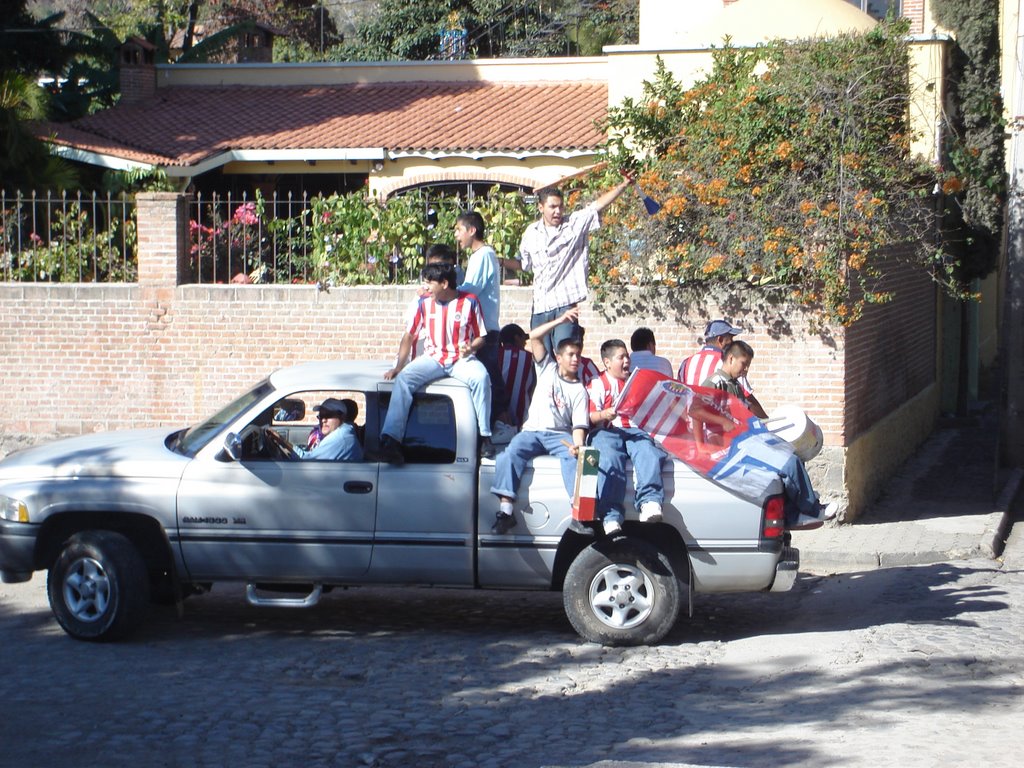
Long-suffering Chivas fans took to the streets on Sunday after their squad bested Toluca 2-1 to capture the Mexican league's Apertura (Opening leg). The Guadalajara-based team only fields Mexican players - which endears it to millions across the Republic - and hadn't won the championship since 1997. Along with celebrations at Lakeside, Chivas fans also swarmed the Glorieta Minerva in Guadalajara and the Angel monument in Mexico City and later lined a two-kilometer stretch of the Carretera Guadalajara-Chapala (which runs by the airport) in order to welcome their conquering heroes home.
Despite the loss, Toluca, the runner up, has perhaps been Mexico's most successful club over the past decade. According to sports marketing expert Hector Lopez Zatarain, the Diablos Rojos (Red Devils, as Toluca is known) have been well managed and seen little turnover. Players are also paid promptly - unlike at some other clubs. The consistency differs from the coaching carousel in Guadalajara, but with a championship under his belt, no one's really blaming Chivas colorful owner Jorge Vergara for anything right now.
Update: The Miami Herald, Mexico Edition ran my piece on why Chivas' is more than just a popular soccer team.
10 October 2005
Mexico ends soccer futility

By David Agren
Mexico's under-17 soccer squad capped an improbable run last Sunday in Lima, Peru, winning the World Cup for its age group. It marked the first time the futbol-mad country claimed a world championship in the sport. Mural, a Guadalajara newspaper, summed up the accomplishment by saying in the lead paragraph of its Monday story: "(It) put an end to 75 years of mediocrity in Mexican soccer."
Making the win even more remarkable, the Mexican teenagers defeated defending champion and perennial soccer power Brazil 3-0 in the final.
The team's run captivated the nation's imagination and drew immense media attention. Some newspaper articles dubbed the young players, "Ninos Heroes," (Boy Heroes) a reference to the six cadets who died defending Mexico City's Chapultapec Castle against invading U.S. troops in 1848. Televisa broke away from its normal professional soccer coverage to beam in highlights of the Mexican squad's games. Jubilant fans crowded the Minerva glorieta in Guadalajara and the Angel de la Indpendencia monument in Mexico City after the win. Supporters also turned out en masse at Mexico City's airport to welcome back the team. The victorious teenagers later visited Los Pinos (the president's residence).
Mexico's victory bodes well for two of Guadalajara's professional squads, which haven't won a championship since 1997. Chivas and Atlas own the rights to nine of the 20 Under 17 squad members. Some legendary European clubs though, including Real Madrid and Chelsea, have expressed an interest in several of the young players.
Previous to this win, Mexico's biggest accomplishment was winning the 1999 Confederations Cup, a tournament for each continent's champion. The team, though, has mostly disappointed, despite usually having a high world ranking. Most recently, the men's team lost a 2002 World Cup elimination match to their northern arch rivals, the United States.
Subscribe to:
Posts (Atom)

